AAMI turns a missing match ball into a five-year Grand Final ritual
AAMI uses Kylie Minogue, a runaway match ball and five years of repetition to turn AFL sponsorship into an ownable Grand Final ritual.


At the AFL Grand Final, sponsorship visibility is easy to buy. Owning a moment that people can recognize year after year is harder.
AAMI has spent five years building one.
Its recurring "AAMI To the Rescue" platform returned for the 2026 Grand Final with a familiar problem: the match ball had gone missing again. This time, a mistaken button press in the MCG scoreboard control room sent the ball "supernova" through the stadium, triggering a rescue sequence that ended with Kylie Minogue stopping it in an AAMI-red heel.
The stunt was not separate from the insurer's sponsorship. It was the sponsorship, translated into entertainment.
That is what makes the 2026 activation useful for marketers. AAMI has taken one simple brand idea, rescue, attached it to one predictable cultural stage, the AFL Grand Final, and repeated the combination long enough for the format itself to become a brand asset.
Table of contents
Jump to each section:
- [Why the rescue stunt works as a brand property](#why-the-rescue-stunt-works-as-a-brand-property)
- [Why repetition makes the sponsorship more valuable](#why-repetition-makes-the-sponsorship-more-valuable)
- [How Kylie Minogue turns a cameo into the payoff](#how-kylie-minogue-turns-a-cameo-into-the-payoff)
- [Why broadcast and stadium placement matter](#why-broadcast-and-stadium-placement-matter)
- [What marketers can learn from AAMI's Grand Final ritual](#what-marketers-can-learn-from-aamis-grand-final-ritual)
Why the rescue stunt works as a brand property
The strongest sponsorship ideas make the brand useful to the story rather than placing it around the story.
AAMI has a straightforward advantage here. "To the Rescue" already fits what an insurer is supposed to do when something goes wrong. The Grand Final activation turns that promise into a deliberately exaggerated entertainment format.
In 2026, the problem starts with the most important object on the field. The match ball is accidentally launched through the MCG, creating a chain of near misses and cameos before it reaches Minogue. The plot is absurd, but the role AAMI plays is consistent: something has gone wrong and the brand has to get it back on track.
That connection gives the campaign room to become bigger without losing the product logic underneath it. AAMI does not need to explain insurance in the middle of a pre-game spectacle. The rescue structure carries the brand meaning.
Why repetition makes the sponsorship more valuable
A one-off stunt can earn attention. A repeated format can build memory.
Suncorp Executive General Manager Brand and Customer Experience Mim Haysom said the rescue mission began five years ago and has grown into a Grand Final moment that people now look forward to seeing. Her own LinkedIn post describes the platform as moving from a sponsorship activation into an "ownable Grand Final moment."
https://www.linkedin.com/posts/mim-haysom-gaicd-abbbb058_for-five-years-now-aami-to-the-rescue-has-activity-7509496707815071744-EUv0
The useful part is the balance between consistency and escalation.
The recurring premise means AAMI does not have to invent a completely new sponsorship language every year. The audience can recognize the rescue setup, while the brand changes the route, cast and payoff.
For marketers, that is a different way to think about event sponsorship. The question is not only what a brand can activate this year. It is whether the activation has a format that can survive next year without becoming repetitive.
How Kylie Minogue turns a cameo into the payoff
Kylie Minogue is not simply placed beside the campaign as a celebrity endorsement. She appears at the end of the rescue story, at the same event where she was already the headline pre-game performer.
That context makes the cameo more useful.
News.com.au reported that Minogue performed a 20-minute set at the MCG in front of more than 100,000 people. AAMI therefore did not need to manufacture a reason for her presence. The campaign borrowed from a cultural moment that already belonged to Grand Final day.
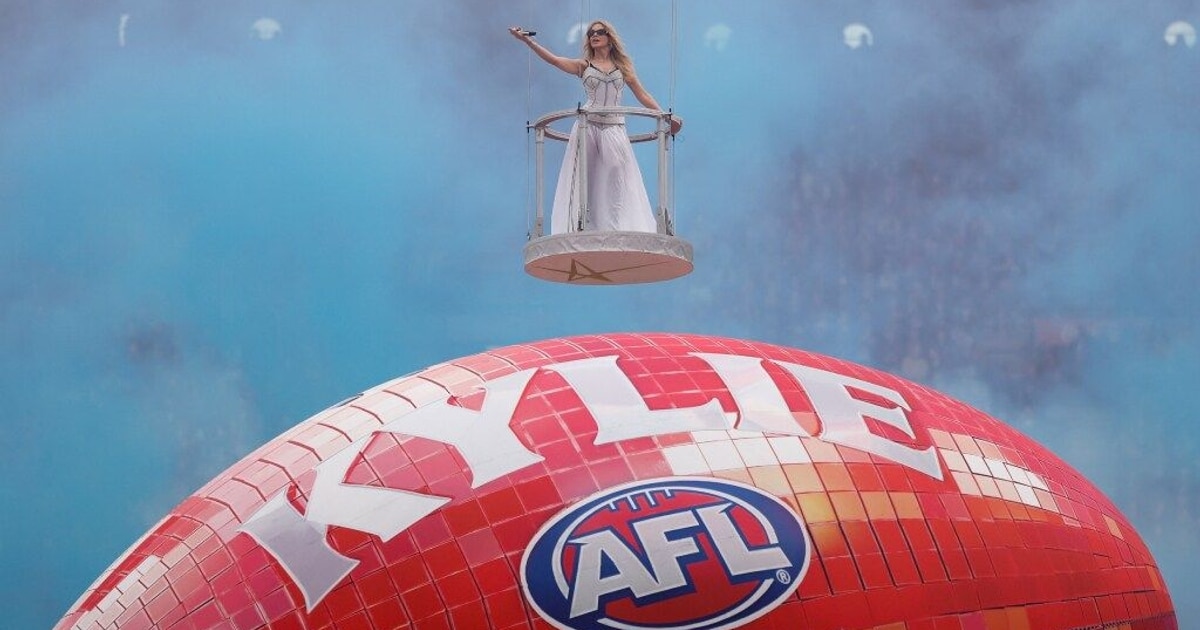
The creative then gives her a specific job. She stops the runaway ball with an AAMI-red heel and hands it back to the AAMI Woman.
That makes the celebrity appearance part of the plot rather than a detached piece of star power. The recognition still matters, but it arrives at the exact point where the story needs a memorable resolution.
Why broadcast and stadium placement matter
AAMI's activation was designed across the places where Grand Final attention already existed.
Suncorp says the work brought together AAMI's AFL partnership, the Seven broadcast and the in-stadium environment. Whooshka Media produced the hero content, with AAMI, WPP Media Sport & Entertainment, Seven and the AFL involved in the broader activation.
That distribution model matters because live-event marketing can easily fragment into separate assets: a stadium stunt, a broadcast integration, a social clip and sponsor signage that happen to share a logo.
AAMI instead built one narrative that could move through the venue and the broadcast.
The MCG gives the rescue physical scale. Television gives it reach beyond the stadium. The AFL partnership gives the story permission to use the match ball and Grand Final context as the central creative device.
The media plan is therefore not just supporting the idea. It is part of how the idea works.
What marketers can learn from AAMI's Grand Final ritual
AAMI's five-year run offers a practical template for brands trying to get more from a major sponsorship.
- Start with a brand truth that can generate stories. "Rescue" is simple enough to repeat but flexible enough to create a different problem every year.
- Build for recurrence, not only launch-day attention. A recognizable format gives the next activation a head start because the brand does not need to rebuild the premise from zero.
- Use celebrity as a role inside the idea. Minogue is more memorable because she resolves the story at an event where her presence already makes sense.
- Treat distribution as creative infrastructure. Stadium, broadcast and partnership rights all contribute to the same narrative.
- Escalate the entertainment without changing the core. Bigger cameos and a bigger rescue can refresh the execution while the underlying brand logic remains stable.
There is no verified 2026 performance data yet showing what the activation did for AAMI's brand metrics or commercial results.
What is visible is the structure. AAMI has spent five Grand Finals teaching audiences what kind of entertainment to expect from its sponsorship. That turns the annual question from "What will AAMI advertise?" into something more valuable: "How will AAMI rescue the Grand Final this time?"