FTC puts guardrails on Publicis's $2.2B LiveRamp deal
The FTC wants Publicis to guarantee rival agencies' access to LiveRamp and protect sensitive client data as the proposed $2.2B acquisition moves ahead.


Publicis Groupe faces new constraints on its planned $2.2 billion purchase of LiveRamp after the US Federal Trade Commission accepted a proposed consent agreement for public comment on October 19, 2026. The FTC's action targets a central concern: an advertising holding company would own identity and data infrastructure on which its agency competitors and their clients also depend.
The proposed order would require neutral access to LiveRamp services and safeguards for confidential customer data. It marks a regulatory milestone for a transaction announced earlier this year, although the acquisition has not closed and the consent agreement is not yet final. For brands and rival agencies, the practical question is how independence can be demonstrated once the two businesses share an owner.
Key Takeaways
- The FTC is seeking contractual protections for LiveRamp customers as Publicis pursues the acquisition, with the order still open to public comment.
- The proposed safeguards cover equal access, separation of competitively sensitive client information and independent compliance audits.
- Agency and brand clients should ask how the promised protections will operate in procurement, support escalation and data handling.
Table of contents
Jump to each section:
- What the FTC wants to protect
- Why LiveRamp neutrality matters to rival agencies
- How the regulatory agreement affects the acquisition
- What brands and agencies should ask next
What the FTC wants to protect
Five years is the proposed duration of the FTC's neutral-access and data-separation commitments, according to the Federal Trade Commission.
Under the proposed consent, Publicis and LiveRamp would have to offer fair, nondiscriminatory access and support for LiveRamp's standalone products. They would be prohibited from delaying or degrading services for customers that use other agencies. Publicis would also have to maintain firewalls preventing access to confidential information received through those standalone services.
The FTC called for independent compliance audits every six months during the first two years after the deal closes and annually during the next three. It also proposed a customer-requested audit mechanism, protection against retaliation when customers raise concerns with regulators, and mediation for contractual disputes that remain unresolved after 30 days.
David Shaw, principal deputy director of the FTC's Bureau of Competition, said the aim was for LiveRamp to "continue operating as it does today as a neutral platform." That formulation makes the remedy's central test clear. The new owner must not turn shared infrastructure into a preferential channel for its own media agencies.
Why LiveRamp neutrality matters to rival agencies
LiveRamp connects audience information across advertisers, publishers and technology platforms. Agency holding companies including Publicis, Omnicom, WPP and Dentsu compete to plan and buy media for major brands. A service supplying data connectivity across that market can become a critical dependency for buyers that do not employ the platform owner's agencies.
The FTC alleges the acquisition could give Publicis the ability and incentive to degrade LiveRamp services for rival agencies or use competitively sensitive customer information to solicit their clients. These are competition concerns set out by the regulator, rather than findings that either company has already engaged in that conduct.
The tension is especially relevant to Publicis because its Epsilon business already operates in audience data services. Combining marketing services and neutral identity infrastructure may create advantages for integrated campaigns, but outside agencies have to judge whether they can keep using the same infrastructure without disclosing sensitive account information or facing different service levels.
For marketing directors, this is a procurement issue as much as a regulatory one. The identity vendor used for audience matching, activation and measurement may also sit inside the company bidding for the brand's broader agency account. Contracts and operational controls, not corporate reassurance alone, will determine how comfortably those relationships coexist.
How the regulatory agreement affects the acquisition
Publicis said in its October 19 statement that the undertakings reflected commitments it had proposed proactively. The company reiterated that it expected the acquisition to close before the end of 2026 and that LiveRamp customers should retain freedom to use its products independently.
The FTC's vote to accept the agreement for public comment was unanimous among the two participating commissioners, but the public comment period and final-order process remain outstanding. The action is not a declaration that the merger has closed or that all future compliance questions have been settled.
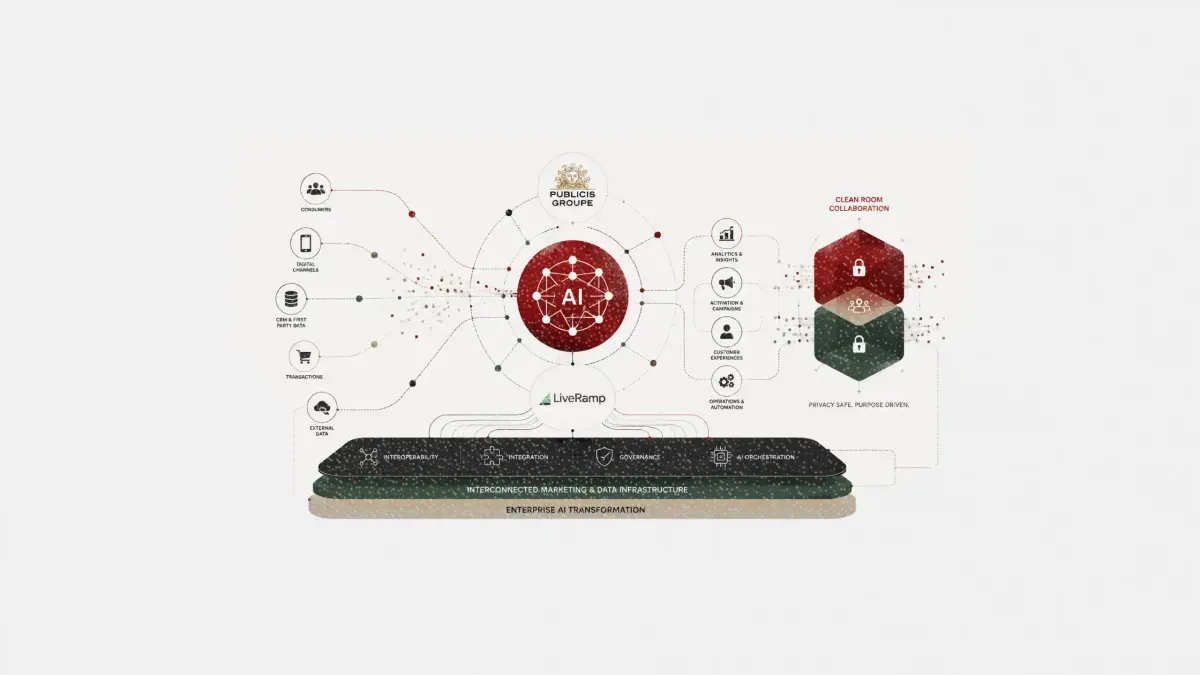
The distinction matters because Publicis originally positioned the acquisition as a step toward more integrated AI and data services. The regulator is now setting out how the purchased infrastructure would need to remain usable by competitors. Both objectives can coexist in principle, but the proposed order is designed to make neutrality an operational obligation rather than a branding claim.
What brands and agencies should ask next
First, request the applicable service commitments. Agency procurement teams should identify the LiveRamp products supporting current clients and ask what nondiscriminatory access means for pricing, support response times, integration priorities and changes to existing terms. Comparable service levels are easier to review when they are documented before a dispute arises.
Second, have legal and privacy teams inspect data separation. A brand using LiveRamp for audience matching should establish which business units can view customer-level account information, who can approve exceptions and how suspected access violations will be investigated. The proposed firewall provisions make those questions central to vendor due diligence.
Third, agree on an escalation path. If a rival agency believes it has received slower support after a product change, it should document the impact, preserve service records and determine when to invoke the available compliance or dispute mechanisms. A contractual protection is useful only when customers know how to exercise it.
The immediate effect of the FTC's intervention is to put enforceable-style safeguards on the public agenda while the transaction remains pending. For Publicis, execution of those safeguards will be as important to the deal's credibility with the wider agency market as the strategic rationale for buying LiveRamp.