
Brittany Broski turns a fake ukulele into Smirnoff Ice's holiday gift
Smirnoff Ice gives Brittany Broski multiple roles in a holiday campaign with a fake ukulele gift box and five novelty merch items.


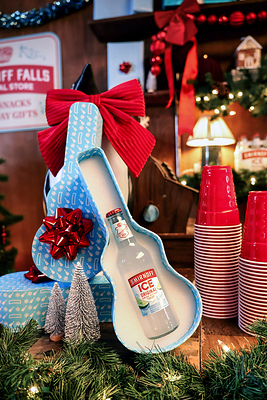
A ukulele under the Christmas tree is a surprisingly specific gift. It suggests somebody believes you are ready to take up a musical hobby. In Smirnoff Ice's new holiday comedy, that assumption is the joke: the instrument-shaped box opens to reveal a bottled drink instead of something with strings.
Comedian and podcaster Brittany Broski is at the center of the idea. Rather than appear in a single celebrity cameo, she plays several versions of herself in a fictional holiday town, including characters willing to quarrel over bottle-shaped slippers. The fake instrument, new merchandise and deliberately strange cast are part of the brand's latest seasonal installment with the creator.
The result is a holiday campaign built for people who recognize Broski's brand of absurd humor, but with tangible novelty gifts that someone could actually give at a gathering. The brand is offering the alcoholic products and related promotions to eligible adults aged 21 and older.
Table of contents
Jump to each section:
- Why Brittany Broski makes the joke feel like her own
- How Smirnoff Falls turns one creator into several characters
- The five gifts turn the punch line into something people can hold
- What marketers can learn from a deliberately ridiculous gift
Why Brittany Broski makes the joke feel like her own
The point of putting Brittany Broski in a seasonal advertisement is not simply that she is recognizable. It is that a certain kind of ridiculous situation already feels at home in her comedy. A gift that looks like a miniature musical instrument but contains a bottled drink makes more sense when the person opening the box is also capable of arguing with several imaginary versions of herself.
Broski became widely known through a 2019 video of her reacting to kombucha. Her career moved beyond that one expression into podcasts and character-led humor, including The Broski Report and Royal Court. In a 2024 interview about creator culture, she described the value of building a community and maintaining a recognizable personality rather than treating follower counts as the only measure of success.
That background matters here because the advertisements ask viewers to recognize her style, not memorize an unfamiliar brand story. A conventional holiday commercial might put a celebrity in a cozy living room holding a product and leave the joke at that. Smirnoff Ice instead gives Broski a fictional town full of her own alter egos, a setting designed to give her comedy room to work.
The strategy also has a limit. People who enjoy her performances may be willing to watch the films, but that does not demonstrate that they will buy merchandise or develop a stronger preference for the drink. Smirnoff Ice has not disclosed views, reach or sales for this new holiday installment. What the available creative does show is a clear reason for choosing this particular creator rather than a generic famous face.

How Smirnoff Falls turns one creator into several characters
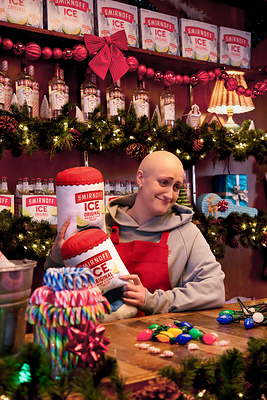
The new films take place in Smirnoff Falls, a fictional town where Broski is trying to find a holiday present. The complication is that almost everyone she encounters seems to be another Brittany. One scene pits her against a more elaborately dressed version of herself over a pair of plush bottle slippers. In another, she works behind the counter of the local general store while a procession of familiar-looking customers arrives.
It is a simple sketch-comedy device, but it gives the campaign more to do than repeat a product shot. The costumes and confrontations make the celebrity a cast of characters. There is no need for a complicated explanation of why every resident resembles her. The absurdity is the point, and it creates short moments that can stand on their own when separated from the wider seasonal campaign.
Broski acknowledged the premise in the November 11 announcement, saying, “I got to fight myself over slippers” while recounting the odd roles she played. The remark fits the films' playful tone without requiring anyone to believe that the fictional events happened outside the advertisement.
This is also a continuation, not a newly signed endorsement deal. An October 1 announcement had already established Smirnoff Ice's partnership with Broski, beginning with Halloween material and promising more seasonal content. The new holiday characters, products and gift-giving gags give the existing relationship another story rather than asking the audience to celebrate the mere fact that a celebrity partnership exists.
For a creator with several recognizable performance modes, that distinction is useful. A single promotional appearance can be forgotten after the first week. A repeatable fictional setting allows the brand to return with another character, another object or another seasonal occasion, provided the jokes still feel connected to the person making them.
The five gifts turn the punch line into something people can hold
The headline object is a ukulele-shaped gift box. It resembles the sort of present that would obligate its recipient to learn a few chords, but it opens to reveal a Smirnoff Ice bottle. The brand lists the box for US$9.99 and says the bottle is included, with the product available only to eligible adults aged 21 or older while supplies last. It is a practical expression of the campaign's central idea: a very specific expectation followed by a deliberately silly surprise.
The other four items extend the visual joke beyond the box. The brand lists a holiday sweater at US$39.99, bottle ornaments at US$9.99, a bottle-shaped dog toy at US$14.99 and plush bottle slippers at US$19.99. The slippers have a role in the Broski film, giving viewers a reason to recognize them when they encounter the merchandise collection elsewhere.
The prices give the campaign a relatively small purchase tier compared with many celebrity merchandise drops. That can make a product easier to consider as a party gag or seasonal stocking stuffer. It does not prove the goods will sell quickly, and the brand has not released inventory quantities or sell-through data. The collection functions as an extension of the joke regardless of how well it performs.
A larger-scale prize sits alongside the retail range. Smirnoff Ice is offering eligible adults the chance to win a limited-edition kayak presented as an oversized gift. The contrast is intentional: the smallest surprise is a fake musical instrument, while the biggest is a boat. Both objects are designed to make gift wrapping part of the campaign story rather than a disposable detail.
The brand directs consumers toward its online shop and official social accounts for the merchandise, films and sweepstakes information. It says eligibility is restricted to people aged 21 and older. Those restrictions matter because this is an alcoholic beverage promotion, not a general-audience holiday toy launch.
What marketers can learn from a deliberately ridiculous gift
The interesting comparison is not just with another drinks brand. It is with holiday campaigns that use celebrities to make familiar shopping situations entertaining. Lids, for instance, put Lil Yachty and other personalities in its 2026 gifting creative to underline the difference between a generic present and something a particular fan actually wants. Smirnoff Ice takes a different route: it turns the mistake itself into the product, then places the joke in a creator-led fictional world.
There is also a contrast within Smirnoff's own marketing. Its separate Avengers: Doomsday collaboration asks eligible fans to follow clues toward a future party and enter for film-related prizes. The Broski campaign relies less on an external entertainment franchise and more on a creator's established comic identity. Both provide ways to extend a drink brand into entertainment, but they invite different kinds of attention.
First, choose a creator because the idea needs that person's recognizable voice. The multiple-Brittany premise would be a different advertisement with somebody whose public work was not built around expressive, self-aware humor. The relationship between the joke and the performer is what makes the concept coherent.
Second, give the audience an object they can understand instantly. A ukulele case that contains a bottle requires almost no setup. The packaging makes the campaign legible in a photograph, a short video or a physical gift exchange. For a seasonal brand story, that matters more than a complicated explanation of why the merchandise is special.
Third, distinguish an entertaining creative system from proven business results. The November 11 release provides prices, product names and campaign scenes, but no independent metrics for awareness, conversion or repeat purchasing. Those results remain unknown. The defensible conclusion is that Smirnoff Ice has designed a recognizable sequence of stories and gifts around one creator, not that the campaign has already been a viral or commercial success.
Ultimately, the holiday fake-out works as a modest cultural observation: presents are not always about usefulness. Sometimes the delight comes from the recipient realizing that the gift was one long practical joke. The brand is betting that Broski can make that joke feel familiar enough to enjoy and unusual enough to remember.
