Agentic marketing is becoming the new operating model according to Salesforce report
Marketing is moving from manual execution to AI-driven systems that operate in real time.

AI in marketing is no longer just about generating content or automating tasks. Salesforce’s latest State of Marketing 2026 report points to a bigger shift: the rise of agentic marketing, where AI systems take on more autonomous roles across execution, optimization, and customer engagement.
This is not a distant concept. It is already showing up in how high-performing teams operate today. This article explores what agentic marketing actually means in practice, how AI agents are changing workflows, and why this model is quickly becoming the next phase of marketing operations.
Short on time?
- What is agentic marketing and why it matters
- AI agents are moving from tools to operators
- How agentic workflows are improving performance
- Why most teams are not fully there yet
 Patrecia Meliana
What is agentic marketing and why it matters
Salesforce frames agentic marketing as a shift from campaigns to conversations. Instead of pushing messages out, brands are expected to engage customers in real time, across channels, with context-aware responses.
This shift is driven by changing expectations:
- 83% of marketers say customers now expect two-way conversations
- Yet 69% still struggle to respond promptly to customer interactions
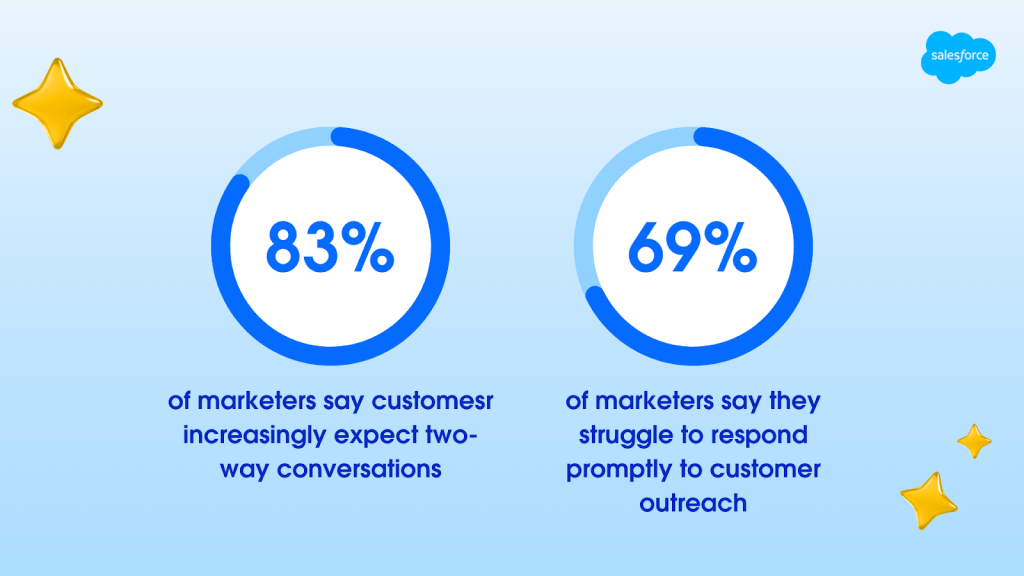
This gap highlights the limitation of traditional marketing models. Campaign-based execution cannot keep up with always-on, conversational engagement.
Agentic marketing addresses this by introducing AI systems that can act, respond, and optimize in real time.
AI agents are moving from tools to operators
AI in marketing has historically been used as a support layer, helping teams generate content or analyze performance.
That is changing.
- 81% of marketers say they trust AI to respond to customer inquiries
- High-performing teams are nearly twice as likely to use AI agents
AI agents are designed to go beyond assistance. They can:
- Handle customer interactions across channels
- Execute campaigns autonomously
- Optimize performance based on real-time data
This shifts AI from a tool into an operator within the marketing workflow.
Instead of marketers manually executing every step, agents can take on continuous, real-time tasks that would otherwise require significant human effort.
 Atikah Amalia
How agentic workflows are improving performance
The impact of agentic marketing is already measurable among teams that have adopted it.
- High-performing marketers use AI agents to increase ROI by 20% and reduce costs by 19%
- They also reclaim up to eight hours per week, freeing time for higher-value strategic work
In addition:
- Teams with unified data are 60% more likely to use AI agents to scale efforts
- They are 42% more likely to respond to customers regularly
This highlights an important shift.
Agentic workflows are not just about efficiency. They enable:
- Continuous optimization instead of periodic campaign updates
- Real-time engagement instead of delayed responses
- Scalable personalization instead of static segmentation
For marketers, this represents a move from managing campaigns to managing systems.
Why most teams are not fully there yet
Despite the potential, agentic marketing is still early for many organizations.
- Only 13% of marketers currently use agentic AI
- 61% say AI is not yet fully integrated into their marketing systems
There are several reasons for this gap:
- Fragmented data systems limit what AI agents can act on
- Integration across tools and workflows is still incomplete
- Teams lack the operational structure to support autonomous systems
Even when AI agents are available, they are often constrained by the same limitations that affect broader AI adoption. This means most teams are still in a transitional phase, experimenting with agents rather than fully operationalizing them.
Why this matters for B2B marketers
For B2B marketers and PR professionals, agentic marketing signals a shift in how marketing work gets done.
The focus is moving from execution to orchestration. Instead of manually running campaigns, marketers will increasingly:
- Define goals and guardrails
- Oversee AI-driven systems
- Optimize strategy based on outputs
The competitive advantage will not come from using AI, but from how effectively teams design and manage these systems.
Agentic marketing is not replacing marketers. It is changing their role.