
Netcore.ai's Rajesh Jain: Your AI marketing agent is only as smart as how old its data is
Netcore.ai founder Rajesh Jain explains why stale customer data can make marketing agents act quickly on the wrong customer picture.

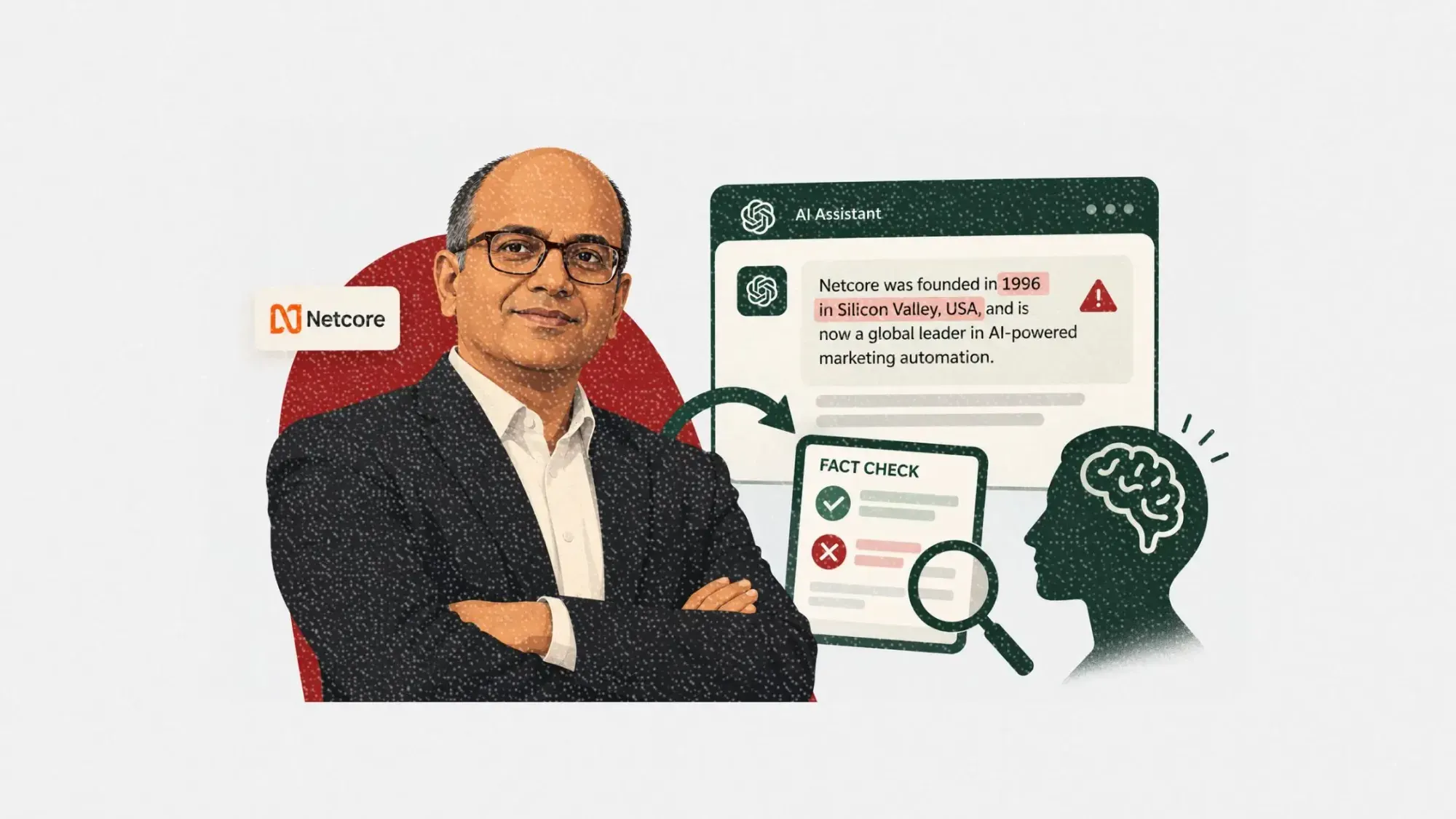
Netcore.ai's Rajesh Jain: Manual overrides can expose bad AI decisions early
A customer buys something expensive. A few hours later, the brand sends a win-back offer. Another customer files a frustrated support ticket, then gets a discount message that ignores the complaint entirely.
The marketing agent may have followed its logic perfectly. The customer picture it saw was already stale.
That failure mode is what Rajesh Jain, founder and managing director at Netcore.ai, wants marketers to catch before autonomous systems are allowed to make more consequential decisions. Netcore.ai describes its platform as bringing customer engagement, product discovery, personalisation, customer data, email marketing and communications tools into one stack, with a shared context layer feeding its AI agents.
Rajesh has spent decades building internet and marketing technology businesses. His profile supplied to ContentGrip traces his career from IndiaWorld, launched in 1995, to Netcore, while his current company leadership page lists him as founder and group MD. In this interview, his advice is deliberately operational: fix the customer record, narrow the decisions an agent can make on its own, and watch how often people have to step in.
Short on time?
- Why stale data makes agents act fast and wrong
- Fix the customer picture before widening autonomy
- Manual overrides are the early warning signal
- Fresh data changes what marketing teams can attempt
- Why Rajesh still writes every day
Why stale data makes agents act fast and wrong
Rajesh’s representative setup is familiar to many large marketing teams. Identity and relationship history sit in the CRM. Purchases sit in an order or transaction system. Browsing behavior sits in web and app analytics. Complaints sit in the support desk. Previous brand messages sit in the marketing engagement platform.
Those systems often update on different schedules. A purchase, complaint or declined application can remain trapped in its source system for hours before the marketing agent sees it.
In that gap, the agent keeps acting on the older record. Rajesh described the consequences plainly: “A win-back offer to someone who just bought. A discount code to someone who just complained. A cross-sell message to someone whose application was declined for risk reasons the agent was never shown.”
His diagnosis is that the reasoning can be internally consistent while the input is already wrong. Rajesh said: “It is a correct decision made on a picture of the customer that was already out of date.”
That concern extends beyond one vendor’s architecture. Braze’s 2026 customer engagement research says only 55% of marketers are updating and using customer information in real time. An autonomous decision layer cannot compensate for an event it has not received yet.
Fix the customer picture before widening autonomy
Rajesh starts with one identity key that ties a customer’s activity together across systems. The goal is a single ID that reliably connects the same person across the CRM, transaction history, analytics, support and engagement tools.
Then he prioritizes real-time sync for the small set of events that can change a decision immediately: a completed purchase, a complaint or a declined application. He does not argue that every warehouse field needs to become real time at once. The expensive mistakes usually hinge on a much smaller group of signals.
Only after those two pieces are reliable does Rajesh widen autonomy. He recommends starting with low-stakes choices such as send time or channel selection before moving into offer and discount logic.
The approach lines up with how Netcore.ai describes its own agentic marketing architecture: a central context layer is meant to give its agents a shared view of the customer while human growth engineers remain involved where judgment is needed.
For a marketing leader evaluating an agentic system, that creates a practical sequence of questions. Which customer identifier does the agent trust? How quickly do purchases, complaints and risk events reach it? Which decisions can it make without approval today? Those answers reveal more about production readiness than a demo of the model alone.
Manual overrides are the early warning signal
Rajesh gives human review a specific job. Decisions that fall outside normal financial ranges should be held before they reach the customer.
His example is a discount rule. If a segment normally receives offers between 5% and 15%, an agent proposing 30% should automatically route that decision to a person. He applies similar caution to customers who complained or showed a churn signal within roughly the previous 48 hours.
The volume of automated decisions is less useful as a trigger. A system can make a thousand routine choices without anyone reviewing most of them. Rajesh focuses human attention where the financial action is unusual or the customer’s current state is sensitive.
He also watches what people do after the agent begins operating. “Long before open rates or conversion move, the first sign is a rise in manual overrides,” Rajesh said, describing people canceling or editing decisions that have already been queued.
A second warning sign is contradictory messaging to the same customer in a short period: one offer followed by another, or outreach that ignores something the customer just did. Those experiences may never generate a loud complaint. They can simply reduce response over time.
That makes override rate a useful operating metric for marketers testing autonomous decisioning. A rising number of interventions can surface problems before campaign-level performance data makes them obvious.
Fresh data changes what marketing teams can attempt
Rajesh sees the advantage of better data in the number of customer groups a team can realistically manage.
When the customer picture is current and complete, he said a brand can run “fifty or a hundred micro-segments” and generate content for each one. With stale or disconnected data, teams fall back toward the handful of segments people can manually create and refresh.
With only around ten segments across five million customers, Rajesh argued, the result is effectively broadcasting with extra steps.
Two brands can therefore appear equally automated on a dashboard while making very different decisions underneath. One agent is working from information that is minutes old. Another is acting on information that is hours or days old. The gap accumulates one customer decision at a time.
For marketers, the useful test is to compare the age of the signals driving an agent’s decisions. A platform that can produce more segments or messages does not become more personal if the underlying customer state is late.
Why Rajesh still writes every day
Rajesh has kept a daily writing habit for much of the period since 2000. He describes it as a loop of reading, thinking and writing, with each part exposing what needs more work.
Rajesh said: “Writing is what tells you whether you actually understood any of it.” The gaps exposed by writing send him back to reading, and he often returns to the same idea repeatedly over months or years.
He calls that process “iter-writing”: revisiting a thought until it becomes clearer. Some ideas, he said, first appeared on his blog years earlier in rough form and only sharpened after being written badly several times.
The habit mirrors his advice for agentic marketing. Teams learn by narrowing the decision, watching what breaks, and improving the inputs before widening the system’s freedom. The useful progress is usually less dramatic than the technology pitch. It is visible in a cleaner customer record, fewer contradictory messages and fewer moments when a person has to stop the machine.