AI marketing frameworks are driving serious ROI in 2026
New industry data shows AI marketing frameworks are delivering measurable gains in conversions, productivity, and revenue growth.

Artificial intelligence is no longer a sidekick in marketing operations. In 2026, it is central to how modern marketing teams execute, optimize, and scale.
Recent industry research shows measurable gains across productivity, conversion rates, and revenue growth for teams using structured AI marketing frameworks.
This article explores which AI marketing frameworks are actually driving ROI in 2026, where performance gains are strongest, and what B2B marketers should focus on next. Adoption is nearly universal. The differentiator now is execution.
Short on time?
Here’s a table of contents for quick access:
- AI adoption is high, but ROI depends on how it’s used
- Where AI frameworks drive the most impact
- What marketers should know
 Patrecia Meliana
AI adoption is high, but ROI depends on how it's used
AI usage among marketers is nearly universal. According to SurveyMonkey research, 88% of marketers report using AI tools daily. Among them, 93% use AI to generate content faster, 81% use it to uncover insights more quickly, and 90% rely on it for faster decision-making.
The scale of adoption is impressive. But usage alone does not equal ROI.
Benchmark data shows an average return of 3.7× on AI investments, meaning every dollar invested generates nearly four dollars in value. In more mature implementations, 74% of organizations report that AI initiatives meet or exceed ROI expectations, and 20% report ROI above 30%. These results are strongest when AI is aligned with industry-critical functions such as IT, operations, marketing, and customer service.
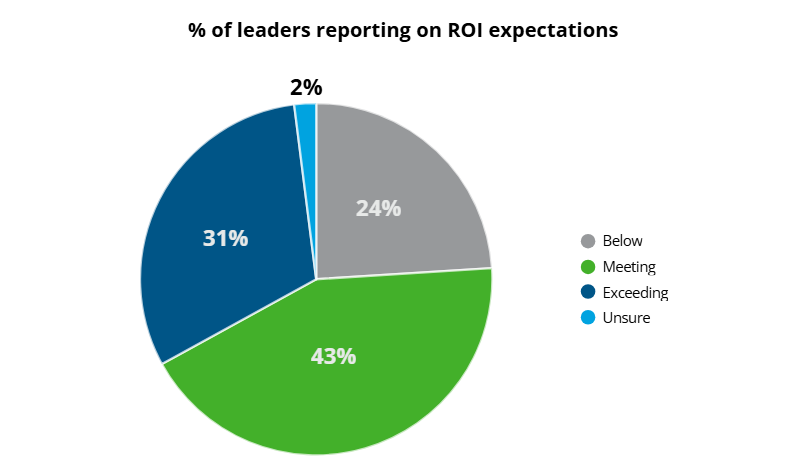
The takeaway is clear. AI becomes financially meaningful when it is embedded into operational frameworks, not layered on top as a productivity hack.
Where AI frameworks drive the most impact
The most successful AI marketing frameworks focus on measurable bottlenecks. The data highlights several areas where structured implementation delivers performance lift:
- Segmentation and targeting
AI-driven segmentation improves ad targeting accuracy by 26% and increases conversions by 32%. This is especially powerful when predictive modeling and behavioral data are integrated into campaign workflows.
- Creative optimization
AI-generated creatives increase click-through rates by 47% while reducing cost per acquisition by 29%. This shifts creative testing from manual iteration to continuous optimization.
- Marketing productivity
Teams using AI report 44% higher productivity and save an average of 11 hours per week. That time is redirected toward strategic planning, experimentation, and cross-functional alignment.
- Revenue alignment across teams
Organizations that adopt AI across both marketing and sales see stronger revenue performance. In data-driven environments, 83% of sales teams using AI report revenue growth, compared with 66% of teams without AI. This suggests that AI frameworks perform best when applied end to end rather than in isolated departments.
What distinguishes high-performing teams is not just automation. It is structured integration, shared data, and continuous feedback loops.
What marketers should know
For B2B marketers building AI marketing frameworks in 2026, the competitive edge comes from disciplined execution.
Here are practical considerations:
- Start with ROI-linked use cases. Focus on applications that directly impact conversion rates, cost efficiency, or pipeline velocity.
- Build cross-functional alignment early. AI impact compounds when Marketing Directors, Sales Leaders, and Operations Managers share data and systems.
- Measure beyond activity metrics. Track CPA, conversion lift, influenced pipeline, and revenue contribution rather than output volume.
- Invest in feedback loops. AI systems improve when continuously trained on campaign performance and customer behavior data.
- Prioritize strategic capacity. The 11 hours per week saved by AI should fund experimentation and growth initiatives, not simply reduce workload.
The 2026 shift is not about whether to use AI. It is about whether your AI framework is structured to produce measurable business outcomes.
Marketing teams that treat AI as infrastructure rather than tooling are seeing stronger conversion performance, higher productivity, and sustained revenue growth.
The competitive gap is widening.