
Argos sends Richard Ayoade through Christmas past in festive ad
Argos gives Richard Ayoade a comic Christmas Carol journey, mixing catalogue nostalgia with today's technology and homeware gifts.


For generations of British shoppers, writing a Christmas list involved more than naming a present. There was a thick catalogue, a pen and the satisfying ritual of circling something that looked just right. The book might be gone, but the memory remains part of what Argos means to people who grew up using it.
That memory can be comforting, and limiting. Someone who remembers the retailer chiefly as a place to pick toys may overlook its televisions, beauty gadgets or home accessories. Argos is playing with precisely that tension in its 2026 Christmas film, casting comedian Richard Ayoade as a man who needs to be shown that the shop has moved on without losing its past.
The new Tales of Argos Past campaign borrows the structure of A Christmas Carol. Two familiar Argos characters take a reluctant adult through a ghostly lesson about presents. The point is not simply to revive a beloved childhood prop. It is to make an old relationship with a retailer relevant to today's gift shopping.
Table of contents
Jump to each section:
- Why the Argos catalogue still feels like Christmas
- How Richard Ayoade meets the ghosts of Argos past
- Why nostalgia now sells gadgets, not just toys
- What marketers can learn from Argos Christmas past
Why the Argos catalogue still feels like Christmas
An Argos catalogue invited a very particular kind of daydreaming. Children could leaf through pages of things they did not yet own, draw circles around favorites and present the resulting wish list to someone with the power to buy a gift. The act was as much about anticipation as it was about the transaction.
The 2026 film uses that shared ritual as an entry point, especially for people who remember Christmas mornings in the 1980s and 1990s. Nostalgia gives the comedy an instantly understandable starting point. Even a viewer who never owned a particular toy can recognize the feeling of wanting something from a catalogue.
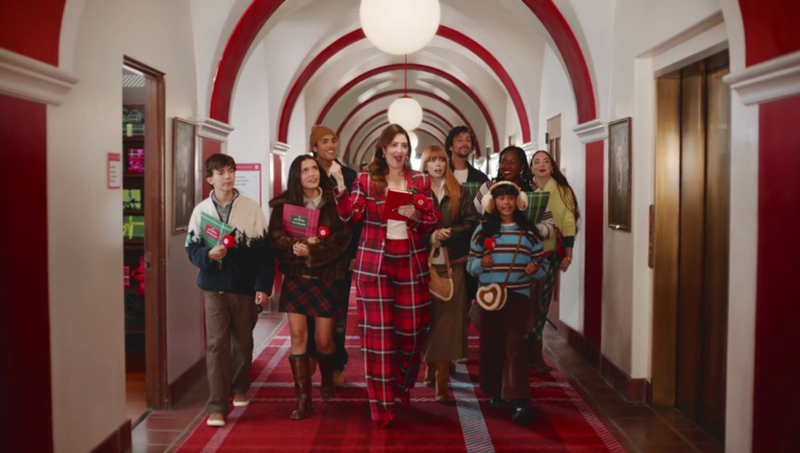
The creative team was careful with the props. Three younger versions of Ayoade appear across the story, each holding a reproduction catalogue matched to the year being depicted. The production team even debated the weight and thickness of old editions. That specificity matters because retro advertising becomes less convincing when the past looks like a generic collection of vintage decorations.
For Argos, the catalogue is also a brand asset that competitors cannot easily copy. The retailer once put those physical books at the center of buying gifts. It has since become a digital-led business, yet its name can still summon memories of a folded page and a carefully marked toy. The film treats that association as an advantage rather than an embarrassment.

How Richard Ayoade meets the ghosts of Argos past
The campaign opens with Ayoade playing an unimpressed, Scrooge-like character. Instead of Dickens' traditional visitors, he meets Connie and Trevor, two Argos toy mascots whose recurring job in the retailer's advertising is to challenge people who underestimate what the shop sells.
The pair take him through the old world of Argos and toward the range the retailer offers now. There is a straightforward comic contradiction in the setup: a man attached to his own childhood memories has to learn that the retailer from those memories is no longer only about children's presents. Ayoade's dry delivery gives the lesson an appropriate amount of skepticism.
The television film was created with agency T&P and directed by Declan Lowney through Merman. Argos plans to run it from November 1, 2026, across television, social media and out-of-home placements. The company has also developed shorter social material from moments improvised on set. This gives the main film and its extra edits a shared character and joke rather than unrelated seasonal posts.
The comedy is a deliberate choice. Argos head of campaigns Laura Boothby said in the campaign interviews that the brand would not choose an emotional Christmas formula: “we would never really do a tearjerker campaign.” Her point was that the retailer could use familiar heritage to create warmth while keeping the entertainment playful.
Ayoade's casting helps the film avoid a sentimental lecture. Viewers know his persona from British television comedy, including The IT Crowd. In this story, a famously dry expression is a believable response to a pair of tiny animated visitors telling him what to buy. The plot lets the mascots be mischievous without asking viewers to believe the human character is eager to be sold to.
Why nostalgia now sells gadgets, not just toys
The outdoor advertising makes the same argument without needing a ghost story. One half of the artwork recalls a Christmas present from years ago. The other places a newer product in a comparable position. Old favorites, including Mr Frosty and the Game Boy Colour, are set against products such as Ninja Slushies and Nintendo Switches.

The comparison gives nostalgia a commercial purpose. A retro game console is not presented merely as an object to admire. It introduces a category that still has something to offer now. A parent can recognize a childhood gift and immediately see the modern device someone might ask for this Christmas.
This is also an evolution of Argos' own seasonal storytelling. Its 2025 Christmas advertisement paired Connie and Trevor with actor Simon Bird and used a similarly mischievous intervention to challenge the idea that Argos is only for toys. The following year's approach keeps the same characters and brand problem, but replaces a contemporary shopping misunderstanding with a trip through personal history.
The distinction is useful because nostalgia can be a trap for a retailer. It invites people to remember an old brand, but memory alone does not show why they should shop there today. Argos tries to bridge that gap by making a modern product visible at the very moment the viewer recognizes an older one.
There is an interesting parallel in the United States. Walmart's 2026 holiday work also borrows A Christmas Carol, putting Walton Goggins in Scrooge's role alongside The Muppets. That campaign uses the familiar tale to explain Walmart's current assortment and shopping services. The two retailers operate in different markets, but both have chosen a recognizable fictional journey to change what audiences think a store can provide.
The broader UK commercial context is changing as well. Sainsbury's has agreed to sell Argos to Swift Partners, with completion expected in 2027. The transaction had not closed when this campaign was unveiled. That makes the advertising's central proposition, a familiar brand demonstrating its present-day relevance, a particularly timely one, although the commercial does not discuss the deal.
What marketers can learn from Argos Christmas past
Holiday advertising often asks consumers to feel something about a brand before asking them to buy from it. Argos is taking a more specific route: it starts with the feelings shoppers already have about the catalogue and redirects them toward a product range that may surprise them.
- Use heritage as the doorway, not the destination. An old catalogue is an effective recognition cue, but it only earns its place in a current campaign when it helps explain what the retailer offers now. The outdoor comparisons make that transfer unusually literal.
- Keep recurring characters consistent while changing their surroundings. Connie and Trevor return with a recognizable purpose, to correct a shopper's assumptions. This time the setting is Dickens-inspired and Ayoade supplies the straight-faced reaction. Repeated characters give the work continuity without requiring exactly the same plot each year.
- Give the comedy a practical job. A scene in which a skeptical adult is visited by toy-sized ghosts has a clear reason to be funny. But the joke is also about a real consumer misconception. When the retail message and the comic premise address the same problem, the advertising feels less like an interruption.
- Make the second screen and outdoor work additive. The social edits can extend improvisations that do not fit in the film, while the split-screen posters show products a television narrative cannot dwell on. Each part has something distinct to contribute while remaining easy to recognize as the same campaign.
None of this establishes whether the film will change shopping behavior. The reporting available at launch includes no independent sales lift, campaign reach or effectiveness data. Its immediate significance is in the creative decision: a brand known for a vanished physical format is using the memory of that format to explain its digital-era offer.
It is also a useful distinction for any long-running consumer brand. A treasured association can open the door to attention, but that same association may preserve an outdated idea of what the company does. The task is not to erase the old picture. It is to add a convincing new one.
For Argos, Christmas makes that argument especially natural. The catalogues once helped children imagine what might be under the tree. The new film asks those same children, now grown up, to imagine what they could put there for somebody else.
