
What is a branded newsroom, and why it's the durable way to do GEO
What is a branded newsroom, and why does GEO need continuous, cross-channel publishing? ContentGrip's own citation data makes the case.

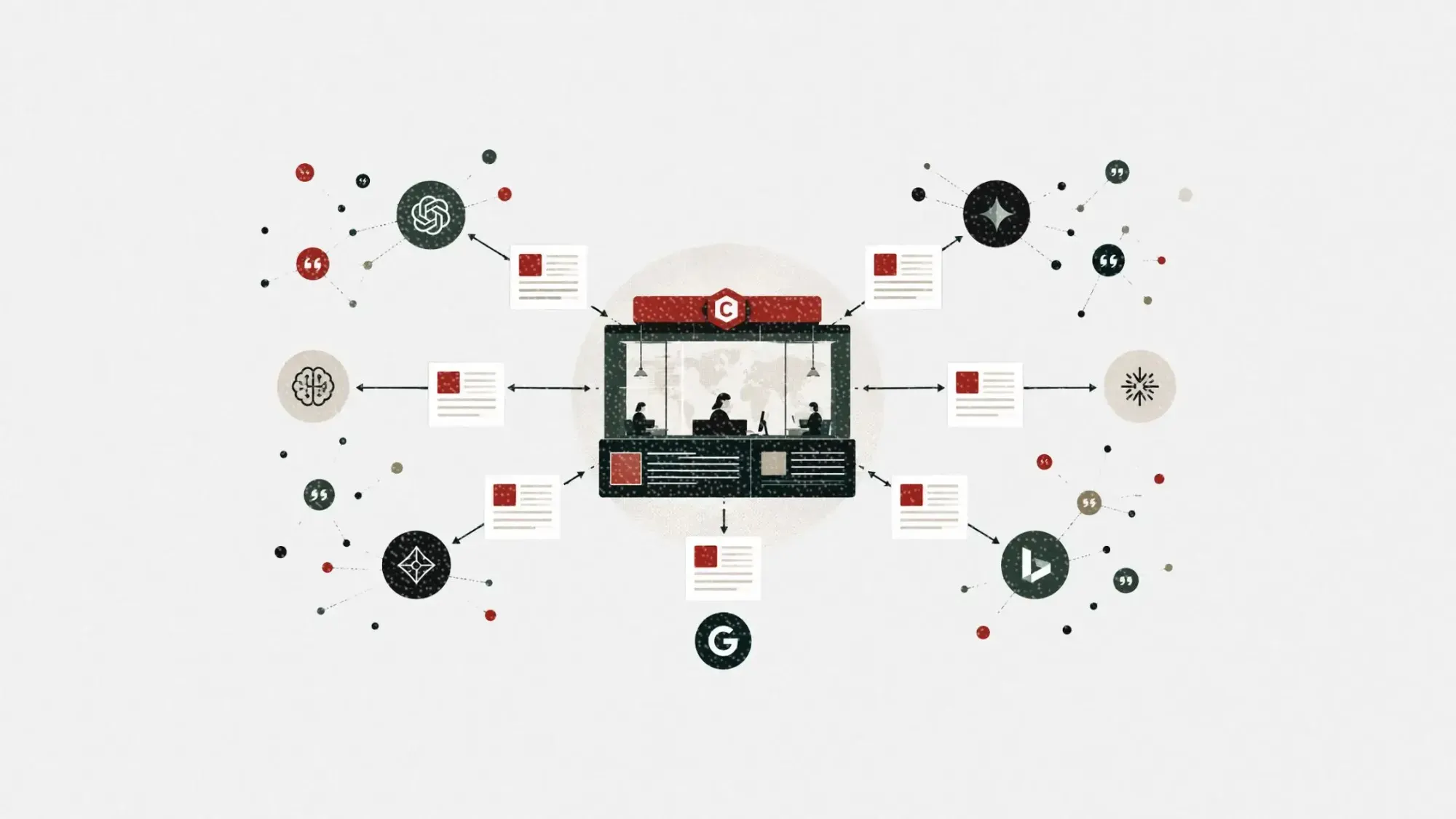
SEO was never a static, single-page game. A page ranks, then earns supporting content, internal links, and backlinks over time, that continuous compounding is how domain authority actually builds. GEO also rewards continuous publishing. The difference isn't cadence. Both disciplines demand it.
The difference is where all that publishing effort accumulates. SEO's compounding work funnels back toward one place: backlinks, internal links, and updates all build authority that sits on your domain, under your index entry. GEO's citation pool doesn't funnel through your domain at all.
When an AI system answers a question, it's drawing directly from a scattered set of independent sources, journalism, forums, other companies' own content, without any link graph pulling that authority back to you. A page with real backlink equity on your own site can still be invisible in that pool, because the systems citing it aren't ranking your domain. They're picking independent-feeling sources from many different domains at once.
A branded newsroom is what taking that seriously looks like in practice. It's the model behind ContentGrip itself: an owned domain built to read like one more independent publisher sitting inside that scattered mix, rather than a domain trying to pull authority in toward itself the way SEO does.
Table of contents
Jump to each section:
- What a branded newsroom is, and why AI visibility changes the definition
- The proof case: what ContentGrip's own citation performance shows
- GEO is continuous and cross-channel, not a page you fix once
- What it takes to build a branded newsroom for AI visibility
What a branded newsroom is, and why AI visibility changes the definition
A branded newsroom is a media outlet a company owns and runs like a publication rather than a marketing asset. Three things distinguish it from a standard company blog:
- It usually lives on its own domain rather than a
/blogsubfolder of the corporate site - Its coverage is framed as industry news rather than company updates, and it promotes the parent company occasionally, as one story among many, rather than treating every post as a pitch.
- It has an editorial calendar, a byline, a publishing cadence, and coverage that goes beyond the company's own product announcements.
Other definitions of the term - such as corporate newsroom - describe something narrower: a page section for press releases, logos, and executive bios that journalists could pull from. That version still exists on most corporate websites, and it still has a job to do. That narrower version was built for a different reader: a journalist looking for logos and boilerplate, not an AI system deciding what to cite.

Muck Rack's Generative Pulse team has tracked how ChatGPT, Claude, and Gemini choose sources across three editions of its What Is AI Reading? study since mid-2025, analyzing more than 25 million cited links in the most recent run. Earned media, which includes journalism, third-party commentary, and independently published analysis, accounted for 84% of what got cited. Paid and advertorial content accounted for 0.3%.
That's the gap a branded newsroom is built to close. Press release pages do still get cited, but unevenly: Muck Rack's data shows they cluster almost entirely in industry-trend queries, appearing about 3.5 times more often there than in "best of" or comparison-style prompts, the exact query types a B2B buyer is more likely to ask.
A newsroom that publishes original analysis, names real companies, cites primary data, and updates on a real schedule reads as something closer to the broader earned media AI systems already prefer to cite across query types, not just the narrow slice a press release can win.
The distinction isn't cosmetic. It changes which parts of a company's content actually have a shot at showing up when someone asks an AI tool a question in that category.
Domain separation adds a second benefit beyond that citation math: editorial freedom. A company blog usually sits inside brand guidelines, legal review, and a marketing calendar built for one job: representing the product consistently. That's the right posture for a pricing page or a product announcement. It's a constraining one for a publication trying to build an actual voice, take a stance on an industry debate, run a comparison piece that doesn't flatter the parent company, or try a storytelling format that would never clear a brand review on the main site.
Off the corporate domain, a newsroom can write like a publication instead of a marketing department. That's also, not coincidentally, what makes the output read as independent enough to cite.
 Enricko Lukman
The proof case: what ContentGrip's own citation performance shows
The easiest way to explain this is to point at a working example instead of a theoretical one. ContentGrip is the branded newsroom for its two sibling companies, ContentGrow and Content Collision. It publishes on its own domain rather than a subfolder of either sibling's site, with original guides, news analysis on marketing and martech developments, and comparison pieces going out several times a week under bylined writers covering a defined beat.
That's not a claim that company blogs can't do good, high-volume, competitively honest content. Plenty do. What the domain separation and industry-news framing add is a cleaner read for both human readers and AI systems: content that lives apart from the product pages, isn't structured around conversion, and only occasionally points back to the parent company is closer to what earned media already looks like. The volume matters less on its own than what it enables: a large, continuously refreshed body of content that AI systems can draw from across many different prompts, not just one.
The mechanism connects directly back to what Muck Rack's data shows. AI systems are already biased toward exactly this kind of third-party-feeling, regularly updated, category-literate content. A branded newsroom is a way to produce a steady supply of it under one company's own domain, instead of hoping outside journalists happen to cover the same ground.
That mechanism shows up in the example below, one that also demonstrates ContentGrip working for both of its siblings at once. As of early August 2026, a Perplexity query for "What are the best PR agencies in Indonesia for tech companies?" (run in incognito mode, with no chat history to bias the result) cited ContentGrip's guide to PR agencies for tech startups in Indonesia as a source, and the AI's own shortlist named Content Collision, the sibling agency ContentGrip evaluated in that piece, as its top recommendation.
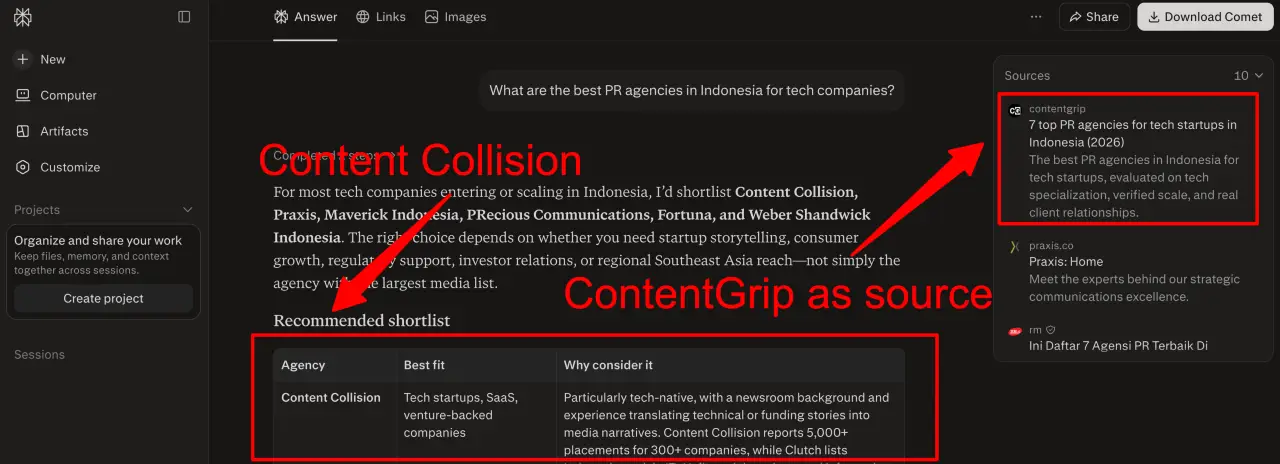
Perplexity's answers aren't static, so this is a snapshot rather than a permanent guarantee, but it's a real, dated instance of the newsroom model producing the exact outcome it's built for: independent-reading editorial content that an AI system trusts enough to cite, which in turn puts a sibling company in front of the person asking.
It's also a good illustration of why this has to be earned rather than engineered. The guide reads as citable because it evaluates seven other agencies on the same criteria, not because Content Collision was inserted into a template.
GEO is continuous and cross-channel, not a page you fix once
GEO (Generative Engine Optimization) is the discipline of structuring content and publishing so AI systems can find, trust, and cite it. The numbers back up why the domain-accumulation point above matters in practice, not just in theory.
Google still handles about 90% of global search traffic as of May 2026, and that share has barely moved in over a decade. Search itself isn't going anywhere, and the SEO discipline built around ranking one domain in it still works the way it always has. But when someone asks ChatGPT, Claude, or Gemini a question, the system isn't reflecting that same domain-centric index back.
Ahrefs has found that roughly 80% of the sources AI systems cite don't appear in Google's own search results at all. Muck Rack's citation data shows a similar pattern one level down: Gemini's most-cited domain is Reddit, ChatGPT leans on Wikipedia, and journalism citations span more than 20,000 distinct outlets.
That's not one domain accumulating authority. It's a scattered mix of independent publishers, forums, and platforms, each contributing directly, with nothing consolidating that back through any single brand's backlink profile.
A branded newsroom is a way to have a real presence in that scattered mix, rather than trying to pull it toward one domain the way SEO does. It's an owned channel that publishes on a real cadence and reads like the kind of third-party editorial content AI systems already reward, sitting inside the same mix as journalism, forums, and independent commentary rather than trying to rank above them.
 Patrecia Meliana
What it takes to build a branded newsroom for AI visibility
Running a newsroom on this model is a heavier commitment than an occasional company blog post, and it's worth being direct about what that commitment actually involves.
- A real editorial cadence. Multiple pieces a week, not sporadic posts whenever someone has bandwidth. Irregular publishing undercuts the recency signal that makes newsrooms outperform static pages in the first place.
- Coverage that goes beyond the company's own news. A newsroom that only writes about its own product launches reads the same way a press release library does. Category news, competitor comparisons, and industry analysis are what make it read as independent.
- Bylined writers with a defined beat. Attributed, consistent authorship is part of what separates editorial content from marketing copy, both for human readers and for the credibility signals these AI systems are trained to weigh.
- A willingness to cover the category honestly. Content that only ever flatters the parent company doesn't build the third-party feel that gets cited. The publications roundup above only works as a proof case because it evaluates ContentGrip's own limitations alongside its strengths.
- Patience on the timeline. Citation performance compounds over months of consistent publishing, not the weeks a single optimized page might need to show results.
- Enough volume for the cadence to register. A handful of articles a year doesn't produce a real publishing cadence, no matter how well each one is optimized. The compounding effect depends on there being enough published material for AI systems to keep re-encountering the brand across different prompts.
The tradeoff is real. A branded newsroom costs more to run than a single optimized landing page, and it takes longer to show results. What it buys in return is a body of content that keeps earning new citations as it grows, rather than one asset slowly losing relevance as the model that once favored it moves on.
That's a real operating model, not a checklist item. ContentGrow, one of ContentGrip's two sibling companies, builds and runs branded newsrooms for other B2B companies on this same model, the one behind ContentGrip's own publishing (and, per the example above, behind putting its other sibling, Content Collision, in front of an AI-generated answer).
The newsroom is the publishing engine, but it doesn't stand alone: GEO work shapes how each piece gets structured for AI retrieval, and human-led content automation is what lets a small editorial team sustain the cadence this model depends on without diluting the editorial standards that make the output citable in the first place.