
Robin Arzón and J.J. Spaun bring T1D stories to Times Square
Two athletes with type 1 diabetes help Breakthrough T1D take its awareness campaign from national billboards to global channels.


On World Diabetes Day, the screens in Times Square carried a different kind of athlete portrait. Breakthrough T1D placed familiar faces from fitness and professional golf alongside stories about something far less visible than a public sporting achievement: the daily experience of living with type 1 diabetes.
The faces belonged to Peloton instructor Robin Arzón and U.S. Open golf champion J.J. Spaun, both of whom live with the condition. As the nonprofit explained in its November 14 campaign announcement, the display was part of a global expansion of See T1D, an awareness platform built around seeing the person rather than only the diagnosis.
Table of contents
Jump to each section:
- What appeared on the Times Square screens
- Why the two athlete advocates fit the message
- How the campaign grew beyond a national launch
- What marketers can learn from visibility-led storytelling
What appeared on the Times Square screens
A large public billboard is a blunt format. A person walking past may have only a few seconds to recognize a face and understand the reason it is there. In this case, the campaign used that constraint to its advantage. Arzón and Spaun are recognizable for performance and discipline, while the message asks viewers to acknowledge an aspect of their lives that those achievements do not necessarily show.
The nonprofit staged the digital-billboard takeover on November 14, World Diabetes Day, with outdoor media company OUTFRONT supporting the wider initiative. The ads put the two celebrity advocates beside stories from the type 1 diabetes community, rather than presenting their portraits as standalone endorsements.
See T1D makes two promises in its wording. See the Everyday is about the practical, emotional and financial realities of managing the autoimmune condition. See the Breakthroughs directs attention to research, early detection, advocacy and progress toward treatments. Together, the ideas make room for both the routine and the possibility of change.
That dual focus matters for an awareness campaign. A portrait of a successful athlete can be uplifting, but it can also suggest that resilience is the entire story. The everyday strand introduces the less glamorous work and choices that a polished celebrity image might leave out. The research strand gives the campaign a reason to continue beyond a single moment of recognition.
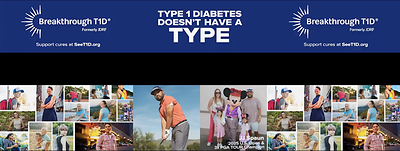
J.J. Spaun appears in the campaign visuals shared with the nonprofit's World Diabetes Day announcement.
There is no disclosed visitor count, billboard impression figure or change in public awareness in the announcement. The visible creative mechanism is clear, but the organization has not supplied evidence that would allow anyone to quantify the reaction to the Times Square display.
Why the two athlete advocates fit the message
Arzón spends much of her professional life teaching movement. As a Peloton head instructor and fitness-programming executive, her public identity is built around showing up, coaching through difficulty and making exercise accessible to an audience. That gives her a different kind of credibility here from a celebrity whose connection to the condition is only a scripted endorsement.
In the campaign statement, Arzón said, “T1D is part of my story, but it doesn't get to define what I'm capable of.” The remark works because it sits alongside her public work, not in place of it. The ad does not ask people to forget her fitness career. It asks them to understand more of the person behind that career.
Arzón has also used familiar consumer culture to make the condition more visible. Her 2026 NYU alumni profile notes a Barbie doll in her likeness that represents type 1 diabetes. A doll and a giant billboard are different media, but each makes a health experience visible inside a format people already recognize.
Spaun offers a second entry point through sport. The golfer won the 2025 U.S. Open, and his appearance in See T1D connects his competition story with his own account of living with type 1 diabetes. The release quotes him describing the condition as a challenge that has also shaped his discipline and resilience.
There is an important difference between placing two famous people in an awareness campaign and placing two people who can speak about their own lives. In the latter case, the connection is not a marketing metaphor invented after the partnership. The advocates themselves are the source of the story. That can give a cause-led message substance without requiring an exaggerated emotional script.
For audiences unfamiliar with type 1 diabetes, the combination also counters a narrow stereotype. The condition is not limited to children and is not caused by a particular diet or lifestyle. The campaign uses adult public figures as an accessible starting point, while the organization provides the fuller explanation elsewhere.
How the campaign grew beyond a national launch
The Times Square display is not the beginning of See T1D. Breakthrough T1D introduced the platform nationally in 2025, using outdoor advertisements and personal stories to challenge misconceptions about the condition. The earlier creative featured actors Brec Bassinger and Ryan McCartan and used public-media placements across the United States.
The current edition changes the scale of the platform, not its basic proposition. Breakthrough T1D says the campaign is expanding through its global affiliates, digital media and outdoor placements throughout November. The Times Square takeover gives the announcement a prominent visual moment, while the continued community storytelling offers material beyond that event.
The 2026 messaging also sits beside the organization's State of T1D report, whose theme is the burden behind the numbers. That report describes emotional and financial pressures as well as research developments. The report's figures are organization-reported, not a measurement of this campaign's success, and should not be confused with advertising performance.
One of the campaign participants, Katie Beth Hand, shares her experience of an investigational treatment and a reported period of insulin independence after a transplant-based clinical trial. Her story is personal testimony about participating in research, not evidence that such an outcome is available to everyone or advice about treatment.
The structure illustrates why an annual campaign can keep growing even when its central name stays the same. The headline moment brings a new reason to look. The longer-running platform holds the information, lived experiences and community relationships that make the attention worth gaining.
For commercial brands, repetition often risks becoming wallpaper. In cause-led communication, consistent framing can instead help audiences recognize the issue while each edition brings forward a different person or experience. See T1D uses the latter pattern, combining returning language with new advocates and a wider distribution footprint.
What marketers can learn from visibility-led storytelling
The lesson is not simply to book a celebrity or buy the biggest screen. It is to make the public face of a campaign lead somewhere more human and more specific.
- Choose advocates with lived relevance. Arzón and Spaun have their own experience of the condition. Their involvement makes the connection between public identity and campaign topic understandable without a long explanation. Marketers should distinguish that fit from fame alone.
- Use spectacle to introduce, not replace, substance. Times Square gets attention because it is visually hard to ignore. The everyday stories and research context give viewers something more meaningful to consider after the first glance.
- Let the creative idea survive across channels. See T1D can travel from outdoor displays to community stories and affiliate communications because its central proposition is simple. The channel changes while the invitation to see the whole person remains recognizable.
- Keep advocacy outcomes separate from media exposure. The nonprofit describes an ambitious global campaign, but it has not released evidence of reach or behavior change for this edition. A useful evaluation would separate billboard delivery, audience understanding and any subsequent action.
A high-profile advocate can make a subject easier to notice, but familiarity should not be mistaken for understanding. The creative challenge is what happens after a recognizable face has won a moment of attention. A story needs enough context to stand on its own once the face is no longer on the screen.
There is also a responsibility specific to health advocacy. Individual experiences are powerful because they are real, not because they represent every person facing the same condition. The strongest version of this approach lets one person's experience create curiosity while making room for other, different experiences.
See T1D shows how a celebrity-led outdoor campaign can function as an opening scene rather than the whole narrative. For marketers trying to work with communities rather than speak over them, that distinction may matter more than the size of the media placement.
