Canva reaches US$4B ARR as AI tools and LLM traffic surge
As AI assistants become discovery engines, Canva is turning design software into an AI-first creative platform.

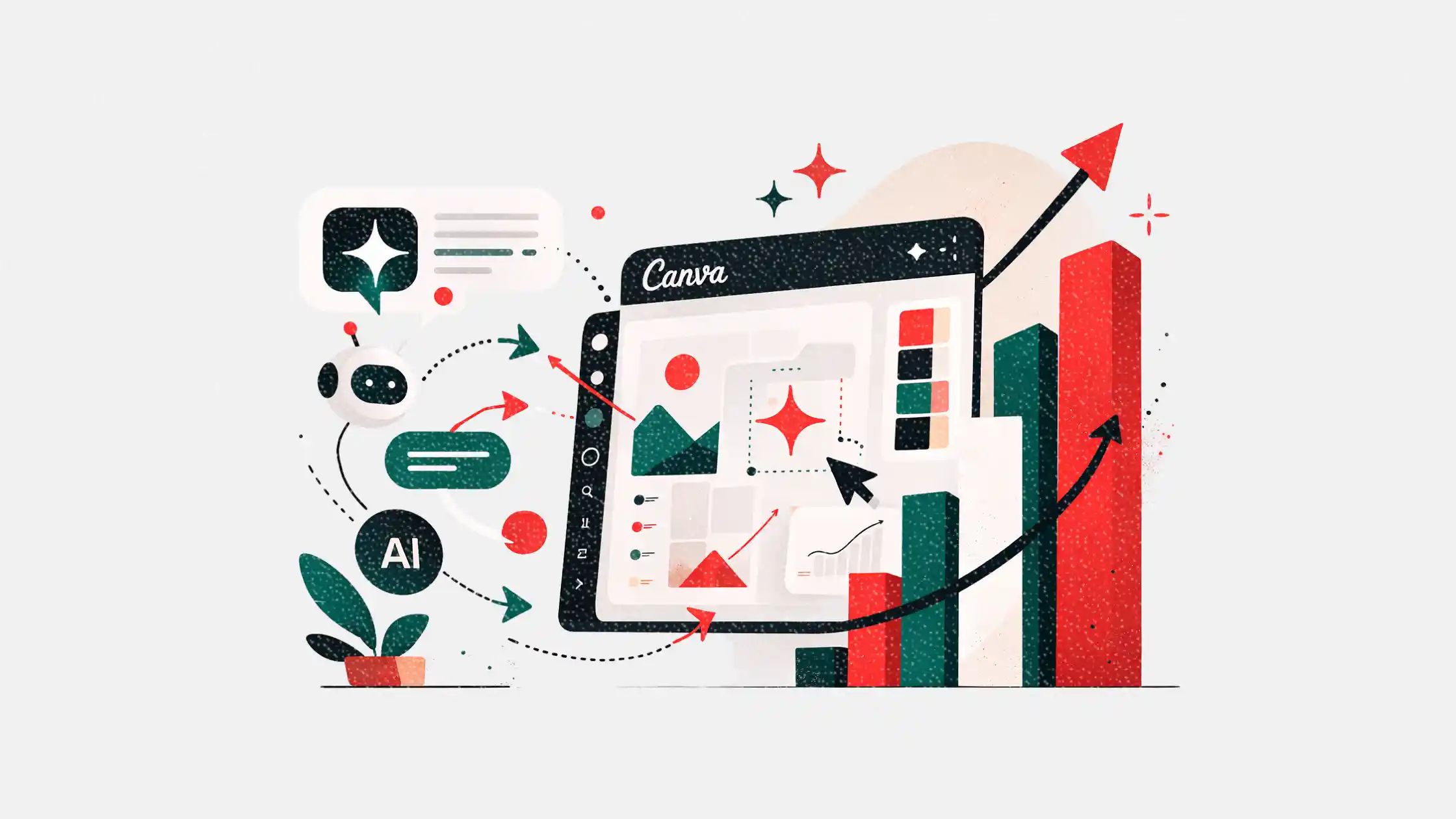
Canva closed 2025 with a major milestone: US$4 billion in annual recurring revenue and more than 260 million monthly active users. The design platform credits part of that momentum to its growing portfolio of AI tools and an unexpected traffic source: large language models.
For marketers, this signals more than just Canva’s continued rise in the creator economy. It also highlights a major shift in how users discover products and tools online. Traffic that once came primarily from traditional search engines is increasingly flowing through AI assistants like ChatGPT and Claude.
This article explores Canva’s latest growth metrics, its shift toward becoming an AI-first design platform, and why LLM-driven discovery is emerging as a new marketing funnel.
Short on time?
Here’s a table of contents for quick access:
- How Canva reached US$4B ARR and 265M users
- Why Canva is repositioning itself as an AI platform
- LLM referral traffic is becoming a new growth channel
- What marketers should know about AI discovery and design platforms
 Patrecia Meliana
How Canva reached US$4B ARR and 265M users
Creative platform Canva ended 2025 with strong growth across both consumer and enterprise segments.
According to Co-Founder and Chief Operating Officer Cliff Obrecht, speaking to TechCrunch on the sidelines of Web Summit Qatar, the company now has:
- 265 million monthly active users
- 31 million paid users
- US$4 billion in annual recurring revenue
The company also reported significant momentum in its B2B segment, defined as organizations with more than 25 seats. That business doubled year over year and now generates US$500 million in ARR.
While North America remains Canva’s largest market, the company is expanding its global footprint. To increase adoption in emerging markets, Canva has introduced lower-priced subscriptions in countries such as Pakistan, Uruguay, Morocco, and Jamaica.
The strategy reflects Canva’s long-standing playbook: grow the user base first, then convert engaged users into paid subscribers through premium tools and team collaboration features.
 Atikah Amalia
Why Canva is repositioning itself as an AI platform
A key driver behind Canva’s recent growth is its expanding set of AI-powered features. The company launched Canva AI last year that allows users to create mini apps and websites using AI, and it has already attracted more than 10 million monthly active users.
But Canva’s long-term strategy goes beyond adding AI features to its existing design tools. The company is flipping the model entirely.
Instead of being a design platform with AI tools, Canva is positioning itself as an AI platform that includes design tools. Obrecht described the shift as turning Canva into something like a “design agency in your pocket.” The idea is that users can generate, edit, and publish visual content with minimal manual work.
This repositioning also comes as competition intensifies across the creator software market. Canva now faces pressure not only from Adobe and Freepik, but also from Apple’s growing creator ecosystem. Apple recently bundled tools such as Final Cut Pro, Logic Pro, Pixelmator Pro, Motion, Compressor, and MainStage into a US$12.99-per-month Creator Studio subscription.
The result is an increasingly crowded market where design platforms are evolving into full creative production environments powered by AI.
LLM referral traffic is becoming a new growth channel
One of the more surprising insights from Canva’s growth story is the role of LLM-driven traffic. The company has actively integrated its platform with AI assistants like ChatGPT and Claude. By October 2025, users had conducted more than 26 million conversations with the Canva app on ChatGPT.
According to Canva, the platform also became one of the top ten domains referred to by ChatGPT. Obrecht says the company now treats LLM platforms as a top-of-funnel acquisition channel, similar to how it previously optimized for Google search.
Historically, Canva grew rapidly by understanding search intent and offering editable design templates that users could quickly customize. Now, the same strategy is being applied to AI-driven discovery.
Traffic from LLM referrals already accounts for double-digit percentages of Canva’s inbound traffic, prompting the company to dedicate resources to ensure its tools appear more frequently in AI-generated responses.
In practical terms, that means optimizing content and integrations so that when users ask an AI assistant to design a presentation, logo, or marketing asset, Canva becomes the recommended tool.
Atikah Amalia
What marketers should know about AI discovery and design platforms
Canva’s strategy highlights several important shifts for marketing teams.
1. AI search is becoming a distribution channel
LLM interfaces are increasingly acting as discovery layers. Instead of browsing search results, users ask AI tools for recommendations or solutions.
Brands that optimize for AI discoverability could capture early demand before users ever reach traditional search.
2. AI-native tools are changing creative workflows
Platforms like Canva are moving toward AI-assisted production, where users generate entire designs, websites, or presentations from prompts.
This could significantly reduce the time and cost associated with creative production.
3. SaaS platforms are competing for AI ecosystem placement
Being integrated with ChatGPT or other AI assistants is quickly becoming as important as ranking on Google.
Marketers may soon need strategies for LLM visibility, including structured content, integrations, and prompt-friendly assets.
4. Global growth requires localized pricing
Canva’s expansion into lower-cost subscription tiers shows how SaaS companies are adapting pricing models to unlock new international markets.
For B2B platforms targeting emerging markets, flexible pricing could become a key growth lever.
Canva’s US$4 billion ARR milestone highlights how quickly the creator software market is evolving. The company’s shift toward an AI-first platform and its focus on LLM-driven discovery suggest that the next phase of growth for SaaS platforms may come from AI ecosystems rather than traditional search channels.
For marketers, the lesson is clear: optimizing for Google alone is no longer enough. As AI assistants increasingly guide user decisions, brands that learn how to appear inside those conversations could gain a powerful new growth channel.