OpenAI’s trompe-l’œil billboards turn ChatGPT Images into building illusions
OpenAI’s “Reimagined with ChatGPT Images” OOH series uses trompe-l’œil billboards in four cities, turning AI output into place-based spectacle.


The fastest way to make AI imagery feel less “made for a screen” is to give it a physical setting that people immediately understand. A billboard that looks like it is carved into a building reads like a visual prank you can stumble into on your commute, not a tech demo you have to opt into.
OpenAI is leaning into that feeling with a trompe-l’œil out-of-home series for ChatGPT Images. The company described the model update in an official product post, then used city architecture and forced perspective to make the work feel grounded.
The series, “Reimagined with ChatGPT Images,” runs on sites in Detroit, New York, Chicago and Los Angeles. Each execution treats the billboard frame as a hole in the building rather than a panel attached to it.
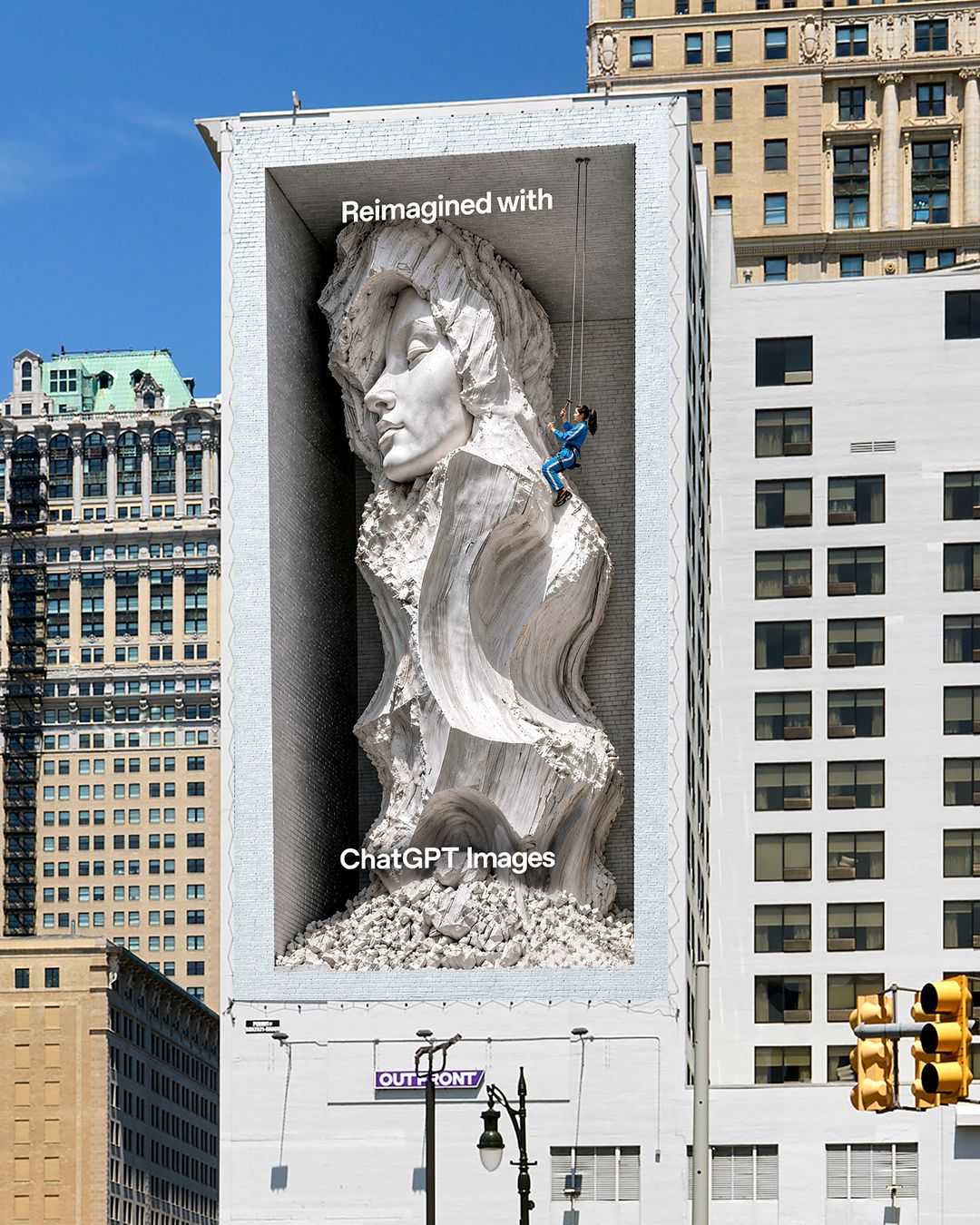
Table of contents
Jump to each section:
- Why trompe-l’œil makes AI art feel more “real” in public
- How the executions use city symbols to earn attention
- What this means for marketers
Why trompe-l’œil makes AI art feel more “real” in public
A lot of AI visuals look like they arrived from nowhere, because they are often shown without context: a clean rectangle in a feed, divorced from place, scale, and texture. Trompe-l’œil flips that by making the environment do part of the storytelling.
In this series, the “cleverness” is framed as the siting rather than the render. The billboard becomes a fake opening in the building, which gives the illusion a built-in logic: of course the image looks surprising, because it is interacting with the architecture.
That physical plausibility matters when you are trying to persuade people that an image generator is more than a novelty. It is a way to make “AI made this” feel like “someone designed this experience.”
 undefined
How the executions use city symbols to earn attention
The executions described are built around recognizable city motifs, then exaggerated into something impossible:
- In New York, a giant marble face appears excavated from brickwork, with a real-scale “sculptor” rappelling down to sell the size.
- In Chicago, a graffiti-tagged “L” train bursts out of an arched portal, with the conductor leaning out.
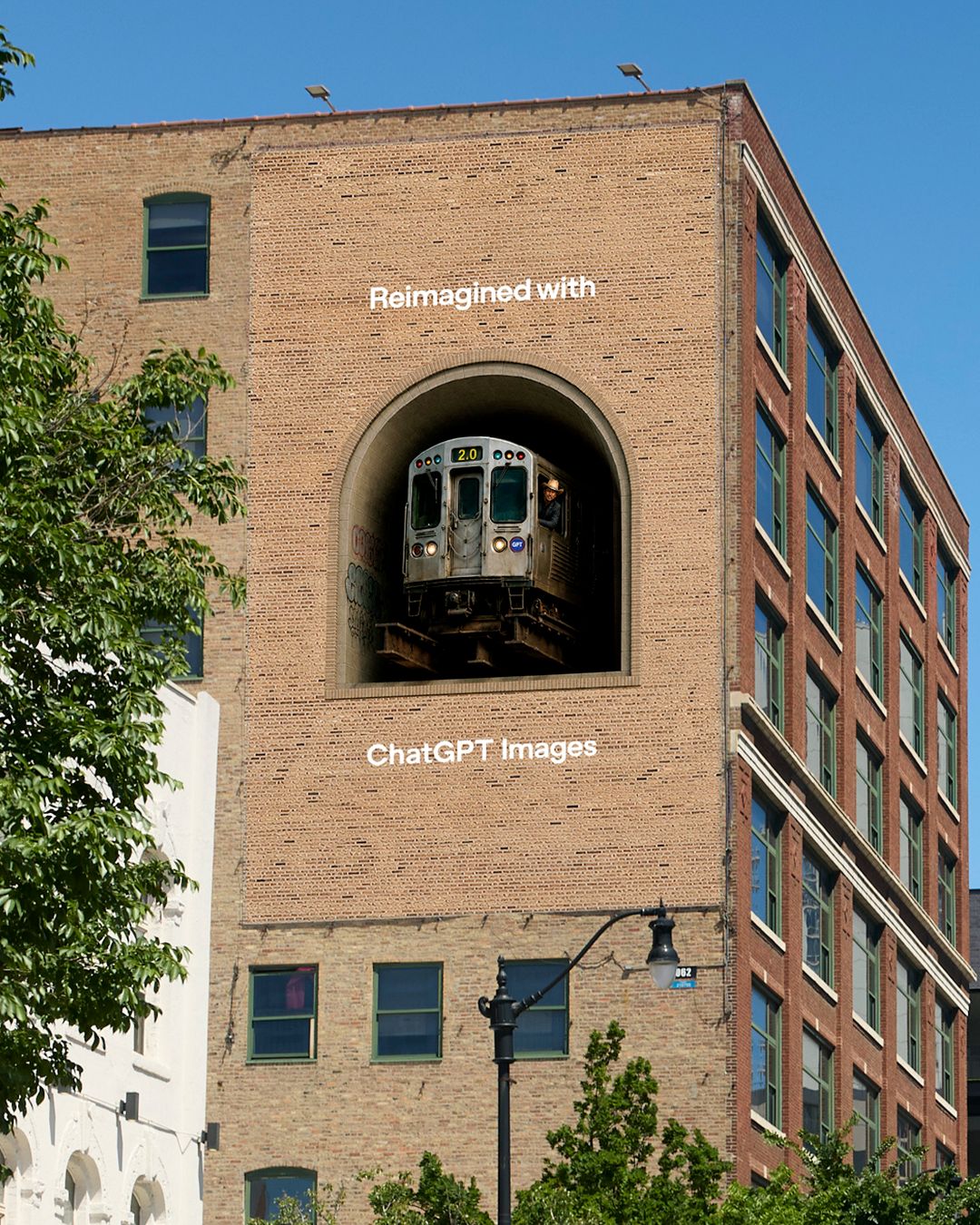
These details are doing two jobs at once. For locals (or anyone who has seen these symbols online), they provide instant recognition. For everyone else, they still work as spectacle because the illusion is readable at a glance.
The timing is also positioned around ChatGPT Images 2.0, which OpenAI is pitching as a “visual thought partner.” The OOH work translates that abstract framing into something more concrete: imagination applied to the built world.
What this means for marketers
The underlying lesson is that AI creative can land better when it is presented as an experience, not a content format. The campaign is effectively saying: the output is only half the story; the context is what makes it stick.
- Use environment to give AI output credibility
If AI visuals can feel unmoored, placing them into architecture, streetscapes, or physical cues can make them feel intentional rather than random.
- Design for “stumble upon it” behavior
Out-of-home works when it catches people mid-routine. Trompe-l’œil amplifies that by creating a moment of double-take, which is often what gets the photo taken and shared.
- Make the concept legible in one second
The billboard-as-hole idea is easy to understand instantly. For AI marketing, that clarity can matter more than showcasing every possible capability.
- Tie creative to local symbols instead of generic brand motifs
Using city-specific references (like the “L” train) helps the work feel like it earned its placement. That is a useful counterweight to AI’s tendency toward sameness.
- Let “craft” be the differentiator, not “AI”
The framing here implies that the win is not “we used AI,” but “we used AI in a way that respects how public space works.”
Zooming out, this kind of out-of-home is a response to the fatigue people feel when AI content looks like infinite variations of the same visual texture. By giving the images a physical rule set, the work feels less like machine output and more like design.
For marketing teams, the strategic implication is straightforward: if you want AI creative to be taken seriously, build a world around it. When the context does the convincing, the technology does not need to shout.