
ChatGPT adds Intelligent UI, changing how answers become experiences
ChatGPT can turn answers into interactive tools. Marketers should rethink product information without assuming conversion gains.


OpenAI is rolling out GPT-6 with Intelligent UI, allowing ChatGPT to answer with interactive elements as well as text. A response can become a comparison, a visual explanation or a small tool that users operate inside the conversation. The update changes how information is presented, rather than simply adding another way to generate copy.
The company outlined the capability in its official announcement. For marketers, the significance lies in the space between discovering information and acting on it. If an assistant can help someone explore a choice immediately, brands may need to think about how their product information supports that interaction, alongside how it earns a mention.
Table of contents
Jump to each section:
- What Intelligent UI changes inside ChatGPT
- An answer can become part of the decision
- Brand content may need to work outside its original layout
- The rollout has practical boundaries
- What marketers should know about interactive AI answers
What Intelligent UI changes inside ChatGPT
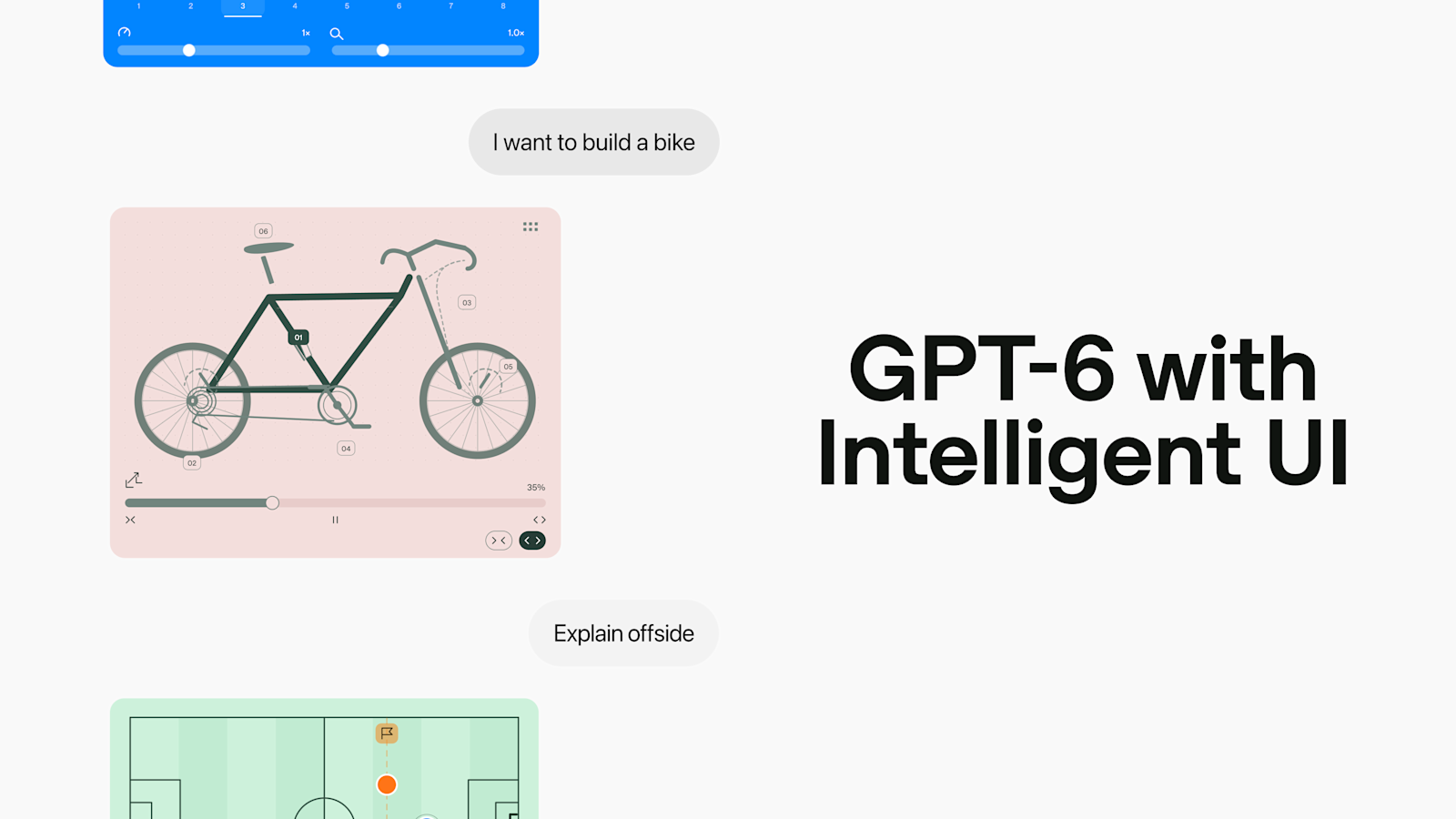
Intelligent UI combines text with controls such as buttons, forms and charts. The layout depends on the question: a comparison can sit side by side, while an explanation can use a diagram with selectable parts. A straightforward question can still receive a straightforward text answer.
OpenAI's examples make the difference concrete. A meal plan can adjust ingredient quantities when the guest count changes. A road trip can put stops on a map. Users can also request a bill splitter, savings calculator or playable game inside the conversation.
The official demonstration shows how these experiences extend the familiar chat format.
Behind the experience, native components appear progressively as the model assembles its response. OpenAI says it trained the model to choose layouts and interactions for clarity and usefulness. That matters because adding controls is valuable only when they help someone understand or complete the task.

An answer can become part of the decision
A product explanation normally asks the reader to imagine the consequences of a choice. An interactive answer can let that person change an input and examine the result. The Sunday roast example is a small demonstration of this: a question about dinner becomes a tool for adjusting a plan.
For brand teams, the potential implication is a different standard of usefulness. Information that merely describes a product may be less helpful than information that explains which attributes change the outcome for a particular need. Accurate specifications, conditions and limitations would become the material from which a useful comparison could be assembled.
Visibility earns consideration. Useful interaction can help people resolve it.
That is an editorial implication, not evidence that Intelligent UI has increased purchases or reduced website traffic. The announcement offers demonstrations of the interface, without establishing a marketing performance result. It also does not give brands a guaranteed place in generated comparisons or control over how an answer is arranged.
The distinction prevents a tempting overreaction. A more capable answer surface creates a reason to examine content quality, but it does not justify treating every existing landing page as obsolete.
Brand content may need to work outside its original layout
Marketers often invest in the sequence of a page: the headline, the proof point, the comparison and the call to action. A generated interface can reorganize information around the user's question. The assistant's layout may therefore differ from the hierarchy a brand designed.
The usual assumption is that better presentation requires more control over the page. Intelligent UI suggests another possibility: usefulness may depend partly on how well the underlying information survives a different presentation.
The road-trip example illustrates the principle. A map makes locations and distances more important than a persuasive paragraph about the journey. Applied to product communication, the question for marketers is which facts remain clear when they become fields, comparisons or adjustable inputs.
This is not a reason to abandon brand expression. It is a reason to distinguish expression from essential decision information. A brand promise, a compatibility condition and a pricing qualification serve different purposes. If those elements are ambiguous, a polished interface cannot make the underlying choice reliable.
A well-designed answer still needs well-defined inputs.
The rollout has practical boundaries
GPT-6 with Intelligent UI began its global rollout to Plus, Pro, Business and Enterprise users on October 7, with Free and Go following from October 8. Enterprise availability depends on workplace admin settings.
OpenAI's Intelligent UI help documentation distinguishes this Chat experience from Work and Voice, where the feature is unavailable. It also says some components can retain their state after refreshing the same thread, but that state does not carry across threads.
Those boundaries matter for marketing teams evaluating the product. An interactive demonstration should not be confused with a durable customer account, a connected campaign system or a brand-owned service workflow. Generating a calculator and reliably maintaining customer-specific information are different responsibilities.
The announcement is therefore best understood as an expansion of the answer format. Its implications for discovery and explanation are worth examining, while claims about end-to-end commercial journeys require additional evidence.
What marketers should know about interactive AI answers
The useful response is to examine where customers struggle to make a decision, then consider whether the information a brand supplies makes that decision easier.
Make comparison criteria explicit. Product attributes, exclusions and tradeoffs should be understandable without relying on the surrounding page design. An assistant cannot reliably clarify a condition that the brand itself leaves vague.
Separate explanation from execution. OpenAI's planning examples demonstrate ways to explore a task. They do not establish that a brand can transact, save customer preferences or deliver a service through every generated interface.
Keep commercial claims testable. A compelling demo is not a conversion benchmark. Evaluate whether people understand their options better before attaching revenue expectations to the feature.
Treat the owned experience as a continuation. If an AI answer helps someone narrow a choice, the brand's next interaction should preserve that clarity. Contradictory specifications or unexplained conditions can undo the value of the earlier comparison.
The broader question is what a brand contributes when the interface is assembled around a person's immediate need. Attractive content can win attention, but precise information makes it easier to compare, explore and decide.
As generated interfaces become more capable, marketing may need to account for experiences it does not fully design. The durable advantage would be information that remains useful wherever the customer encounters it.