ChatGPT uninstalls spike after OpenAI’s defense partnership sparks backlash
App analytics data shows a wave of uninstall activity and shifting downloads as users respond to OpenAI’s U.S. Department of Defense agreement.

OpenAI’s growing role in government and defense technology is triggering a new kind of reaction from consumers.
After the company confirmed a partnership with the U.S. Department of Defense, ChatGPT’s mobile app experienced a sharp surge in uninstall activity, signaling how sensitive users have become about AI’s role in military and surveillance contexts.
This article explores what triggered the backlash, how competitors like Anthropic’s Claude are benefiting from the moment, and why the incident highlights a new reputational challenge for AI companies operating at both consumer and government scale.
Short on time?
Here’s a table of contents for quick access:
- Why ChatGPT uninstalls surged after the defense deal
- How Claude gained momentum during the backlash
- Why defense partnerships create reputational risk for AI companies
- What marketers should know about the AI trust shift
 Patrecia Meliana
Why ChatGPT uninstalls surged after the defense deal
ChatGPT’s mobile app saw a dramatic spike in uninstall activity shortly after OpenAI confirmed a partnership with the U.S. Department of Defense.
According to market intelligence firm Sensor Tower, daily U.S. uninstall activity jumped 295% day over day on February 28. By comparison, ChatGPT’s typical uninstall fluctuation over the previous 30 days has been around 9%, making the spike unusually large for a consumer AI app.
The timing suggests a direct reaction to the announcement that OpenAI had reached an agreement with the defense department to deploy its AI models for government use cases. OpenAI said the partnership focuses on secure government applications and emphasized that safeguards remain in place, though financial details were not disclosed.
Users quickly voiced concerns across social media platforms including Reddit and X. Some shared screenshots showing canceled subscriptions or deleted accounts to support the “Cancel ChatGPT” movement, while others criticized the company’s decision to provide AI technology to military institutions. Several posts raised concerns about potential uses of advanced AI systems for surveillance or autonomous defense systems.

The backlash also appeared in the app’s ratings data. Sensor Tower reported that 1-star reviews surged 775% on Saturday, followed by another 100 percent increase on Sunday, while five-star reviews declined by roughly 50 percent during the same period.
Separately, download data also showed a shift in momentum. ChatGPT’s U.S. downloads dropped 13% day over day on Saturday, followed by another 5 percent decline on Sunday, reversing the 14 percent growth recorded the day before the defense partnership news became public.
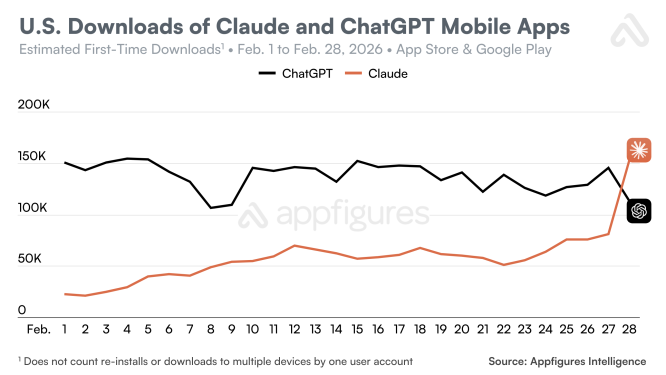
Appfigures data points to a simultaneous rise in competing AI assistants. According to the firm, Claude’s daily U.S. downloads surpassed ChatGPT’s for the first time, reflecting a sharp spike in new installs around the same time the backlash unfolded.
How Claude gained momentum during the backlash
While ChatGPT faced a wave of uninstall activity, rival AI assistant Claude saw a notable increase in downloads.
Sensor Tower reported that Claude’s U.S. downloads jumped 37% on February 27 and 51% the following day. Another analytics firm, Appfigures, estimated the surge even higher, placing the increase at 88% day over day on Saturday.
For the first time, Claude’s daily U.S. downloads surpassed ChatGPT’s.
The surge pushed Claude to the No. 1 position among free apps in the U.S. App Store, where it climbed more than 20 positions compared with the previous week.
Part of that momentum may stem from Anthropic’s stance on defense partnerships. The company declined to reach an agreement with the U.S. defense department, citing concerns about the potential use of AI for domestic surveillance or fully autonomous weapon systems.
Anthropic Chief Executive Officer Dario Amodei said the company could not agree to the terms proposed, though he noted that Anthropic hopes the government might reconsider working with its technology in the future.
The policy disagreement also escalated politically. President Donald Trump criticized Anthropic publicly, while the Department of Defense reportedly considered classifying the company as a supply-chain risk for national security procurement.
Despite the political tensions, the publicity appears to have boosted Claude’s consumer visibility. According to Anthropic as reported by The Information, the company’s free user base has grown by more than 60% since January, while daily sign-ups have tripled since November.
Why defense partnerships create reputational risk for AI companies
For OpenAI, the defense partnership represents a strategic expansion into government contracting, a sector that offers stable long-term revenue and geopolitical influence. Many large technology firms have historically pursued defense and public-sector contracts for precisely these reasons. Government deals tend to be large, long-running, and less volatile than consumer subscription revenue.
However, the reaction to the OpenAI agreement illustrates a new challenge unique to AI companies.
Unlike traditional enterprise software, generative AI platforms have massive consumer user bases that closely follow corporate decisions. That creates a feedback loop where strategic partnerships can trigger immediate consumer reactions.
Artificial intelligence is increasingly viewed not just as productivity software but as critical infrastructure with national security implications. That perception raises ethical concerns about surveillance, autonomous weapons, and algorithmic decision-making in military contexts.
OpenAI Chief Executive Officer Sam Altman has argued that democratic governments should have access to advanced AI systems under responsible governance frameworks. In previous statements, he suggested that collaboration with public institutions is preferable to leaving frontier technologies outside regulatory oversight.
Still, the uninstall spike shows how quickly public sentiment can shift when AI companies enter politically sensitive arenas.
What marketers should know about the AI trust shift
For marketing leaders and brand strategists, the episode reveals several emerging dynamics around AI adoption and public perception.
1. AI brand perception is becoming political
Technology brands are increasingly judged not just on product quality but on ethical positioning. Partnerships with governments, defense agencies, or controversial institutions can directly influence consumer trust.
2. Platform loyalty is becoming more fluid
The rapid shift in downloads between ChatGPT and Claude suggests that AI users are willing to switch tools quickly when sentiment changes.
For marketers building AI-powered products or campaigns, this means platform dependency carries more reputational risk than before.
3. Trust narratives are shaping AI competition
Anthropic has positioned itself as a safety-first AI developer. In moments like this, those narratives can translate into tangible growth through increased downloads and sign-ups.
4. Brand transparency matters more than ever
Companies integrating AI into customer-facing experiences should communicate clearly about how their models are trained, deployed, and governed. Transparency can help prevent backlash when sensitive partnerships or use cases emerge.
The surge in ChatGPT uninstalls highlights how AI companies now operate at the intersection of consumer technology, geopolitics, and public trust.
For OpenAI, the defense partnership may represent a strategic expansion into government infrastructure. But the immediate consumer backlash demonstrates that AI platforms are no longer neutral productivity tools in the public eye.
As AI becomes embedded across industries, companies will need to balance commercial opportunities with the expectations of a highly engaged user base. The next phase of the AI race may not be decided solely by model performance, but also by trust, governance, and brand perception.