Ease Health raises $41M Series A to unify behavioural health CRM, EHR and billing
Ease Health lands $41M Series A to streamline behavioural health operations with an AI-native CRM, EHR, and billing platform.

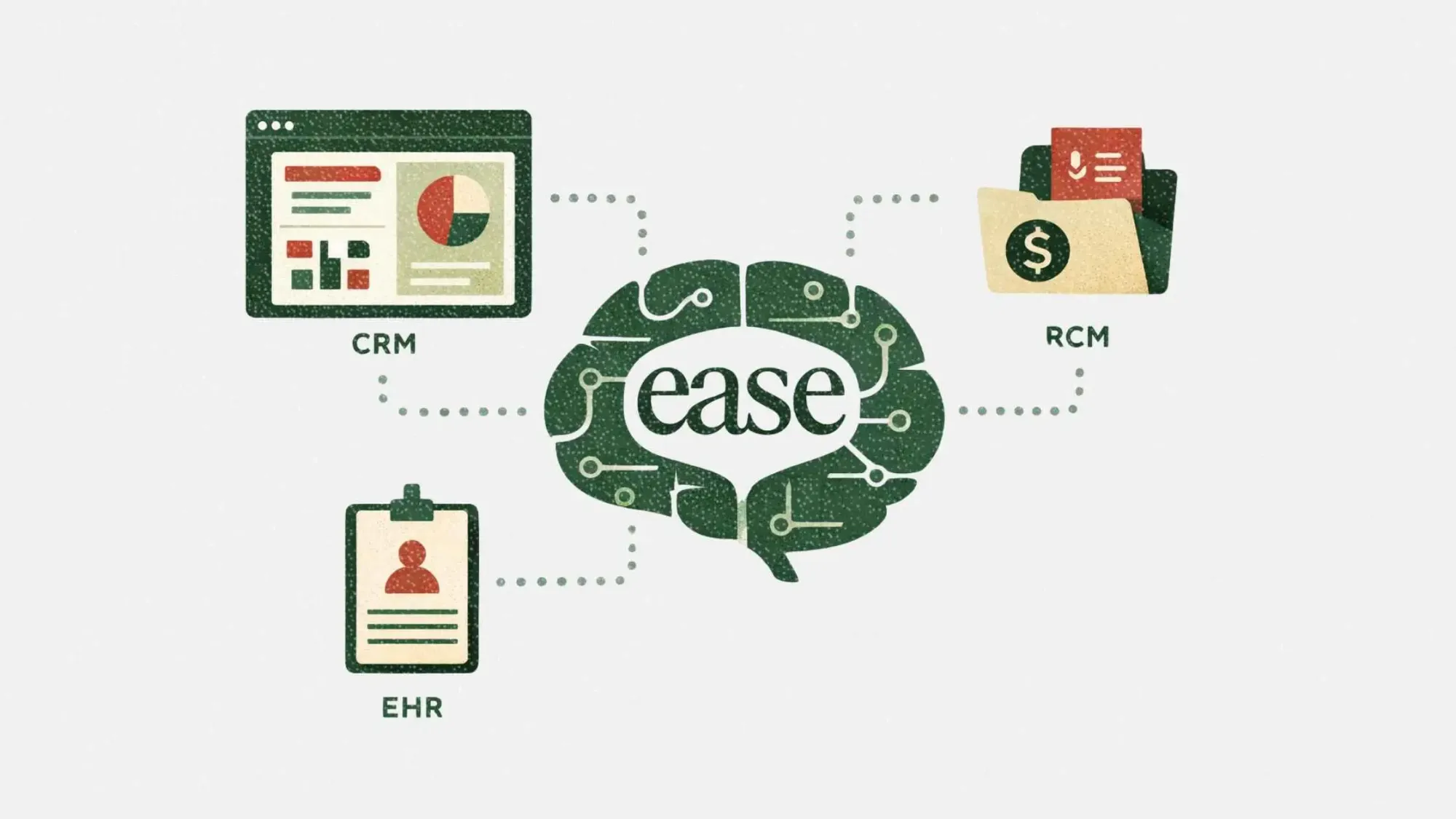
Ease Health has raised a $41 million Series A as it comes out of stealth with an AI-native platform that combines CRM, EHR, and revenue cycle management (RCM) for behavioural health providers.
The core pitch is consolidation: instead of clinics running separate tools for admissions, patient records, and billing, Ease is positioning a single workflow layer where clinical documentation and billing configuration connect more directly, with automation aimed at reducing admin load and improving collections performance.
Short on time?
Here’s a quick look at what’s inside:
- What Ease Health raised and what it is building
- Why behavioural health ops software is becoming a billing and staffing issue
- How Ease Health fits into a crowded CRM/EHR market
- What this signals about AI automation in clinic back offices
- What marketers and growth teams in healthcare should take from this
What Ease Health raised and what it is building
Ease’s Series A was led by Andreessen Horowitz. The company says the funding will go toward expanding product and engineering, strengthening automation features, and pushing further into larger enterprise provider groups.
Product-wise, Ease is targeting the operational spine of behavioural health providers by bringing admissions (CRM-like workflows), clinical care documentation (EHR), and billing and claims processes (RCM) into one system. It also claims its billing tooling is trained on millions of behavioural health claims to reduce errors and speed up reimbursement workflows.
From a go-to-market perspective, Ease is positioning itself as relevant across levels of care, including outpatient clinics, IOP and PHP programs, residential treatment centers, detox, inpatient psychiatry, and medication-assisted treatment programs. Named customers include Christian Counseling Associates and N.O.W. Counseling.
 Patrecia Meliana
Why behavioural health ops software is becoming a billing and staffing issue
Behavioural health demand has been rising, but the operational environment for providers is still shaped by fragmented tooling and manual handoffs. In practice, that fragmentation often shows up as slow admissions, inconsistent documentation, coding and claims errors, and delayed cash flow.
That matters because RCM is not just a finance function in care delivery settings. When collections are slow or claims are denied, clinics may respond by restricting intake, delaying hiring, or leaning harder on staff to do administrative work. So the “workflow” problem becomes a capacity problem.
Ease is betting that unifying the patient record and the handoffs between teams can improve throughput. For providers, the value proposition is less about having “AI features” and more about reducing the number of steps and systems needed to move a patient from intake to treatment to reimbursement.
How Ease Health fits into a crowded CRM/EHR market
The behavioural health software market already includes vendors like Valant, TherapyNotes, Netsmart (myAvatar), and SimplePractice, many of which provide established EHR and practice-management capabilities.
Ease’s differentiation claim is “AI-native” automation and tighter end-to-end workflows across admissions, clinical documentation, and billing. That matters if it reduces operational friction in places where legacy systems can feel like modules bolted together, or where clinics still rely on third-party tools and manual workarounds.
At the same time, this category is competitive and sticky. Switching EHR and billing workflows is disruptive, and enterprise provider groups tend to be cautious. Ease will likely be judged on measurable outcomes: denial rates, time-to-bill, time-to-cash, documentation completion, and the ability to support complex multi-site operations without creating new administrative burden.
What this signals about AI automation in clinic back offices
Ease’s positioning reflects a broader shift: AI in healthcare software is increasingly being applied to operational leverage, not only clinical decision support. In other words, “automation” is moving toward the functions that determine whether providers can sustainably scale, including claims, coding workflows, and intake operations.
It also signals that healthcare CRM is converging with care delivery systems. For behavioural health in particular, patient acquisition and admissions workflows (referrals, eligibility checks, scheduling, program fit) are tightly connected to staffing, treatment capacity, and reimbursement. A unified system can make those constraints more visible, which can change how leadership teams plan growth.
For vendors, “AI-native” is becoming table stakes language. What will separate platforms is whether automation is deeply integrated into workflow execution (and reduces headcount pressure) versus being add-on copilots that still require extensive manual oversight.
What marketers and growth teams in healthcare should take from this
For growth leaders at behavioural health providers, platform consolidation can directly affect marketing efficiency. If intake capacity, eligibility checks, and scheduling are bottlenecks, more demand generation can worsen patient experience rather than improve revenue.
A few practical takeaways:
- Treat admissions ops as part of the growth stack. Faster intake and cleaner handoffs can improve lead-to-admit conversion and reduce wasted spend.
- Align acquisition targets to RCM realities. Denial rates and payer mix have downstream impacts, so “good leads” are not only about volume.
- Ask vendors for operational benchmarks. When evaluating platforms, request proof around time-to-bill, denial reduction, and documentation turnaround, not just UI and automation demos.
- If you run multi-location growth, prioritize reporting consistency. A unified patient record and workflow data can make it easier to identify which channels and referral sources lead to reimbursable, retained patients.