Firmable finds 82% dismiss cold outreach as AI trust lags
Firmable's survey highlights AI outreach distrust, mass-message fatigue and why B2B teams should measure positive replies separately.


Firmable has put a number on a familiar B2B marketing problem: professionals dismiss unsolicited messages even while sending outreach themselves. Its Cold Outreach Pulse Report, published in August, examines how recipients judge messages and how senders use AI.
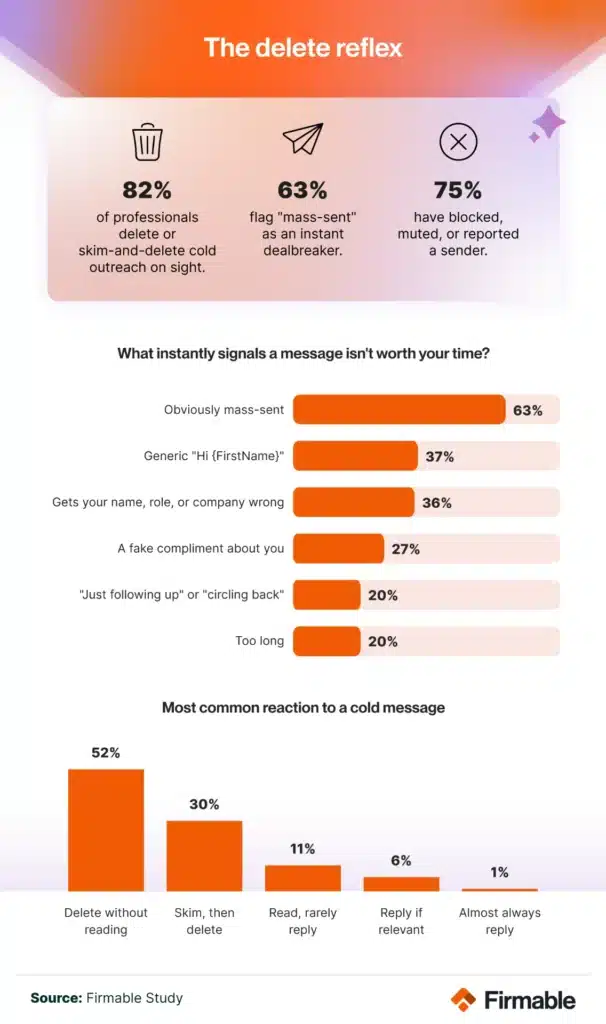
82% delete or skim-and-delete cold outreach on sight. The finding comes from a survey of 1,009 full-time professionals, according to Firmable.
For marketing teams, the findings raise a question about where to invest effort. AI can help produce a polished message, but polish alone gives a recipient little reason to care. The strategic test is whether automation improves the decision to contact someone, as well as the words that reach them.
Table of contents
Jump to each section:
- Cold outreach has a relevance problem
- AI trust and AI use can coexist
- A reply can signal rejection
- What this means for marketers
Cold outreach has a relevance problem
63% identify a mass-sent appearance as a dealbreaker, versus 37% for a generic greeting. Separately, 52% delete without reading and just 1% almost always reply, according to Firmable.
The distinction between deleting immediately and skimming first matters. The headline figure combines both behaviors. It also describes respondents' reported habits, rather than the proportion of messages deleted in an observed campaign.
A common assumption behind AI personalization is that making a message sound individually written will make it worth reading. These responses challenge that assumption. A recipient can recognize an apparently tailored greeting while still finding no useful connection between the offer and their work.
Personalization earns its place when it explains why this recipient should care.
For teams evaluating outreach software, that points toward a different purchasing question: can the system help establish a defensible reason for contact? A stronger drafting interface cannot independently establish that the offer fits the recipient's responsibilities. The quality of the underlying account decision deserves its own review.

AI trust and AI use can coexist
61% distrust incoming AI outreach, while 33% use AI for their own cold or professional messages. These are separate survey findings, according to Firmable.
The figures suggest tension between how professionals assess incoming messages and how they produce outgoing ones. They do not establish the exact overlap between the groups. Without that cross-tabulation, it would be inaccurate to say a specific share of AI skeptics also uses AI for outreach.
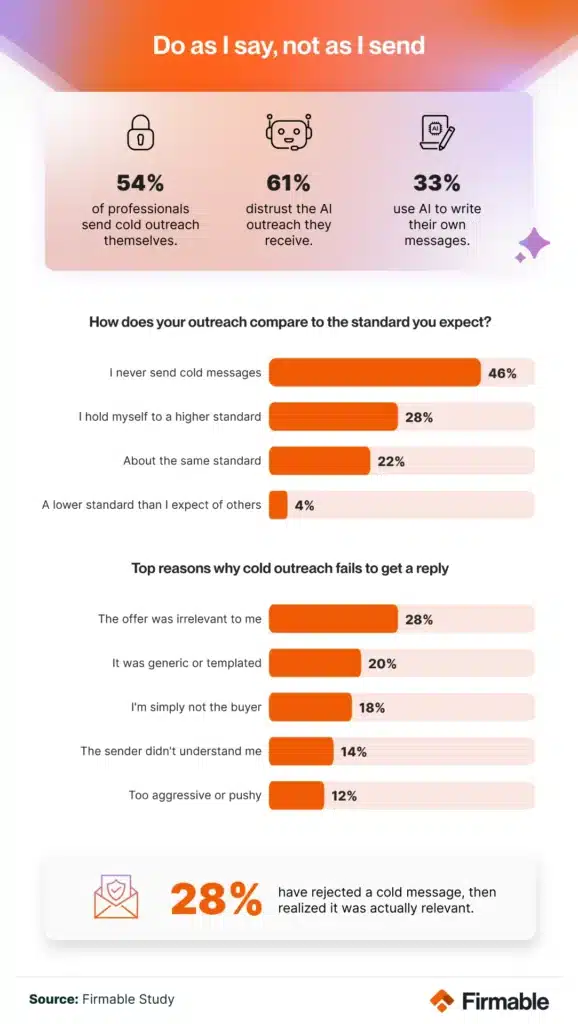
58% prioritize relevance or value when deciding whether to reply; 13% prioritize human authorship. The comparison comes from Firmable.
That gives marketers a more productive question than whether a message can pass as human. The useful test is whether the recipient can see a reason to engage. Teams can assess that independently of the writing method by asking reviewers to identify the offer, its relevance to the account, and the evidence supporting that relevance.
Firmable has a commercial interest in this interpretation. Its business provides sales intelligence, contact information and buying signals for prospecting. Its findings should inform questions for testing, rather than serve as proof that any particular vendor or targeting method improves results.
A reply can signal rejection
75% have blocked, muted or reported repeated outreach, and 38% have replied just to stop the messages. Both findings describe respondents' experiences, according to Firmable.
For teams reporting campaign performance, this is a reminder to inspect the meaning of a response. A dashboard that rewards every reply can place a request to stop alongside a request for a meeting. Those interactions imply very different outcomes for the brand.
A reply is evidence of a reaction. Its commercial value still needs to be established.
This creates a useful test for AI-assisted sequences: does the workflow recognize a negative response and change what happens next? Automating follow-ups without a reliable way to interpret rejection risks optimizing activity while obscuring its consequences.
The survey cannot establish how often that happens in a particular company's campaigns. It can justify an audit of how that company classifies responses and whether those classifications influence future contact.
What this means for marketers
The findings support a review of outreach quality and measurement, with clear limits on what a survey can prove.
Evaluate relevance before fluency. Ask what verified account information supports the message and why the offer belongs with that recipient. Review generated copy against those facts before treating polished language as evidence of quality.
Separate interest from resistance. Distinguish positive replies, neutral replies and requests to stop in campaign reporting. A higher response count is meaningful only when its composition supports the intended business outcome.
Test AI on recipient value. Compare how well different workflows establish relevance, avoid factual errors and earn qualified interest. Authorship alone is an incomplete basis for assessing whether outreach is useful.
Keep the evidence in proportion. The published methodology does not specify respondent geography, recruitment, weighting or fieldwork dates. Treat the findings as directional evidence from a vendor survey, rather than a universal benchmark for every market.
AI adoption makes it easier to ask how much communication a team can produce. Marketing leadership also needs a way to judge which communication deserves to be sent.
That responsibility belongs in the design of the workflow: the account criteria, the evidence behind the offer, and the treatment of recipient feedback. Writing quality becomes more valuable when those decisions are sound.