
Gemini 4 Argon scores 51.3% on AutomationBench
Google says Argon scored 51.3% on AutomationBench, showing why marketing teams still need review gates for autonomous workflows.


Google says Gemini 4 Argon reached a 51.3% score on AutomationBench, a benchmark designed to test whether AI agents can complete realistic work across business software rather than simply generate a plausible answer.
The company outlined the result in its Gemini 4 Argon announcement, positioning the model for long-horizon enterprise work. The more useful reading for marketing teams is not that Argon topped a leaderboard. It is that even the leading result leaves a large share of workflows incomplete.
Table of contents
Jump to each section:
- What the 51.3% score actually measures
- Why benchmark leadership still means incomplete workflows
- What marketers should know about autonomous AI workflows
What the 51.3% score actually measures
AutomationBench is built around end-to-end business tasks across areas including marketing, sales, operations, support, finance and HR. Agents work inside simulated business environments, and the benchmark checks whether they leave those systems in the correct final state.
That distinction matters because marketing automation often fails outside the text box. A model may write the right campaign summary but still update the wrong CRM record, omit a required field, select an incorrect audience, or stop before the workflow is complete.
51.3% Google reported this AutomationBench score for Gemini 4 Argon at launch, according to Google.
Google's launch comparison also placed Argon ahead of Claude Opus 5.5 and GPT-6 Astra on the same benchmark. Because AutomationBench is versioned and its task set can evolve, these figures are best read as a dated snapshot rather than a permanent ranking.
| Model | AutomationBench score in Google's launch comparison |
|---|---|
| Gemini 4 Argon | 51.3% |
| Claude Opus 5.5 | 42.5% |
| GPT-6 Astra | 41.4% |
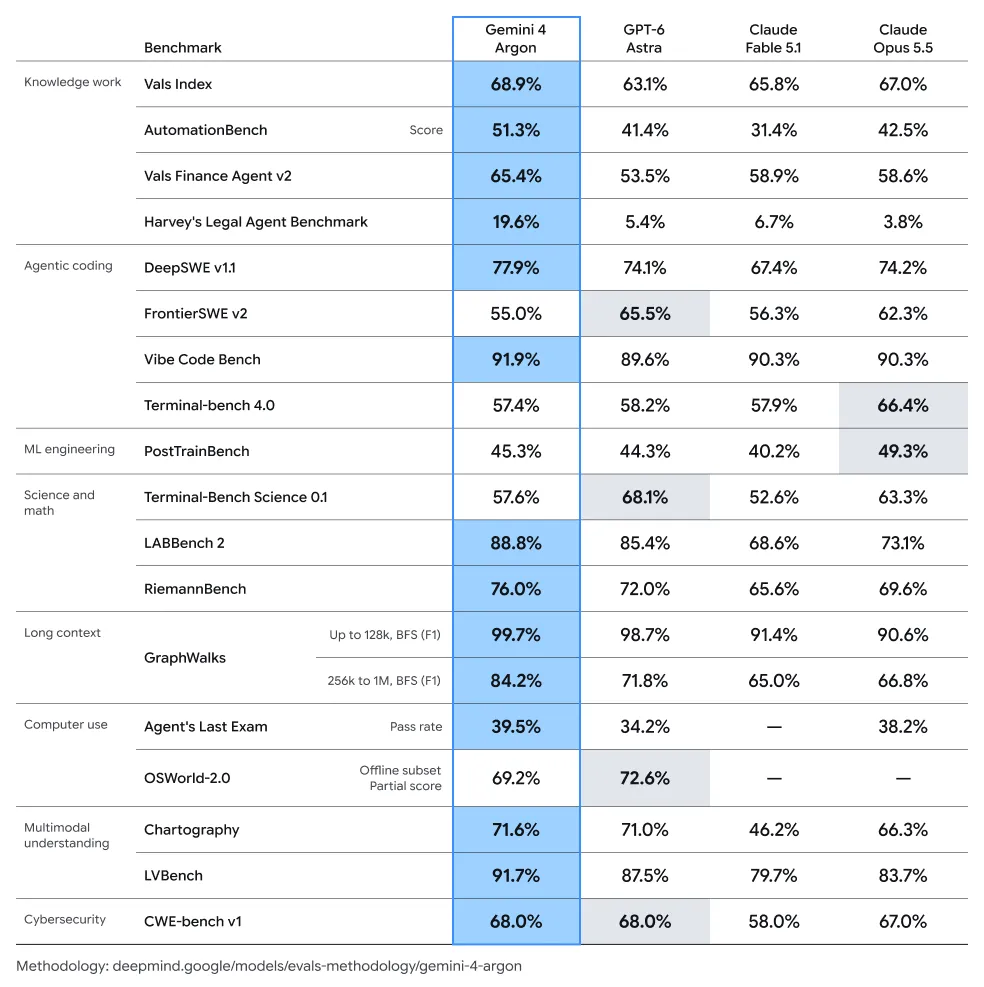
The benchmark itself also has an important limitation. It uses simulated SaaS tools so runs can be reproduced. That makes it useful for comparison, but it does not reproduce every permission model, data dependency, exception case or integration problem a marketing stack can introduce.

Why benchmark leadership still means incomplete workflows
The common assumption is that once a frontier model leads an agent benchmark, teams can begin replacing human-operated workflows. The contrasting reality is that a 51.3% pass rate still represents a system that does not fully complete a substantial share of benchmark tasks.
Leadership and reliability are different metrics.
For marketers, that changes how the benchmark should influence buying decisions. A team evaluating an AI agent for campaign operations should care about the percentage of representative jobs completed correctly, but also about which failures are recoverable, which require human approval, and which can silently change customer or campaign data.
Google's own rollout offers a useful example. The company says some large internal code migrations involving Argon undergo automated and manual auditing, testing and review before production deployment. Marketing teams do not need the same controls as a kernel migration, but the operating principle transfers: higher capability can justify more ambitious workflows, not fewer checks.
The cost question changes too. Google says Argon will start at US$2 per million input tokens and US$10 per million output tokens before rising to US$4 and US$20 after the introductory period. Argon also supports up to one million output tokens.
Those numbers make long-running tasks technically and economically easier to attempt. They do not make a failed workflow cheap.
The more useful unit is cost per correctly completed job. That can include model spend, reruns, human review, exception handling and the operational cost of fixing mistakes downstream.
What marketers should know about autonomous AI workflows
The practical question for marketing leaders is not whether Argon is capable enough to automate work. The better question is which parts of a workflow can tolerate imperfect execution.
Benchmark the job, not the model. Recreate the actual sequence your team uses, including approvals, handoffs and system writes. A general benchmark is evidence, not a substitute for testing your workflow.
Separate content quality from system accuracy. A persuasive campaign brief and a correctly updated CRM are different outcomes. Evaluate both.
Design for recoverable failure. Human approval gates matter most where an incorrect action affects customers, budgets, permissions or production data. Low-risk research and analysis can tolerate a different control model.
Track completion economics. Token pricing is easy to compare. Cost per successful workflow is harder, but closer to the real business decision.
The deeper shift is that frontier-model evaluation is moving from answer quality toward operational completion. That is especially relevant for marketing because the most valuable AI use cases increasingly span several systems rather than one prompt.
Argon's 51.3% result is meaningful because it shows progress on that harder problem. It is equally meaningful because it shows how much of the problem remains.
For marketing teams, the next stage of agent adoption will depend less on finding a model that looks intelligent in isolation and more on building workflows that know what to do when intelligence is not enough.