Rival Technologies finds Gen Z feels unseen, raising loyalty pressure
Rival’s Gen Z survey finds only 11% feel understood. Disengagement is high, and price and quality outweigh influencers as loyalty drivers.


Rival Technologies says only 11% of Gen Z consumers feel brands understand them “really well,” a gap the company frames as a direct risk to loyalty. The details were outlined in the company’s report download page.
The more telling signal is not dislike, but indifference: 64.5% of Gen Z respondents chose disengaged reactions like “Meh” or “I don’t care” when asked how brand messaging makes them feel. That is a loyalty problem disguised as a creative problem.
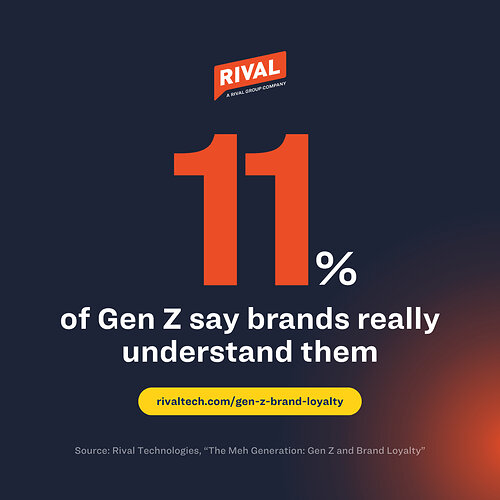
Table of contents
Jump to each section:
- What the study measured, and the headline numbers marketers can’t ignore
- Why “feeling understood” is becoming a loyalty multiplier
- What Gen Z says really drives loyalty (and what doesn’t)
- How the U.S. vs Canada split changes segmentation assumptions
- What marketers should know about earning Gen Z loyalty now
What the study measured, and the headline numbers marketers can’t ignore
Rival Technologies surveyed 903 Gen Z consumers across the U.S. and Canada in July 2026 using its AI-accelerated, mobile-first conversational research approach.
Three numbers shape the marketing implication:
Only 11% say brands understand them “really well.” Those who feel understood are about nine times more likely to be “unconditionally loyal” than those who feel misunderstood (45% vs 5%). And the dominant emotional response to brand messaging is disengagement (64.5%).
A concise way to put it: when most of your audience feels nothing, performance can look stable right up until it suddenly does not.
Another observation worth holding onto: loyalty is not only earned through product satisfaction. It is also earned through accurate self-recognition, when customers feel a brand “gets” their context.
 ContentGrip
Why “feeling understood” is becoming a loyalty multiplier
The common assumption is that loyalty is mainly a function of points, perks, and habit. The contrasting reality in this dataset is that loyalty tightens when consumers feel seen, and collapses when they feel misread.
That distinction matters because “understood” is not a brand value. It is an operational capability.
If a brand can consistently reflect back the right motivations, constraints, and tradeoffs customers are actually making, it earns permission to stay relevant even when alternatives are cheaper or louder. If it cannot, it may still win a transaction, but it loses the right to be a default.
A memorable observation: personalization that feels accurate builds loyalty faster than personalization that feels frequent.
Rival’s CMO, Paula Catoira, points to an approach that is less about guessing and more about letting Gen Z explain their choices “in the moment and in their own words.” Strategically, this reframes customer understanding from a quarterly research activity into an always-on feedback loop.
What Gen Z says really drives loyalty (and what doesn’t)
This study contains a corrective many brands will find uncomfortable: influencer recommendations ranked last among measured loyalty drivers, cited by 9% of participants.
Meanwhile, the top drivers were direct and utilitarian:
- Price and value: 82%
- Product quality: 80%
- Alignment with personal values: 36%
A useful tension emerges here. Many marketers have been trained to treat Gen Z as a “values-first” cohort. This dataset suggests the stronger baseline is “value-first,” with values as a secondary filter rather than the primary engine.
One more concise observation: creator reach can start attention, but it does not automatically convert into repeat purchase permission.
The list of “most loyal brands” respondents named (Apple, Nike, Costco/Kirkland leading a broader set that includes Adidas, Samsung, Amazon, Lululemon, CeraVe, and a tie among Starbucks, Uniqlo, Dove, Walmart) also hints at what loyalty looks like in practice: brands that combine familiarity, consistent product experience, and perceived value.
How the U.S. vs Canada split changes segmentation assumptions
Gen Z respondents in the U.S. were nearly three times as likely as those in Canada to say brands understand them “really well” (17% vs 6%), and about twice as likely to be unconditionally loyal.
It is tempting to treat this as a simple “market maturity” story, but the more interesting question is what it does to your segmentation logic. If “feeling understood” varies this much between neighboring markets, then any North America-level persona that assumes a uniform emotional relationship to brands is likely too blunt.
Another nuance: negative reactions to brand messaging increased with age, rising from 22% among 18 to 20-year-olds to 34% among 25 to 29-year-olds, while disengagement stayed high across age groups. In other words, indifference is the floor, and skepticism rises with experience.
A concise observation: if your messaging does not earn relevance early, your audience does not just tune out, it learns to distrust.
What marketers should know about earning Gen Z loyalty now
This research frames loyalty less as a “brand love” outcome and more as a measurable response to whether customers feel accurately understood.
1) Treat disengagement as a signal of misfit, not a creative failure
When “Meh” dominates, the issue is often message-to-context mismatch. The fix starts with diagnosing what customers are trying to accomplish, not rewriting taglines.
2) Rebalance loyalty strategy toward value and product confidence
With price/value (82%) and quality (80%) leading, loyalty programs and campaigns should reinforce concrete tradeoffs: durability, consistency, total cost, and reliability. Values messaging can support, but it should not be the only pillar.
3) Stop over-assigning loyalty outcomes to influencer spend
Influencers can drive awareness and trial, but this dataset suggests they are weak as a direct loyalty lever on their own. Loyalty work sits closer to product experience, pricing architecture, and credibility over time.
4) Segment Gen Z by life stage and market context, not just generation
The age-based rise in negativity and the U.S. vs Canada split both argue for sharper cohorts. “Gen Z” is not a sufficient brief if the emotional baseline differs by country and age band.
5) Invest in mechanisms that let Gen Z explain “why,” not just choose “what”
Rival’s emphasis on conversational, in-the-moment feedback is a reminder that the richest loyalty insights sit behind the checkbox. The teams that win will be the ones that can capture intent and constraint continuously, then reflect it back in product and messaging.
Over time, loyalty will look less like a points economy and more like an understanding economy. Brands will still compete on price and quality, but the differentiator will be who can correctly interpret shifting context without overreacting to noise.
That shift also changes what “brand strategy” means day to day. It becomes a coordination problem across research, product, pricing, and comms, with customer understanding as the shared operating system.
The simplest competitive edge is not louder messaging. It is fewer wrong assumptions.