
Google is quietly paying publishers when their content shapes AI answers
Google is reportedly paying select publishers whose content helps generate AI answers, but the formula behind those payments remains opaque.


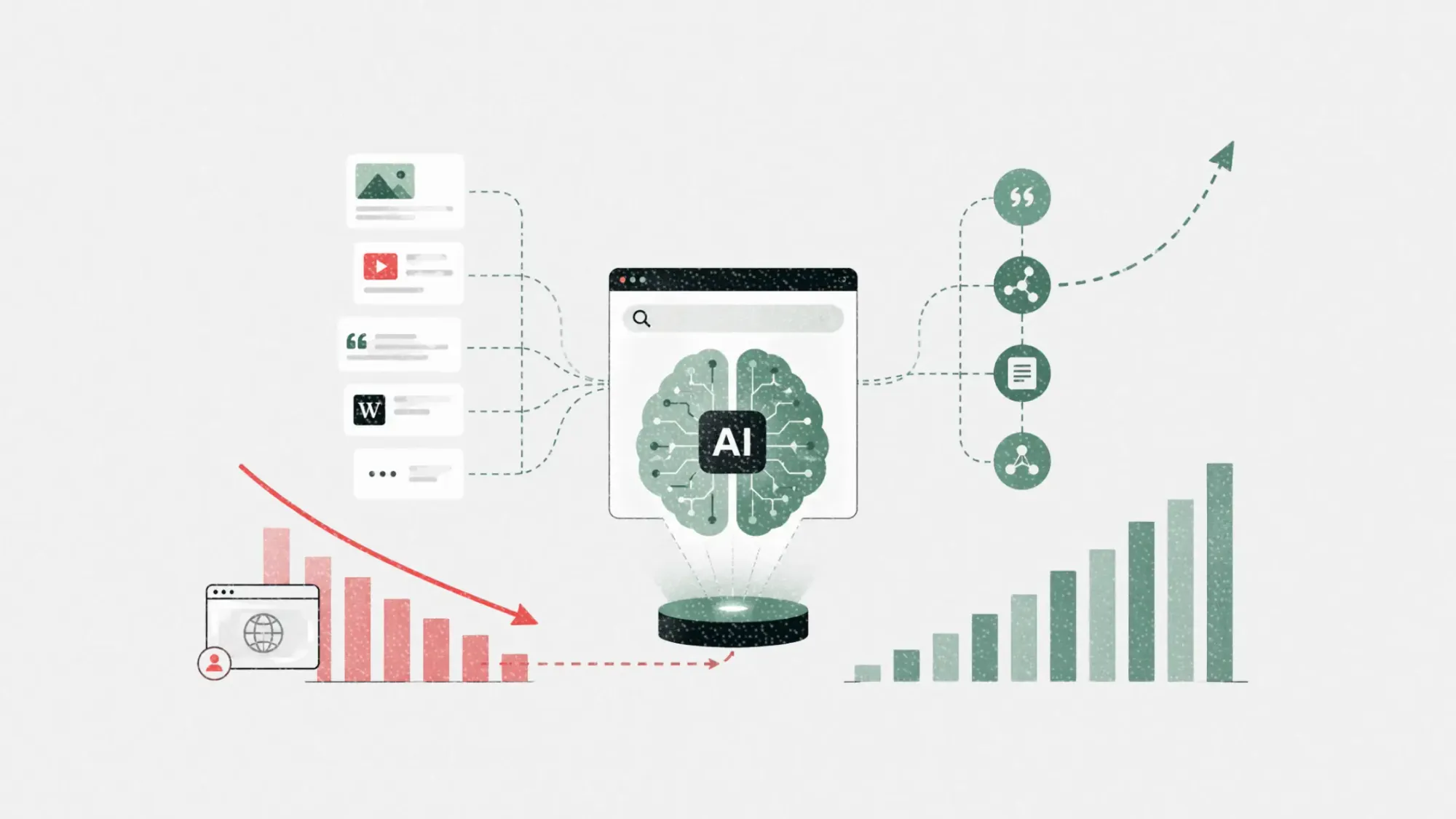
Publishers have spent the past two years watching AI answers absorb information from the open web while the economics around that use remained unsettled. Now, according to Digiday, Google is reportedly paying some publishers when their content "significantly" contributes to AI-generated responses. Google confirmed to Digiday that the effort is an early-stage learning pilot, but it has not publicly announced the payment formula, eligibility criteria, or a broader rollout.
That makes this a different side of the same zero-click shift ContentGrip examined when publishers started buying search traffic they once earned organically. The new pilot should not be read as compensation for lost clicks because the reporting does not establish that link. What it does suggest is that Google is experimenting with a separate economic value for content that helps generate an AI answer, even when referral traffic is not the outcome.
Table of contents
Jump to each section:
- What Google's AI contribution pilot appears to be
- Why significant contribution is the whole question
- What payments change about AI visibility
- What content teams should do now
- What the pilot still does not settle
Key Takeaways
- Google is reportedly testing payments to selected publishers whose content materially helps generate AI answers.
- The payout formula, eligibility rules, and definition of meaningful contribution remain undisclosed.
- Content teams should track AI visibility now, but should not rebuild strategy around an unpublished payment model.
What Google's AI contribution pilot appears to be
The reported pilot sits inside Search Console rather than a separate licensing dashboard. Participating publishers receive an AI earnings widget that shows a monthly earnings figure and some historical information, while the underlying calculation is not shown. Search Engine Land reported that the test covers content used across AI Mode, AI Overviews, and Gemini and is limited to a group of publishers.
The important distinction is what Google appears to be valuing. Search Engine Journal reported that qualifying content contributes to generating an answer, while a page that is simply linked after an answer has been generated does not qualify on that basis. That means a visible citation and a paid contribution may overlap, but they are not necessarily the same event.
This is also not a publicly launched publisher program. Google has publicly rolled out AI visibility reporting and controls in Search Console, but those announcements did not disclose the payment terms described in the current reporting. For now, the safest description is a limited, reported licensing experiment whose mechanics are still mostly private.
Why significant contribution is the whole question
The phrase "significantly contributes" determines whether the model becomes commercially useful or merely interesting. Publishers do not know what threshold Google applies, how contribution is attributed across multiple sources, how different types of content are valued, or why one contribution might be worth more than another. Google controls the measurement system, decides what qualifies, and sets the price.
That asymmetry makes forecasting difficult. A publisher can see an earnings number without seeing the inputs that produced it, which means there is no reliable way to model revenue or decide which editorial investment would improve it. AdExchanger described the reported approach as a black box, a useful characterization of the core operating problem rather than a judgment about whether the pilot will ultimately pay enough to matter.
For content teams, the practical danger is optimizing too early. If the weighting changes, if eligibility stays selective, or if Google values contribution in ways that do not map neatly to citation counts, a content strategy built around today's assumptions could become obsolete before the pilot becomes a real program.
What payments change about AI visibility
AI citations have mostly been treated as a visibility metric: a sign that a brand or publisher is appearing inside answers even when the user does not click through. ContentGrip's guide to SERP features and AI Overviews already treats visibility and referral traffic as separate outcomes. The contribution pilot adds a possible third outcome: direct economic value attached to helping produce the answer itself.
That changes the internal case for GEO and AEO work, but only cautiously. If paid contribution becomes measurable at scale, content teams may eventually be able to connect source authority to revenue rather than just brand visibility. Until Google exposes more detail, however, citation tracking remains a proxy, not a payout model.
The APAC context is also worth watching. In India, Google and JioStar have launched a campaign that integrates AI Search features into mainstream Hindi television dramas, according to The Economic Times. That campaign does not indicate publisher eligibility for the contribution pilot, but it shows Google pushing AI Search into mass-market consumer use at the same time that it experiments with new publisher economics.
What content teams should do now
- Check Search Console. If your property has access to AI contribution reporting, document what appears and how it changes over time.
- Track AI citations as a standing metric. Measure where your content is cited or surfaced across major answer engines, but keep citation visibility separate from any reported contribution earnings.
- Do not restructure around an unpublished formula. There is not enough information to know which editorial patterns, formats, or topics Google values financially.
- Keep licensing and traffic separate. A payment for contributing to an AI answer does not restore a referral visit, and current reporting does not say the pilot is designed to replace lost traffic.
- For brands, focus on source value. Even without publisher payments, content that becomes a trusted input to AI systems can influence how products, categories, and expertise are represented in answers.
What the pilot still does not settle
The largest unknown is scale. There is no verified public payout schedule, no disclosed eligibility threshold, no complete list of participants, and no evidence yet that the economics are large enough to become a dependable publisher revenue stream. A pilot can also change substantially before it becomes a product, or end without becoming one.
It also does not solve the bargaining question. Publishers still have limited visibility into how Google assesses contribution, and a selective invitation model gives them little basis for comparing terms. The more important precedent may simply be that content used to construct an AI answer can have a price attached to it.
ContentGrip takeaway: AI citations are becoming a revenue line, not just a visibility metric. The problem is that only one party knows how the line is calculated.