Google introduces a new AI shopping protocol
Google’s UCP could make agent-based shopping the new normal. Here’s what brands and marketers should know

Agent-powered commerce is no longer just a future-facing concept. At this year’s National Retail Federation (NRF) conference, Google introduced the Universal Commerce Protocol (UCP), an open standard designed to let AI agents manage every part of the shopping journey.
Supported by Shopify, Etsy, Wayfair, Target, and Walmart, UCP aims to remove the friction between brands and customers by allowing AI agents to work across discovery, checkout, and post-purchase flows without custom integrations.
This article explores what UCP and Google’s broader AI play mean for marketers, especially those navigating the shift toward agent-first digital commerce.
Short on time?
Here’s a table of contents for quick access:
- What is Google’s Universal Commerce Protocol
- Google expands AI presence with Gemini Enterprise for CX
- What marketers should know about agentic commerce
 Patrecia Meliana
What is Google's Universal Commerce Protocol
UCP is a new open framework that allows AI agents to interact with retailers, platforms, and payment providers using a shared language. Instead of creating individual connections for every agent, brands can adopt UCP to enable cross-platform functionality at scale.
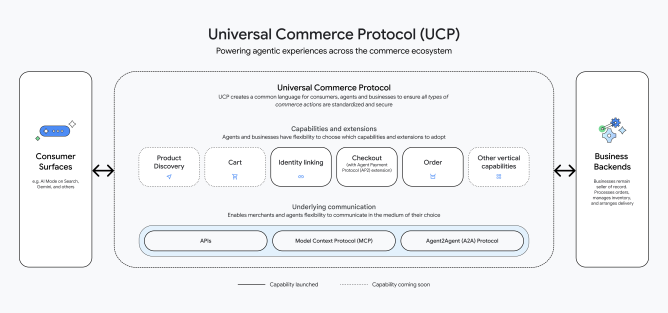
Developed with major players like Shopify, Target, and Walmart, and endorsed by over 20 companies including Stripe, Visa, and Macy’s Inc., UCP is designed to work with existing standards such as Agent Payments Protocol (AP2), Agent2Agent (A2A), and Model Context Protocol (MCP).
In practical terms, Google will begin using UCP on eligible product listings in AI Mode on Search and in the Gemini app. Shoppers will be able to complete purchases directly within these experiences using Google Pay or, soon, PayPal. Shipping info from Google Wallet carries over automatically, and the retailer retains control as the seller of record.
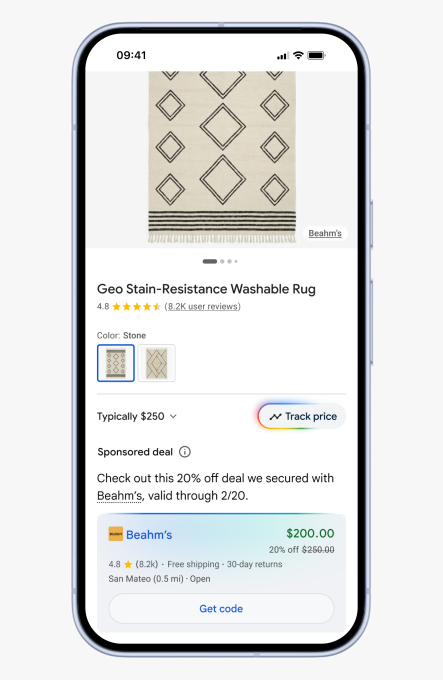
Google also introduced a new ads pilot called Direct Offers. This allows brands to deliver exclusive discounts in real time when a shopper expresses clear intent, such as searching for a product with specific needs.
Google expands AI presence with Gemini Enterprise for CX
To power this new era of agentic commerce, Google also unveiled Gemini Enterprise for Customer Experience (CX), a full-stack AI solution that unifies product discovery and customer service into a single intelligent platform.
The system includes configurable agents built on Google’s latest Gemini models. These agents can be deployed quickly and handle everything from answering product questions to building carts or resolving customer issues across channels.
Early adopters like Kroger, Woolworths, and Papa John’s are already using the CX suite. Meanwhile, retailers like Lowe’s and Reebok are testing Google’s new branded Business Agent. This tool lives in Google Search and acts like a virtual sales rep, answering product questions and even enabling direct checkout.
Google is also supporting content generation through partnerships with brands like Authentic Brands Group, which now uses Gemini to automate creative asset production for labels like Reebok and Nautica. In early tests, AI-enhanced ads produced a 60 percent higher return on ad spend.
What marketers should know about agentic commerce
As AI agents take center stage, marketers must rethink how to stay visible, relevant, and effective in this new commerce model. Here are four key considerations:
1. Merchant data optimization will determine discoverability
Google is rolling out new product attributes within Merchant Center to improve AI discoverability. Brands must now supply enriched data such as answers to common questions, compatibility details, and relevant product pairings. These signals help agents surface your products when shoppers ask nuanced or conversational queries.
2. Expect the funnel to compress
With UCP and Business Agents, customers may go from discovery to purchase in a single AI interaction. Traditional marketing stages are collapsing, so every branded touchpoint needs to convert, not just inform.
3. Use Direct Offers to nudge action in the moment
With Google's AI now capable of identifying high-intent shopping scenarios, brands can deploy real-time promotions to accelerate decisions. Marketers should experiment with Direct Offers to turn discovery into purchase when the timing is right.
4. Train your AI agent like a brand rep
Business Agent allows retailers to show up in Google Search with a customized voice. Marketers should treat these AI assistants like human sales associates: train them to reflect your brand tone, understand inventory, and support upsell opportunities.
Google’s Universal Commerce Protocol is a major step toward mainstreaming agentic commerce. By enabling scalable AI interoperability and pairing it with powerful new tools like Gemini Enterprise, Google is changing how—and where—shopping happens.
For marketers, the implications are clear. AI agents are quickly becoming both the gateway and the guide to product discovery. Brands that prepare now will be the ones who win when AI becomes the default shopping interface.