Google opens Search profiles to publishers with 10,000 followers
Google has lowered the Search profile threshold and added multi-brand management, giving U.S. publishers another controlled surface across Search and Discover.


Google has lowered the eligibility threshold for Search profiles to 10,000 followers, making the feature available to a wider group of U.S. publishers and creators. The company also added multi-brand management from one login and redesigned how articles appear on profile pages.
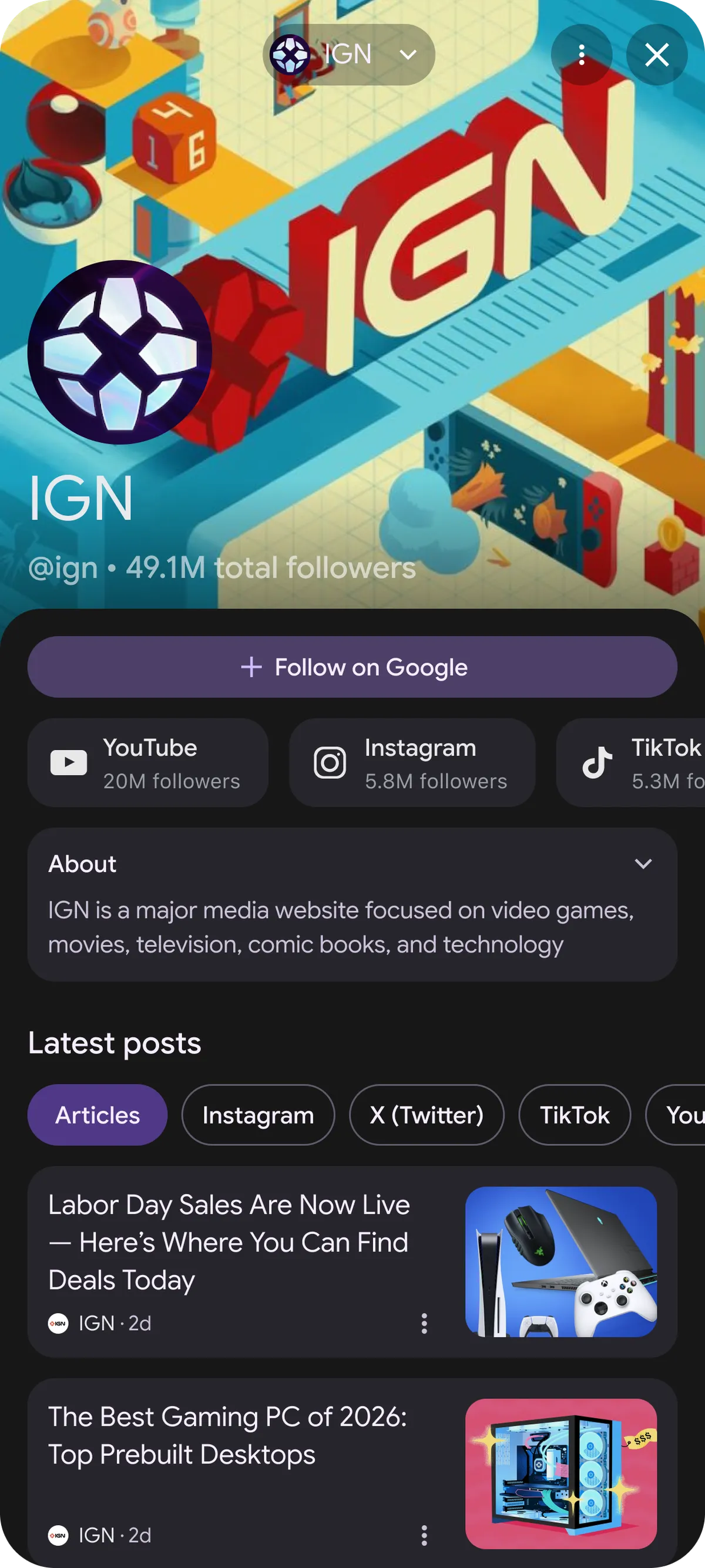
The changes make Search profiles more useful as a publisher-controlled identity and distribution surface rather than a decorative extension of a knowledge panel. A profile can bring together articles, social accounts, videos and links, while giving readers a way to follow a publication and potentially see more of its content in Discover.
Table of contents
Jump to each section:
- The 10,000-follower threshold broadens access
- Multi-brand management removes an operational hurdle
- Search profiles create a controlled layer inside Google
- Discover exposure is possible, not guaranteed
- The rollout remains limited to the United States
Key Takeaways
- Google has lowered Search profile eligibility to 10,000 followers across four supported social platforms.
- Publishers can manage profiles for multiple brands from a single login.
- Following may increase a source's visibility in Discover, but Google has not published traffic-lift data.
The 10,000-follower threshold broadens access
Google's latest Search profile update says publishers and creators can qualify based on their audience on YouTube, Instagram, X or TikTok. The wording applies the same threshold to both groups rather than setting separate criteria for media brands and individual creators.
10,000 followers is the new eligibility threshold across YouTube, Instagram, X or TikTok, according to Google.
That is a substantial reduction from the feature's earlier, more restrictive entry point. It gives mid-sized specialist publications and creator-led media brands a more realistic path to claiming a verified presence, provided they meet Google's other requirements.
Multi-brand management removes an operational hurdle
The update also lets media organizations claim and manage profiles for multiple publications through one login. For groups running several vertical titles, the change reduces the need to switch between accounts to maintain profile details and connected channels.
This matters because publisher portfolios rarely map neatly to one corporate identity. A group may operate separate news, lifestyle and trade brands, each with its own audience and social footprint. Centralized administration makes the feature more practical for those organizations without collapsing their brands into a single profile.
Google has also lengthened visible headlines and improved thumbnail treatment on article cards. Those design changes give publishers more room to communicate what a story is about before a reader clicks.
Search profiles create a controlled layer inside Google
A Search profile is a verified page where a publisher or creator can consolidate articles, videos, social posts and links. Users may reach it through a knowledge panel, from Discover or through a direct URL.
That makes the profile one of the few surfaces inside Google's ecosystem that a publisher can actively shape. It does not replace a website or an owned subscriber channel, but it can give people a clearer route from a brand search to recent work and verified social accounts.
The distinction from a knowledge panel is important. Google's documentation explains that Search profiles can be accessed through knowledge panels, but it does not say that claiming a profile changes eligibility for a knowledge panel. Publishers should treat the profile as an additional managed layer, not as a shortcut into Google's entity systems.
Discover exposure is possible, not guaranteed
Google's Search profile help documentation says creating a profile does not directly affect how content ranks in Search. If a user follows a publisher, however, that person may see more of the source's content in Discover.
The wording is deliberately conditional. Google has not disclosed adoption figures for Search profiles, nor has it shared data showing how much Discover traffic participating publishers receive. Publishers therefore have a reason to claim the feature, but not enough evidence to forecast a referral lift.
The practical value may be less about immediate traffic and more about preserving a recognizable identity across Google's surfaces. As conventional search referrals face pressure from richer results and AI-generated answers, a followable publisher page creates another route for maintaining audience recognition inside the platform.
The rollout remains limited to the United States
Google's current documentation says Search profiles are available only in the United States. Publishers elsewhere, including those in Asia-Pacific markets, cannot yet assume that they can claim a profile even if their social following clears the threshold.
For eligible U.S. publishers, the immediate task is straightforward: verify whether the publication qualifies, connect the relevant social accounts and decide who owns profile maintenance across brands. For international media groups, the update is worth monitoring because the multi-brand model appears designed for organizations that will eventually need to manage profiles across a broader portfolio.
Search profiles will not solve publishers' dependence on platform distribution. They do, however, give eligible media brands a more coherent and controllable presence at the point where Search identity and Discover distribution meet.