Hinge tackles dating fatigue with AI
The dating app just launched “Convo Starters,” an AI feature to end message dead-ends. Here's how it reflects broader UX trends.

Let’s face it. Small talk is killing the vibe on dating apps. Hinge thinks it has a fix. On Hinge, where most users say they’re looking for serious relationships, conversations still struggle to gain momentum. While matches typically exchange only 10 to 20 messages before deciding whether to meet, engagement jumps sharply when prompts feel more personal—profiles with video prompts see 50% more interaction than text alone, suggesting generic openers often fail to spark sustained conversation.
Hinge thinks it has a fix. The app’s newest feature, “Convo Starters,” uses AI to help users break the ice with tailored conversation suggestions, nudging people beyond the usual “How are you?” and into something more meaningful.
This article explores how Hinge’s new AI feature reflects broader shifts in UX design, the use of AI for human-centric personalization, and why B2C marketers, especially those in app-based businesses, should pay attention to how behavior-driven AI can be deployed with nuance.
Short on time?
Here’s a table of contents for quick access:
 Patrecia Meliana
What is Convo Starters
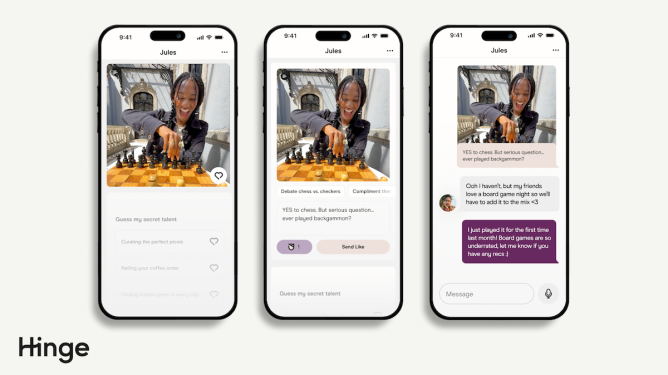
Hinge’s “Convo Starters” is a new AI-powered feature that provides users with personalized suggestions to initiate conversation after liking someone’s profile. Instead of waiting for users to draft that awkward first message, the feature scans the potential match’s photos and prompts, then suggests three conversation kickoffs under each one. For example, if someone’s photo shows them playing chess, Hinge might suggest starting a conversation about board games.
The feature was built in response to a key user pain point. Matches that go nowhere. According to Hinge, users are twice as likely to go on a date when a like is paired with a message. Their internal research also showed that 72% of daters are more likely to consider a match when it includes a message.
Convo Starters follows Hinge’s January rollout of “Prompt Feedback,” another AI-driven feature that offers personalized advice on how users can improve their profile prompts. That update encouraged users to be more specific, leading to less generic profiles and more engaging conversations. In June, Hinge also teamed up with psychologist Esther Perel to launch “Your World,” a set of new prompts designed to elicit deeper answers and foster compatibility.
Why Hinge is betting on AI-led personalization
This is all part of a broader product evolution from Hinge’s parent company, Match Group, which has allocated between US$20 million to US$30 million toward AI innovation in 2025.
But it’s not just about features. It’s about fixing broken behavior loops. In many dating apps, users get stuck in what Hinge calls the “infinite scroll,” driven by superficial swipes and poor-quality matches. By injecting contextual AI into the moment a user is about to send a message, Hinge is addressing user inertia directly in the flow of action.
What’s also notable is how carefully the company is integrating AI into an emotionally sensitive product. Instead of letting AI take over the conversation, Hinge’s approach is to suggest ideas that users can use in their own voice. This subtle UX framing is intentional and may explain why Hinge is positioning AI more as a confidence booster than a replacement for human interaction.
Still, user skepticism remains, especially among Gen Z. According to Bloomberg Intelligence, Gen Z users feel more uneasy than older generations when it comes to AI involvement in dating apps, particularly with drafting prompts or messages.
What marketers should know
Hinge’s AI rollout reveals several lessons for product marketers, UX strategists, and behavioral designers.
1. AI works best when it supports, not replaces
Unlike tools that fully automate replies or profile creation, Hinge’s Convo Starters act more like a nudge than a takeover. This gives users a sense of control while still benefiting from AI. Marketers designing AI into consumer experiences should consider how assistive UX can feel more empowering than generative UX.
2. Micro-frictions are the new battleground
Hinge’s move is a case study in solving for micro-friction, the tiny moments where users stall, hesitate, or drop off. For dating apps, that moment is after a like but before a message. For marketers, it might be the scroll after a CTA or the delay in cart checkout. Applying behavioral AI to these small pain points can unlock major gains.
3. Personalization isn't just about content. It’s about timing
What makes Convo Starters feel useful is that it appears at the moment of intent. This kind of just-in-time personalization is more likely to land than generic onboarding or passive suggestions. Marketers should think about when to surface personalized nudges to actually drive action.
4. AI ethics will shape user trust
Even if the AI works well, perception matters. As more users voice concern about AI in sensitive contexts like dating or mental health, marketers will need to strike a balance between utility and transparency. Hinge’s strategy shows a possible playbook. Give the user the final say, don’t hide the AI, and invite feedback loops to improve performance over time.
Hinge’s Convo Starters may seem like a niche dating app feature, but it’s part of a much bigger pattern. AI is moving into the micro-moments of user interaction, and doing so with greater personalization and restraint.
For marketers, especially those building consumer apps, this is a moment to study. If AI can improve small talk on a dating app without sounding robotic, it might just be able to help reduce friction in your funnel too.