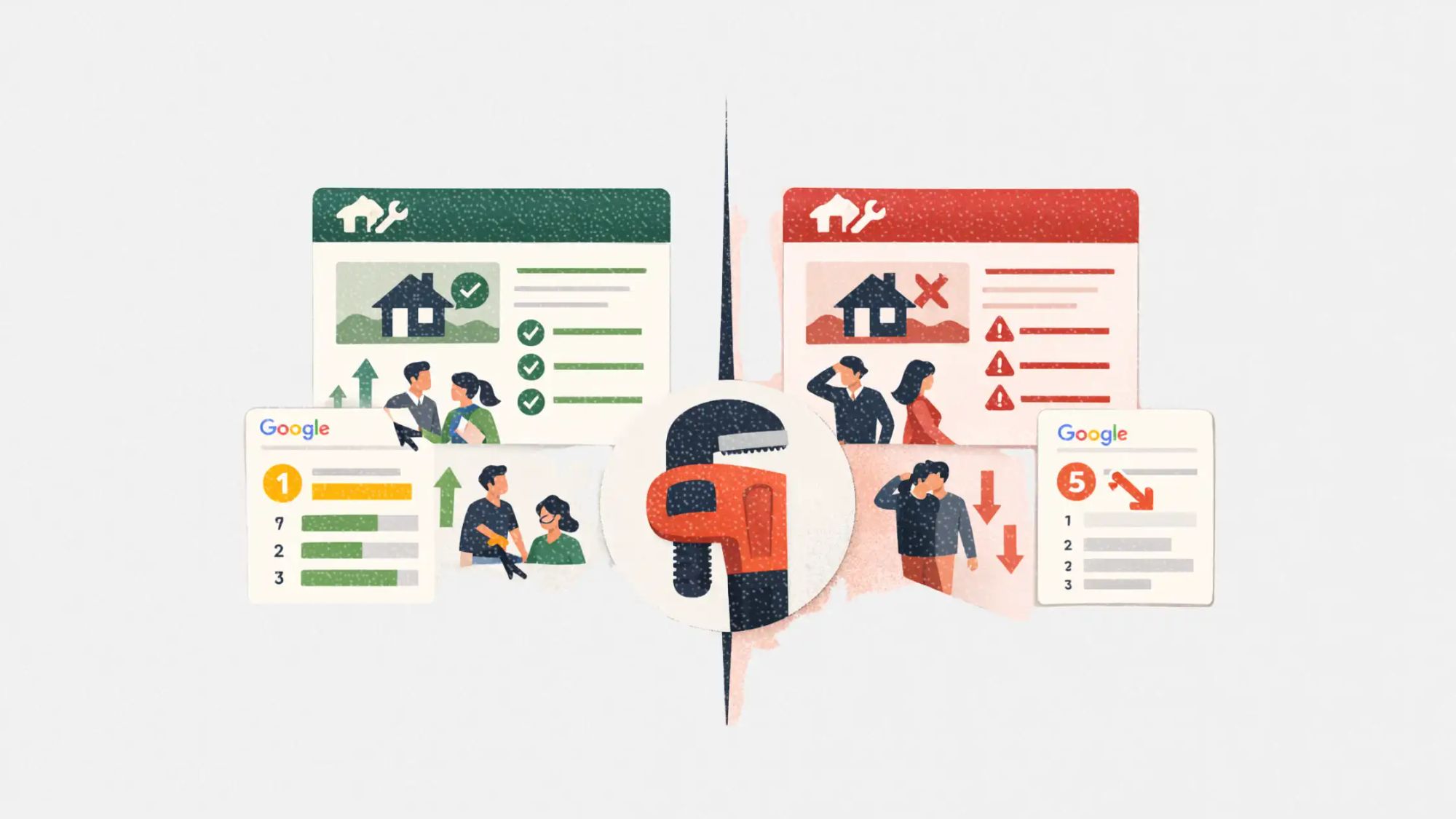
Your website is either working for your home services business or against it — here is how to tell
How website structure, speed, and SEO impact leads, visibility, and long-term growth for home service businesses

Home service businesses — plumbers, electricians, HVAC technicians, landscapers, roofers — have historically built their client base through referrals, repeat customers, and word of mouth. For decades, that was enough. A good reputation in a neighborhood or town could sustain a business indefinitely without a single dollar spent on digital presence.
That model still works, but it no longer works alone. The way people find and evaluate service providers has shifted fundamentally. When a pipe bursts or an HVAC system fails in the middle of summer, most homeowners do not call the person their neighbor recommended two years ago. They open a browser, type a few words, and call whoever appears at the top of the results. If your business is not there, it does not exist in that moment — regardless of how good your work is or how long you have been operating.
This is the gap that a functional, well-structured website is designed to close.
The first impression happens before the phone rings
For most home service businesses, the website is the first interaction a potential client has with the company. Not a referral, not a review, not a conversation — a website. That interaction happens in seconds, and the judgment formed in those seconds is difficult to reverse.
Research on user behavior consistently shows that visitors decide within a few seconds whether to stay on a page or leave. In the home services context, that means a potential customer looking for an emergency plumber or a seasonal HVAC checkup is making a quick assessment: does this business look credible, can I easily find what I need, and can I contact them without friction?
A website that fails any of those three criteria loses the visitor — and likely sends them to a competitor who passes all three.
What separates a functional website from a decorative one
There is an important distinction that many business owners miss when thinking about their website: the difference between a site that looks professional and a site that performs professionally. These are not the same thing, and confusing them is one of the most common and costly mistakes in home services marketing.
A visually polished website with high-quality photos, modern typography, and clean layout can still be functionally ineffective. If it loads slowly on a mobile device, buries the contact information, lacks clear descriptions of services and coverage areas, or is structured in a way that search engines cannot read properly, it will underperform a simpler site that gets the basics right.
The most effective home services website design prioritizes function alongside form. That means fast load times — particularly on mobile, where the majority of local searches now originate. It means a prominent and easy-to-use contact mechanism on every page, whether that is a phone number, a callback request form, or a booking tool. It means clear, specific language about what services are offered and where, rather than vague descriptions that could apply to any business in any location.
It also means thinking about the visitor's intent. Someone searching for an emergency service has different needs than someone planning a home renovation months in advance. A well-structured website anticipates both and provides clear pathways for each.
How website structure affects search visibility
Beyond the user experience, website structure has a direct effect on how the site performs in search results. This is where many home service businesses fall behind without realizing it.
Search engines read websites the way a very literal reader would — systematically, looking for signals about what the site is about, who it serves, and whether it is trustworthy. A site that has all services listed on a single page, with no clear hierarchy, minimal written content, and no location-specific information gives search engines very little to work with. A site that has dedicated pages for each service, uses clear headings, includes relevant location references, and is regularly updated gives search engines much more to index and rank.
Effective SEO for home services is not a separate layer applied on top of a finished website — it is built into the structure from the beginning. That includes how pages are organized, how content is written, how images are labeled, how the site links internally between pages, and how the site presents its information to both visitors and search crawlers.
The cost of delaying SEO investment
One of the most common patterns in home services businesses is treating SEO as something to address later — once the business is larger, once there is more time, once the busy season is over. This reasoning is understandable, but it creates a problem that compounds over time.
Search rankings are not built overnight. They develop over months of consistent effort: publishing relevant content, earning backlinks from credible sources, maintaining accurate business listings, collecting reviews, and keeping the website technically sound. Every month that passes without this foundation in place is a month that competitors are building theirs.
A business that begins this work early holds a structural advantage that is difficult for later entrants to overcome quickly. Conversely, a business that waits two or three years to invest in SEO will spend considerable time and resources simply catching up to competitors who started earlier — before they can begin pulling ahead.
The practical starting point does not require a large budget. It requires clarity about what services you offer and where, a website that communicates that clearly, a complete and maintained Google Business Profile, and a consistent approach to collecting and responding to customer reviews. These fundamentals, applied consistently, form the foundation that everything else builds on.
Paid advertising and organic search are not competing strategies
Many home service business owners operate under the assumption that they must choose between paid advertising and organic search — that one replaces the other. In practice, they serve different purposes and work better together than either does alone.
Paid advertising — Google Local Services Ads, pay-per-click campaigns — can generate leads quickly and is useful for filling gaps in a calendar or testing new service offerings. But it stops the moment the budget runs out. There is no residual benefit, no compounding return, no long-term asset being built.
Organic search works the opposite way. It is slower to produce results but creates a durable asset over time. A website that ranks well for relevant searches continues to generate leads without ongoing spend. Reviews that have been collected over years continue to influence purchasing decisions. Content that was published eighteen months ago continues to bring in visitors.
The most effective home services businesses use both, but they understand the difference. Paid advertising is a short-term tool. Organic search and website quality are long-term investments. Businesses that invest in the foundation first tend to see better returns from paid advertising when they do run it, because the underlying site converts traffic more effectively.
Before spending more, audit what you already have
If the website is underperforming — high bounce rates, low time on page, few form submissions or calls relative to traffic — the answer is rarely to spend more on advertising. More traffic sent to a site that does not convert well produces more of the same result at higher cost.
The more productive approach is to audit the existing site honestly. Is it loading quickly on mobile? Is the contact information easy to find? Does each service have its own dedicated page with clear, specific content? Is the site appearing in search results for the terms potential customers are actually using?
These questions do not require a technical background to ask. The answers, however, often reveal opportunities that are both significant and addressable without major investment. A website that loads two seconds faster, makes the phone number easier to find, and adds two or three well-written service pages can meaningfully change its performance — and in the home services industry, where a single new customer relationship can be worth thousands of dollars over time, that change has real financial consequences.
The website is not the whole story of a home services business. But it is increasingly the first chapter — and first chapters determine whether people keep reading.