India proposes AI royalty system for copyrighted content
India’s proposed copyright royalty framework could change how AI models are trained and who gets paid.

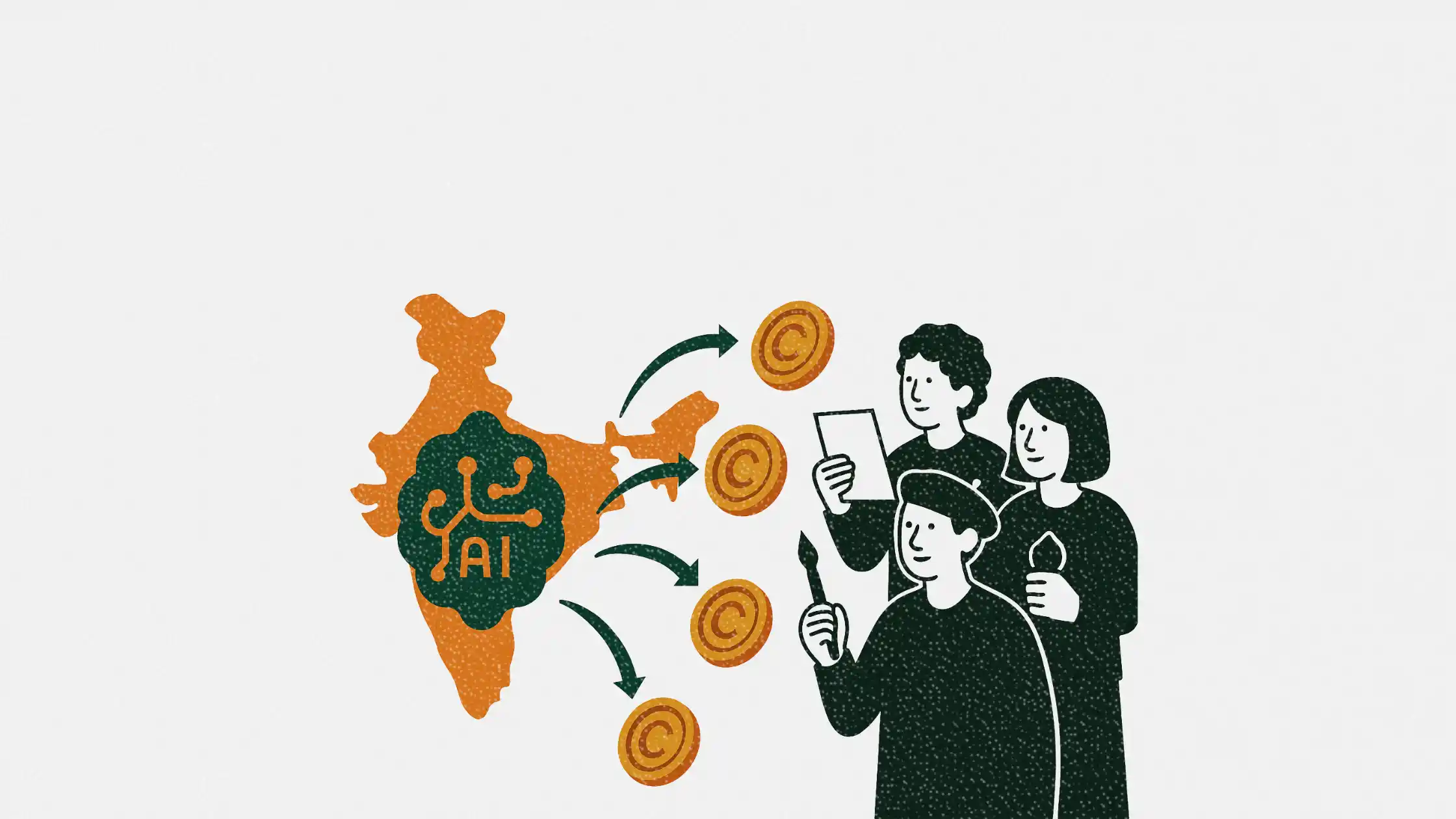
India’s new copyright framework could force OpenAI, Google, and other AI firms to pay up
India is taking a bold swing at generative AI regulation. A government-backed proposal released this week outlines a new framework that would require AI firms to pay royalties for training their models on copyrighted content. If adopted, the move could reshape how companies like OpenAI, Google, and Microsoft operate in one of their most critical and fastest-growing markets.
Unlike approaches in the U.S. and European Union, which hinge on transparency or fair use debates, India’s model favors intervention. It offers automatic access to all copyrighted works in exchange for mandatory royalties paid to a central collecting body. This article explores what the proposal entails, the legal and industry context behind it, and why marketers, tech leaders, and rightsholders should be paying attention.
Short on time?
Here’s a table of contents for quick access:
- What is India’s AI copyright licensing proposal?
- Why this matters in the global AI debate
- What marketers should know
 Patrecia Meliana
What is India's AI copyright licensing proposal?
On Tuesday, India’s Department for Promotion of Industry and Internal Trade (DPIIT) released a proposed framework that introduces a “mandatory blanket license” for AI training. Under the plan:
- AI firms would get automatic access to copyrighted content for model training
- In return, they must pay royalties to a central collecting body
- The body would distribute funds to creators, including those who aren’t formally registered
The eight-member committee behind the framework argues this would cut transaction costs, resolve legal ambiguity, and ensure creators—authors, musicians, journalists, and visual artists—are compensated when their work is scraped to train AI models.
OpenAI CEO Sam Altman’s earlier comment that India is the company’s second-largest market is cited as part of the rationale. With AI firms profiting from Indian users and creators, the proposal argues it’s time for value to flow back.
Why this matters in the global AI debate
Globally, lawsuits over AI’s use of copyrighted content are piling up. News agencies have sued OpenAI in India, and creators across the U.S. and Europe are challenging AI firms in court. But while Western regulators are still sorting out whether AI training counts as fair use, India is fast-tracking a licensing-first approach.
This proposal is one of the most aggressive moves globally to force commercial GenAI systems to pay rights holders. Rather than waiting years for courts to decide, India is positioning itself as a market that rewards creators upfront while giving AI developers legal clarity.
The government argues that a broad text-and-data-mining (TDM) exception or an opt-out system—like what’s being discussed in the EU—would be ineffective and hard to enforce. Instead, the committee is pushing a “hybrid” model that guarantees access for AI developers but mandates royalties.
What marketers should know
If you're in tech, media, or content strategy, this proposal isn't just policy. It could change your AI stack, data sourcing, and licensing costs. Here’s what to watch:
1. India could set a global precedent
As a top market for GenAI tools, India’s licensing regime could inspire similar moves in Southeast Asia, Latin America, or Africa. Global marketers should watch for regulatory spillover, especially if training content or customer data includes Indian IP.
2. Content scraping is becoming a compliance risk
If your brand or agency uses GenAI tools trained on third-party data, this proposal underscores a growing risk: unknowingly using content scraped without consent. Expect pressure to audit vendors and demand transparency on training data sources.
3. Licensing fees may reshape AI product pricing
If OpenAI and others have to start paying royalties in India, those costs could eventually pass to enterprise customers. Marketers relying on commercial GenAI tools for content, media generation, or insights may need to adjust budgets or renegotiate contracts.
4. Creative value chains may be redefined
This framework treats creators not just as content producers, but as economic stakeholders in AI development. That opens doors for licensing marketplaces, creator collectives, and new business models that brands could align with for campaigns or CSR positioning.
India’s proposal marks a major escalation in the global debate over AI and copyright. While U.S. and EU regulators debate fair use and opt-outs, India is laying down a marker. If AI firms are going to profit off creators’ work, creators should get paid.
For marketers, that’s more than a legal nuance. It’s a shift in how content value, compliance, and creator partnerships will work in an AI-driven economy. Whether the proposal is adopted in full or triggers a wave of counterproposals, it’s clear that GenAI’s regulatory honeymoon is over and the bill is coming due.