Instacart’s app now lets users shop and check out inside ChatGPT
Instacart debuts a first-of-its-kind app inside ChatGPT, letting users shop and pay for groceries without leaving the chat

The grocery AI race is heating up, and Instacart just placed its bet on OpenAI. As of December 8, the North American grocery tech company has launched a fully integrated shopping app directly inside ChatGPT. Users can now plan meals, browse local grocery items, build a cart, and check out — all within a single conversation.
This article explores how the new app works, what it signals about agentic commerce, and why marketers should be paying close attention as AI continues to reshape consumer shopping behavior.
Short on time?
Here’s a table of contents for quick access:
- How the Instacart ChatGPT app works
- OpenAI’s agentic commerce strategy in action
- What marketers should know
 Patrecia Meliana
How the Instacart ChatGPT app works
Instacart is now the first company to offer full checkout functionality inside ChatGPT. The experience allows users to go from recipe brainstorming to doorstep delivery in a seamless flow. By leveraging OpenAI’s latest models and Instacart’s real-time retail network, the app identifies available products in local stores, builds a ready-to-review cart, and lets users securely check out without switching tabs.
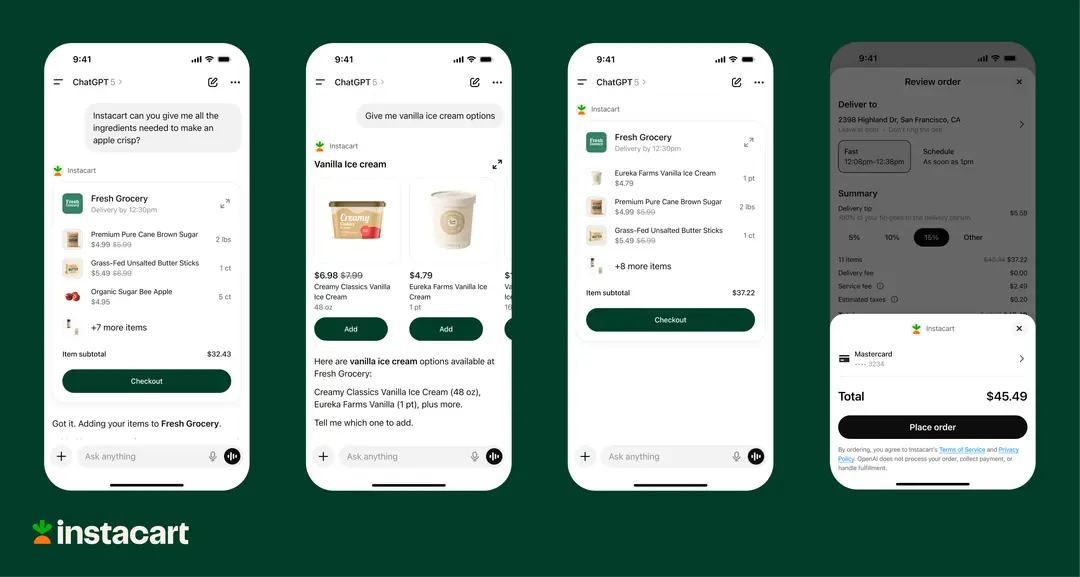
The app is powered by the Agentic Commerce Protocol and Stripe, enabling real-time product selection, up-to-date pricing, and secure in-chat payments using credit cards. Support for Apple Pay and Google Pay is coming soon. Users activate the experience by prompting something like “Help me shop for apple pie ingredients.” Once signed into their Instacart account, the app finds relevant products and handles fulfillment.
The integration is already live on desktop and mobile web. Rollout for iOS and Android is expected in the coming weeks.
 Patrecia Meliana
OpenAI's agentic commerce strategy in action
This launch fits into OpenAI’s broader push into agentic commerce — a model where AI tools don't just recommend products but also complete transactions. While OpenAI has integrated apps like Canva, Spotify, and Expedia into ChatGPT, Instacart is the first to offer embedded checkout directly within the interface.
This is a strategic move for OpenAI, which has yet to turn a profit despite ChatGPT’s popularity. Its services are compute-intensive, and subscription revenue alone won’t cover infrastructure costs. With this new model, OpenAI takes a small fee for every sale it helps generate. It may not close the revenue gap immediately, but it sets up a scalable path toward monetization.
What marketers should know
Whether you’re in retail, CPG, or AI product development, this integration offers a preview of how digital commerce is evolving.
1. AI is now part of the checkout journey
ChatGPT is no longer just a place to ask questions or brainstorm ideas. It’s now a full-fledged shopping assistant that can close the loop on intent and action. Brands should start thinking of AI interfaces not just as media channels, but as transactional surfaces.
2. Embedded commerce is here to stay
Instacart’s decision to meet users where they chat — instead of pulling them into its own app — reflects a larger shift toward embedded experiences. As AI platforms gain reach, expect more brands to build native integrations rather than fight for direct traffic.
3. Personalization is getting smarter
Instacart is combining over a decade of purchase data with OpenAI’s model capabilities. The result is hyper-personalized suggestions that reflect dietary needs, brand preferences, and local availability. That kind of tailored experience raises the bar for marketers using first-party data.
4. Multi-agent presence will become a competitive edge
Instacart is not just working with OpenAI. It also has partnerships with Microsoft and Google. As AI agents become more central to consumer behavior, marketers should anticipate building across multiple ecosystems. Think beyond “search optimization” and consider “agent optimization” as the next frontier.
Instacart’s ChatGPT integration is not just a feature update. It is an early signal of where agentic commerce is heading — toward real-time, personalized, AI-led shopping embedded directly into user conversations.
For marketers, this is a cue to rethink conversion paths, personalization strategies, and platform partnerships. The AI agent is no longer a novelty. It is a sales channel.