Integrate buys CaliberMind to connect demand gen with revenue
Integrate is buying CaliberMind to connect B2B lead orchestration with attribution and revenue intelligence in a faster feedback loop.


Integrate has acquired CaliberMind, combining a B2B lead-management and data-governance platform with a marketing attribution and revenue-intelligence system.
The deal is aimed at a familiar demand-generation problem: campaign execution happens at the top of the funnel, while proof of what actually created pipeline and revenue often arrives later in a separate analytics stack. Integrate wants to use CaliberMind's buyer-journey and attribution data to feed performance signals back into campaign decisions sooner.
That makes the acquisition more interesting than another martech platform adding analytics. The strategic promise is a tighter feedback loop between demand capture, measurement and the next activation. The practical question is whether Integrate can make that loop operational without forcing marketing teams to manage another layer of integration.
Key Takeaways
- Integrate is adding CaliberMind's attribution and revenue intelligence to its lead-governance and demand-orchestration platform.
- CaliberMind will remain a dedicated product line while native cross-platform capabilities roll out over the coming months.
- The real test is whether faster revenue feedback improves campaign decisions without increasing martech complexity.
Table of contents
Jump to each section:
- What Integrate is actually buying
- Why the closed-loop promise matters
- The integration roadmap is the real test
- AI may be the bigger strategic reason for the deal
- What B2B marketers should watch next
What Integrate is actually buying
Integrate already sits near the front of the B2B revenue engine. Its platform validates, enriches, deduplicates and governs leads from channels such as content syndication, events, paid media, partners, webinars and forms before those records reach a MAP or CRM.
CaliberMind operates further downstream. Its platform unifies marketing and sales data for multi-touch attribution, buyer-journey analysis, ABM insights, account scoring, marketing mix modeling and revenue reporting. That gives it visibility into what happens after a lead enters the funnel, including accounts, opportunities and closed-won revenue.
The acquisition therefore connects two adjacent layers rather than two identical products.
| Layer | Integrate | CaliberMind |
|---|---|---|
| Primary role | Lead intake, governance and orchestration | Attribution, analytics and revenue intelligence |
| Core data question | Is this demand signal clean, compliant and ready to route? | Which activity contributed to pipeline and revenue? |
| Combined ambition | Use downstream revenue signals to influence the next campaign and activation decision | |
Mehul Nagrani, CEO of Integrate, summarized the commercial question as: “Will this lead drive revenue?” The acquisition is designed to make that answer arrive earlier in the campaign cycle instead of after marketers wait for separate reporting.
Why the closed-loop promise matters
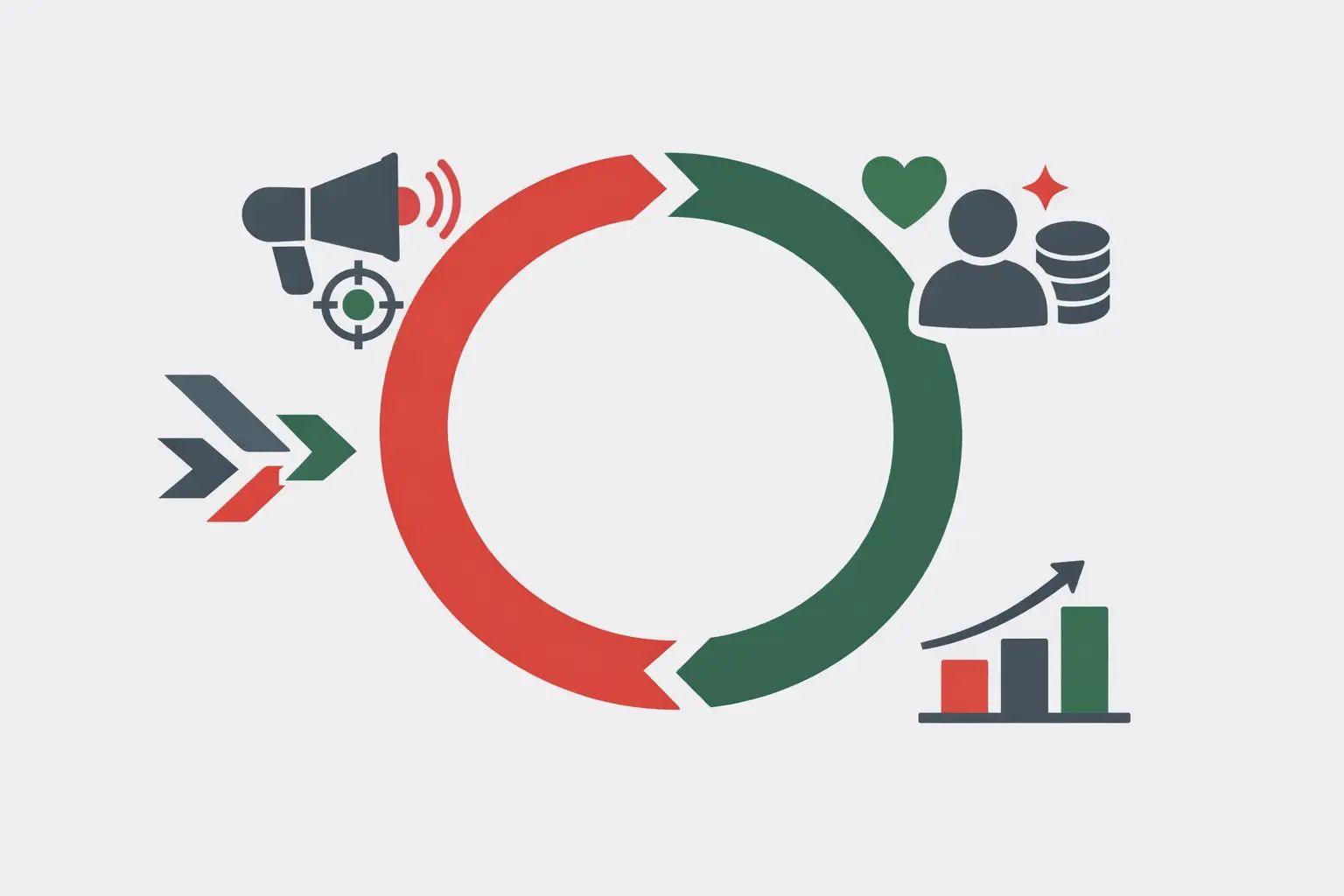
The phrase “closed loop” is common in martech because the problem is persistent. B2B teams often have one stack for acquiring and routing demand, another for CRM and sales activity, and another for attribution or executive reporting. Each system may work, but the feedback between them can be slow.
That lag matters because a report that explains last month's winning campaign is useful for planning, but less useful for an active campaign that is still spending budget today. Integrate's thesis is that CaliberMind can turn measurement from a retrospective layer into an input for ongoing orchestration.
The official acquisition announcement says the combined platform is intended to adapt targeting, segment buying committees and use campaign-performance signals for subsequent activations. Financial terms were not disclosed, according to DestinationCRM.
That direction also matches the framing in the MarTech report that surfaced the deal: the value is not merely consolidating data, but closing the operational gap between demand generation and revenue outcomes.
The integration roadmap is the real test
The deal is not a fully merged product on day one. CaliberMind will continue operating as a dedicated product line, and Integrate says existing contracts, integrations and roadmaps will remain in place.
That is sensible for continuity, but it also means the strongest closed-loop claims depend on future integration work. Native cross-platform capabilities are expected to begin rolling out in the coming months, with broader interoperability planned through 2027.
For customers, that creates two distinct phases. The first is organizational: the platforms now share an owner and a product strategy. The second is technical: data, permissions, workflows and activation logic must become connected enough for a revenue signal in CaliberMind to reliably change what Integrate does next.
This distinction matters because B2B marketing teams already struggle with stack complexity. An acquisition only reduces fragmentation if workflows become simpler in practice. If the combined product still requires duplicated configuration, reconciliation or separate operational ownership, the “closed loop” remains more architectural than experiential.
AI may be the bigger strategic reason for the deal
The acquisition announcement repeatedly connects the combined data layer to AI workflows. Integrate says it plans to expose end-to-end capabilities through the AI assistants and environments customers already use, eventually covering areas such as source selection, campaign planning, execution, attribution and buyer-journey analysis.
That ambition requires more than an AI interface. An agent can only make useful campaign recommendations if it has trustworthy context about what happened downstream. Integrate contributes governed lead data and routing logic. CaliberMind contributes attribution, journey context and revenue outcomes.
This is where CaliberMind's existing data model may matter strategically. Its platform is already built to unify fragmented GTM data, and its Agent Cal product lets users query that data with natural language. The company also operates an MCP server designed to make its governed data layer available to external AI tools.
The acquisition could therefore give Integrate a better foundation for agentic campaign operations than building an assistant on top of lead-flow data alone. But the same caution applies here: the companies describe headless, agentic execution as the direction of travel, not as a fully deployed capability across the combined platform today.
What B2B marketers should watch next
For demand-generation and marketing-operations teams, the first question is how quickly Integrate can make CaliberMind data actionable inside live campaigns. The strongest signal will not be another dashboard. It will be a workflow where a downstream revenue or buying-group signal changes targeting, source allocation or routing with clear controls and little manual stitching.
The second question is governance. CaliberMind emphasizes data transparency and auditability, while Integrate emphasizes lead quality, consent and privacy controls before records reach downstream systems. Bringing those governance models together could become a meaningful enterprise differentiator if AI-driven actions remain explainable and reversible.
The third question is whether the combined product replaces tools or simply coordinates them. Enterprise B2B stacks rarely disappear after an acquisition. Marketo, Salesforce, 6sense, paid media platforms and specialized analytics tools will remain part of many customer environments. Integrate has to prove its feedback loop works across that reality rather than only inside its own products.
The acquisition has a coherent product logic: Integrate controls demand intake, CaliberMind explains what turns that demand into revenue, and the combined company wants those answers to shape the next action. The opportunity is clear. Now the integration roadmap has to make the loop feel closed to the marketer, not just look closed on a product diagram.