Jo Malone London brings Sea Salt & Bergamot into Fortnite
Jo Malone is marketing Sea Salt & Bergamot via a limited-time Fortnite island, pairing in-game play with creators, livestreams, and social content.


Fragrance launches do not usually come with an island code, but this one does. Jo Malone London is tapping into the way younger audiences treat games less like “games” and more like hangout spaces, with branded moments that feel discoverable instead of interruptive.
In its first gaming activation, Jo Malone London is using a popular Fortnite creator-made map to introduce Sea Salt & Bergamot Cologne, with details outlined in an official announcement. The limited-time experience runs through Aug. 24 and is designed to translate the scent’s coastal vibe into something players can explore.
Jo Malone is placing the activation inside Minigame Box PvP, a creator-built island that already has scale: 3.6 million favourites and 7.6 billion minutes played. Players can access the island using code 8532-9413-6963.
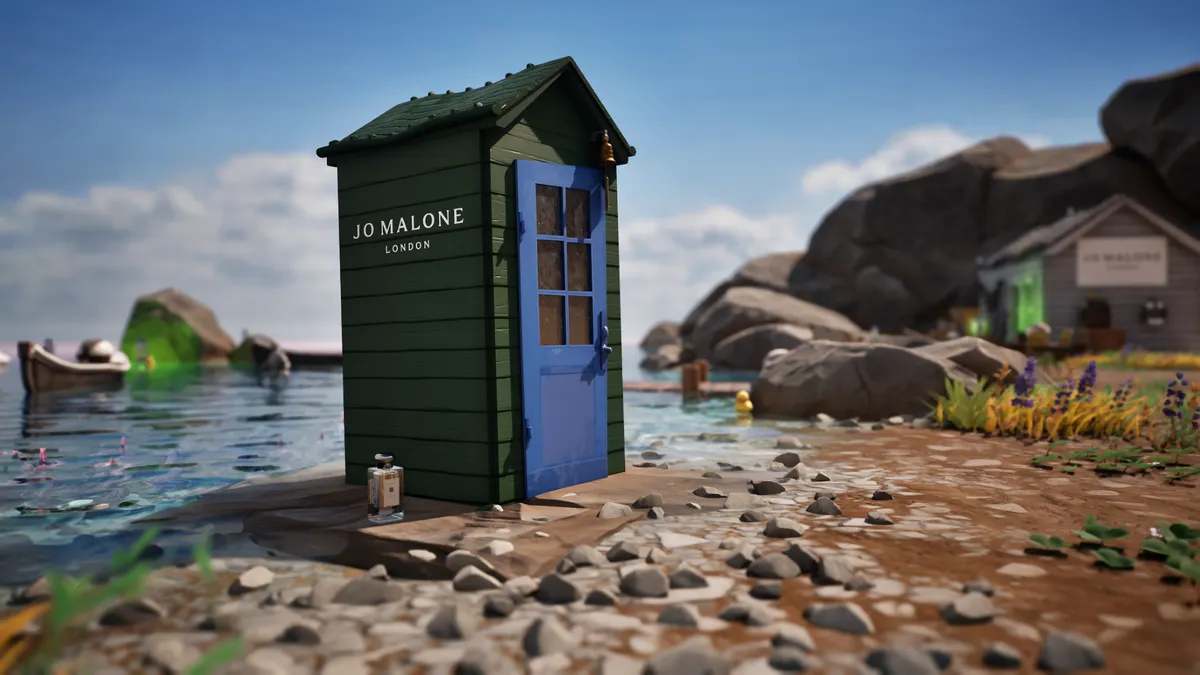
Table of contents
Jump to each section:
- Why Jo Malone chose a creator-made Fortnite island
- What the limited-time game is trying to do for the scent launch
- What this signals about beauty marketing in sandbox games
- What brand teams can learn from Jo Malone’s Fortnite play
Why Jo Malone chose a creator-made Fortnite island
Rather than building a brand-new island from scratch, Jo Malone is “setting up shop” inside an existing world that already has player habits, repeat traffic, and its own internal culture. That choice matters, because it shifts the brand’s role from “destination you must visit” to “something you run into while playing.”
The island, Minigame Box PvP, was developed by Fortnite creators Birdo and Dagwummy using Unreal Editor for Fortnite. Jo Malone partnered with Chartis, described as a user-generated games and media company, to develop the limited-time game experience.
The creative shortcut here is also a distribution strategy. In sandbox ecosystems, the hardest part is not building an experience. It is getting people to care enough to show up. Placing the activation inside a map with billions of minutes played makes the brand feel less like an ad buy and more like an in-world cameo.
 Editorial Team
What the limited-time game is trying to do for the scent launch
The activation is built around a British coast-inspired world, meant to portray the “spirit” of Sea Salt & Bergamot in a digital way. That is a smart fit for fragrance, which is notoriously hard to communicate through screens. You cannot sample scent in-game, but you can build associations: place, mood, and atmosphere.
Jo Malone is also pairing the in-game moment with a campaign featuring gaming creators, livestreams, and a social content series across Instagram, TikTok, and Fortnite. The mix suggests the brand is not treating the island as a standalone stunt, but as a piece of content that can be watched, clipped, and shared outside the game.
Just as importantly, the limited-time window (through Aug. 24) gives the experience a “now or never” feel. In gaming culture, scarcity often drives exploration, especially when the barrier to entry is simply typing in a code.
What this signals about beauty marketing in sandbox games
Beauty and fragrance brands keep moving toward environments like Fortnite and Roblox because these platforms offer something traditional social feeds do not: captive attention inside interactive worlds where users are already in discovery mode.
Jo Malone’s approach also reflects how brands are leaning into creator-led infrastructure. Creator-made islands can give marketers faster routes to relevance, but they also add constraints around compliance, measurement, and suitability. Roblox’s recent introduction of Brand Link, described as a directory to streamline brand integrations and support compliance and measurement standards, is one example of platforms formalising this layer.
The broader context is that games are still an “untapped audience” in many media plans, and tooling from game companies has made integrations easier. But scrutiny is rising too, especially around child safety in platforms with younger user bases.
What brand teams can learn from Jo Malone’s Fortnite play
Jo Malone’s move is a reminder that gaming activations work best when they feel like they belong to the way players already behave, not when they force players into a brand’s idea of interaction.
- Borrow distribution before you build a destination
Using a prebuilt creator island with proven playtime reduces the risk of launching into an empty space. The brand gets context, traffic patterns, and familiarity for free. - Turn an “un-sampleable” product into a world people can feel
Fragrance marketing often relies on language and imagery. Translating a scent into a coastal setting gives players an experience to remember, even if the product itself cannot be sampled. - Let creators be the bridge, not just the megaphone
Gaming creators and livestreams do more than amplify. They show audiences how to enter, what to do, and why it is worth attention in the first place. - Design for audiences you do not reach on your usual platforms
The activation is explicitly meant to reach young players who may not encounter the brand through more traditional social media behaviour. That is a targeting insight and a media mix insight. - Expect more governance as brands enter kid-adjacent spaces
As platforms add compliance and measurement layers, brands need to plan for approvals, safety considerations, and reporting expectations early, not as a post-launch fix.
Taken together, this is less about “beauty in gaming” as a novelty and more about where culture is already spending time. For younger audiences, games are social spaces, and brand moments in those spaces are judged by whether they feel native to the world, not whether the product category is “supposed” to be there.
Jo Malone’s choice to integrate into an existing creator island is also a signal that the next phase of in-game marketing may look more like partnerships with the creator ecosystem than brand-built theme parks. The brands that win will be the ones that understand the map culture, not just the media inventory.
The business backdrop matters too. Estée Lauder Companies reported net sales up 5% year over year for the quarter ended March 31, with fragrance up 10% in the same period, making continued experimentation in fragrance storytelling a logical place to test new channels.