
How LEGO turns toy sets into real-world brand experiences
LEGO's Unicorn Café, Botanicals Bloom Bar and Formula 1 cars reveal how physical experiences make different audiences part of the story.


A purple café that exists as a toy set can suddenly have a front door. A flower kit can become something two people make together across a bar. And a miniature race car can grow into a vehicle driven around a Formula 1 circuit. The settings are different, but the invitation is recognizable: do more than look at LEGO.
For the LEGO Group, real-world brand experiences have become a way to put its core activity, building, into places where people already gather. Its latest example is the LEGO Friends Unicorn Dream Café in London, but the same principle appears in adult-focused Botanicals events and its Formula 1 partnership. The experiences are not interchangeable. Each gives a different audience a reason to handle bricks, enter a familiar world or join an existing cultural ritual.
Table of contents
Jump to each section:
- From a toy café to a place families can enter
- The Botanicals Bloom Bar makes building social
- LEGO Formula 1 puts play inside a racing ritual
- Three experiences, three kinds of participation
- What marketers should know about LEGO's approach
From a toy café to a place families can enter
At London's Potters Fields Park, the Unicorn Dream Café is not simply a large model behind a barrier. Families can walk into a setting they may recognize from a LEGO Friends set and Heartlake The Musical, then take part in building activities, screenings and sing-alongs. The three-day event runs October 29 to 31, 2026.
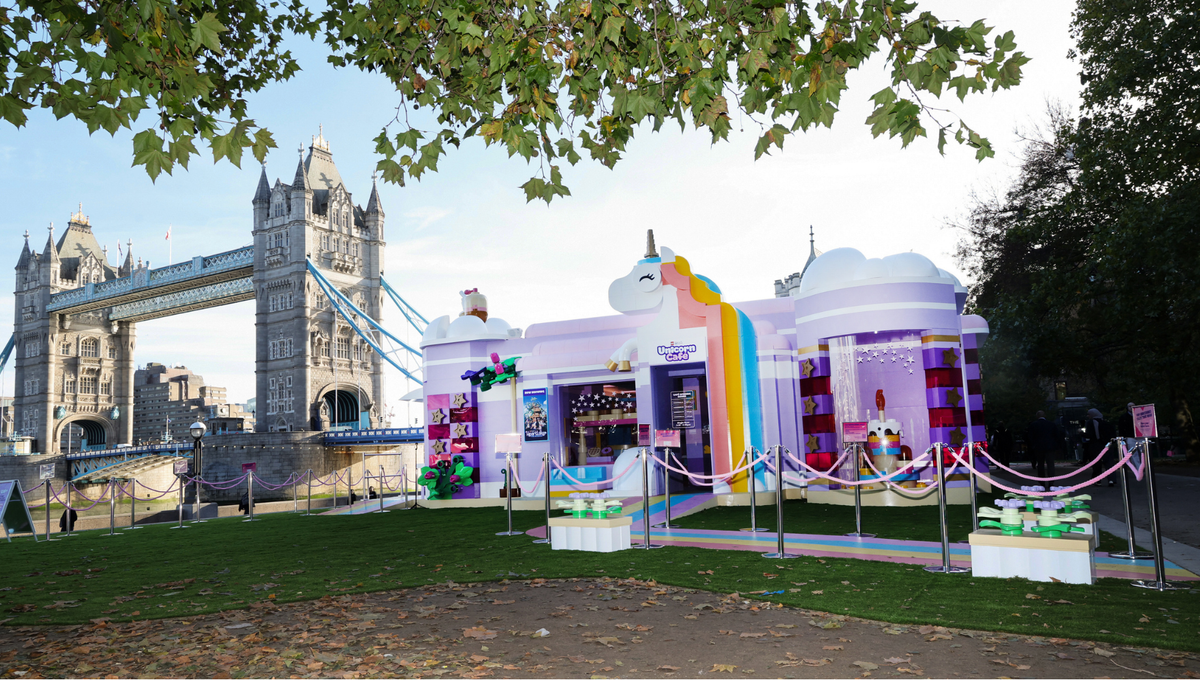
LEGO's October 28 product announcement also uses the café as a setting for showing three sets scheduled for January 1, 2027. That creates a link between a place children can visit now and a world they can continue building at home. There is no public evidence yet that the pop-up has increased purchases, so its clearest observable role is to make the brand's fictional environment tangible.
The London café was developed by LEGO Agency with HATTER, the experiential agency also involved in an earlier Botanicals project. LEGO Friends is built around the fictional Heartlake City and its characters, making the transformation from toy to musical to physical venue unusually direct. People encounter the same fictional place in three formats without having to learn a different premise for each.

The Botanicals Bloom Bar makes building social
In February 2026, another LEGO project gave adults a different reason to gather around bricks. At the Botanicals Bloom Bar in Amsterdam, guests stepped into a space designed like a stylish bar but ordered flowers to build instead of drinks. Staff called Brickologists presented the pieces, conversation cards helped groups talk, and a wrapping station let visitors leave with what they had made.
The design decision mattered. A single flower model could have been displayed in a store, but the bar setting made construction into an activity for dates, friends and curious passersby. HATTER founder Simon Hatter, discussing the concept in an April interview, put it this way: "The bar gave us the social architecture, while LEGO gave us the activity."
More than 3,500 visitors built 9,506 LEGO flowers over four days, according to figures HATTER shared about the Amsterdam Bloom Bar. The agency also reported 658,000 social impressions; those are agency-reported campaign results, not independently audited sales or brand-lift figures.
The Amsterdam event ran February 12 to 15. LEGO's official Bloom Bar schedule lists comparable pop-ups in other cities, including Munich, Stockholm, Copenhagen and Toronto. That broader footprint makes the social-building format more than a one-off Amsterdam experiment, although results from one city cannot be assumed for every location.
LEGO Formula 1 puts play inside a racing ritual
At the 2025 Miami Grand Prix, LEGO's partnership with Formula 1 reached people through a very different setting. Instead of the usual pre-race drivers' parade truck, all 20 drivers rode in ten near-life-size, drivable LEGO cars. The vehicles were modeled on the brands and liveries of the F1 teams and connected to LEGO's Speed Champions collection.
The Formula 1 account of the parade says each car used nearly 400,000 bricks, while the project involved 26 designers, engineers and builders across more than 22,000 hours of work. The spectacle turned a recurring sporting ritual into a demonstration of what building with LEGO could look like at full scale.
There was a clear distinction from the café and Bloom Bar. Most spectators could not build those enormous cars themselves. But other LEGO and Formula 1 fan-zone activities invited attendees to construct smaller vehicles. The partnership combined an attention-grabbing public moment with hands-on play that more fans could access.
That is also a way to meet people within an experience they already value. LEGO did not have to invent a separate cultural calendar around race cars. It found a place within Formula 1's own event, while maintaining an activity that made the collaboration recognizable as LEGO.
Three experiences, three kinds of participation
The comparison is less about making every branded environment bigger and more about matching the invitation to the people who enter it.
| Experience | Audience context | What people do | Connection to product |
|---|---|---|---|
| Unicorn Dream Café, London | Families following LEGO Friends | Enter Heartlake City, watch and build | Sets and a musical share the same setting |
| Botanicals Bloom Bar, Amsterdam | Adults gathering with partners or friends | Build flowers and take them home | Flower building becomes a social ritual |
| Formula 1, Miami | Motorsports fans at a live event | Watch drivable cars; build at fan areas | Speed Champions gains a real-world counterpart |
The distinction also helps explain why a large installation alone is not the full story. The race cars supply spectacle, while the flower bar supplies a repeatable activity and the café supplies familiarity with a fictional world. Each puts a different kind of participation around the same physical system of bricks.
There are also different limits to what is known. HATTER has published visitor and media figures for the Bloom Bar. Comparable attendance, conversion or sales-uplift data for the London café has not been published. The Formula 1 parade generated substantial visibility, but the available reporting does not establish how many eventual buyers it created. Counting press coverage or visitors is not the same as measuring incremental demand.
What marketers should know about LEGO's approach
LEGO's recent experiences offer a useful question for brand teams: what can people actually do with a product idea when it leaves the screen, shelf or campaign film?
- Give audiences a recognizable role. At the Unicorn Café, visitors enter a place from the LEGO Friends world. At the Bloom Bar, they become people making a gift together. A role makes a branded space easier to understand than a room full of logos.
- Design a social activity, not just a photograph. The Amsterdam bar's conversation cards and wrapping station helped turn building into a shared occasion. The broader lesson is that people need something to do once the initial novelty of a setting wears off.
- Join an existing ritual when it fits. The Formula 1 partnership inserted LEGO play into a race weekend and its drivers' parade. For a brand, borrowing an established occasion can offer context that a standalone pop-up would need to create from scratch.
- Separate participation from commercial results. Visitor counts, build totals and media impressions can indicate reach or activity. They do not prove sales lift, repeat purchases or stronger long-term affinity without additional measurement.
The point is not that every brand should build a giant café or a life-size race car. LEGO can translate products into spaces because its underlying product already asks people to make things. That does not make the economics or logistical demands of these projects universal.
What the three cases illustrate is a closer relationship between the object being sold and the activity being offered. For families, couples and sports fans, the experiences differ. But LEGO keeps the activity understandable: build something, step into a world or see an imagined object made real.
The strongest version of experiential marketing may therefore be less about scale and more about coherence. When the temporary experience makes sense alongside the product people already know, a physical visit can extend the story without having to explain the brand all over again.
