LinkedIn says 1M users flagged “AI slop” posts in two weeks
LinkedIn says 1M users used its “AI slop” feedback in two weeks. The signal personalizes feeds and can reduce views at scale.


LinkedIn's Chief Product Officer Hari Srinivasan says more than a million people have used its new “seems like AI slop” feedback option within the first two weeks of rollout. The company framed the control as a way for members to shape what they personally see, not as a punitive reporting channel.
LinkedIn also outlined how the signal is interpreted, including safeguards against targeted misuse and a plan to notify creators who receive a high volume of “AI slop” feedback.
Table of contents
Jump to each section:
- How LinkedIn defines “AI slop” and what the button does
- Why the distinction matters: low-substance is not a policy violation
- Distribution, safeguards, and the platform’s “many signals” approach
- What marketers should know about publishing in an “AI slop” era
How LinkedIn defines “AI slop” and what the button does
LinkedIn’s internal definition is narrower than “AI-written.” It describes “AI slop” as content that may look polished but “lacks substance,” with no real experience, perspective, or insight behind it.
That framing is doing a lot of work. It shifts the conversation from tools to outcomes: the problem is not assistance, it is emptiness.
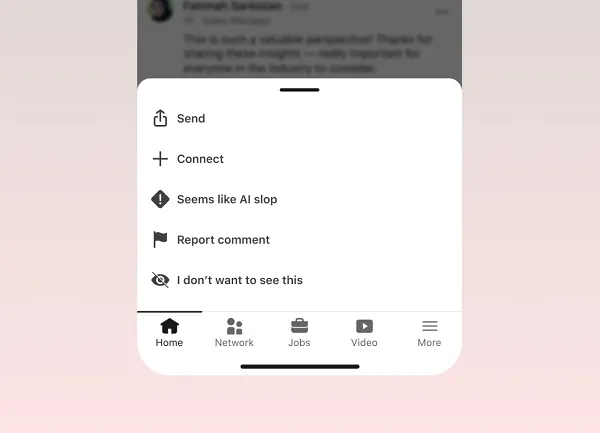
LinkedIn also clarified that using AI to refine language is not the target. The focus is on posts that read like effort-minimized attention capture.
A useful strategic observation for teams publishing on LinkedIn: As generative tools make “polish” cheap, substance becomes the only defensible differentiator.
 ContentGrip
Why the distinction matters: low-substance is not a policy violation
LinkedIn’s Creator Product Lead emphasized that this is “not a reporting path for policy violations.” That matters because it draws a boundary between moderation and preference.
A common assumption is that if users can “report” something, distribution will drop automatically. LinkedIn is explicitly arguing the opposite: the primary effect is personalization.
That creates a strategic tension for creators and brands:
- Common assumption: Platforms will punish low-quality AI content the way they punish spam.
- Contrasting reality: LinkedIn is positioning this as a viewer control, not an enforcement lever.
- Strategic implication: The penalty is quieter and more personal: you can lose the right audiences without triggering a platform-wide takedown.
In practice, that can be worse for marketing outcomes. A post can remain “live” while steadily becoming invisible to the people most likely to care.
Distribution, safeguards, and the platform’s “many signals” approach
LinkedIn says no single piece of feedback determines distribution. The platform uses “many signals together,” and it has safeguards to prevent individual feedback from unfairly targeting others.
It also signaled how creator impact can happen: if many users report the same concern, performance can change. LinkedIn’s Chief Product Officer noted that content LinkedIn defines as “AI slop” is now seeing 40% fewer views than just a few weeks ago.
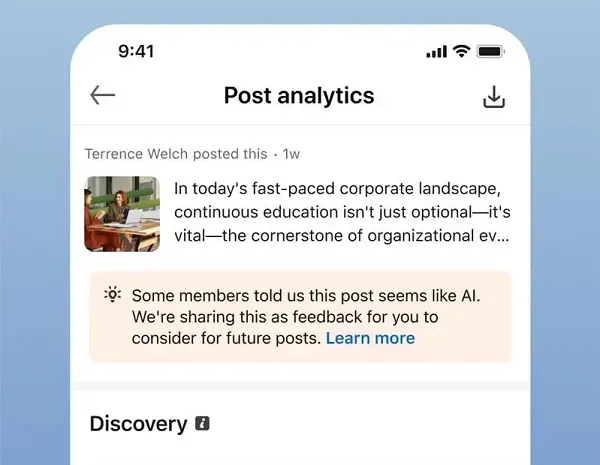
LinkedIn is also rolling out notifications to users who receive many “AI slop” reports. The posture is framed as informative rather than punitive, nudging creators to adjust.
Another strategic observation: Platforms increasingly manage content quality with “soft friction” and feedback loops, not just hard removals.
LinkedIn also highlighted verification as a way to confirm members are real people, and as a signal that users can use to filter responses. Read together, this is a product strategy for identity and intent: if low-substance content rises, the platform needs more ways to help users trust what they see and who they are hearing from.
What marketers should know about publishing in an “AI slop” era
The shift is not “AI is banned.” The shift is that LinkedIn is formalizing a user-facing label for low-substance content, and that label can shape what audiences choose to ignore.
1. Write for “earned attention,” not formatted attention.
If a post is optimized for looking complete rather than saying something specific, it will be easy for readers to mentally file it as filler. On LinkedIn, filler is now a first-class concept.
2. Treat perspective as a measurable asset.
LinkedIn’s definition explicitly values experience, viewpoint, and insight. That means marketing teams should invest in real operator narratives: what you tried, what changed, what you learned.
3. Assume feed visibility is becoming individualized faster.
If “AI slop” feedback mainly changes what the reporter sees, distribution can fragment quietly. You might still see strong surface metrics in one slice while losing relevance in the audiences you actually want.
4. Creator governance matters more when the penalty is subtle.
Notifications to creators with many “AI slop” reports suggest a new kind of quality management: feedback without enforcement. Brands using executives, employees, or agency partners should align on what “substance” means before volume publishing.
5. Identity signals are becoming content strategy.
LinkedIn’s emphasis on verification points to a broader pattern: as content gets easier to generate, platforms value signals that reduce uncertainty about who is speaking.
The deeper shift is that social platforms are starting to separate “bad” from “empty.” That is not the same thing, and marketers should not treat it the same way.
In the near term, this likely raises the bar for B2B publishing discipline: fewer generic posts, more authored points of view, and clearer proof that a human mind is behind the claim.
Longer-term, it nudges brand strategy toward something that sounds old-fashioned but is newly scarce: being worth following because you consistently have something to add.