
McDonald's puts Pickle Boost on Auckland's 22-ad running route
McDonald's took bottled pickle brine to Auckland runners, with 22 outdoor placements and a hands-on race-day giveaway.


There is an odd intersection between McDonald's New Zealand burger pickles and the items runners carry in their belts. One belongs to the familiar ritual of ordering fast food. The other belongs to a race morning, when every pocket and drink can feel important. In Auckland, the chain put the two together by offering bottles of pickle brine to runners heading toward the start line.
It is not the first appearance of Pickle Boost. McDonald's described an earlier Chicago Marathon giveaway in its October 5 announcement. The newer Auckland running event, reported on November 8, turns that unusual idea into a local outdoor campaign as well as an on-the-ground handout. The appeal is not a conventional food ad: it is seeing something from a burger show up in a running kit.
Table of contents
Jump to each section:
- How pickle brine became a race-day prop
- What Auckland runners actually encountered
- Why a small stunt can travel across markets
- What marketers should know about brand-owned sports moments
How pickle brine became a race-day prop
Pickle juice already has a place in conversations about endurance sports, even though the evidence for its effects on muscle cramps should not be confused with the promises of a marketing campaign. Some athletes use it, and the very idea of drinking brine mid-event has become recognizable enough to make an unexpected brand connection intelligible. McDonald's did not have to invent a new ingredient to enter that conversation. It could draw attention to something customers already associate with its burgers.
The New Zealand work began with an earlier pickle connection involving Auckland FC. McDonald's marketing director Luke Rive recalled that the company had already shared the brine with the football club and then saw a reason to bring it to the city's runners. "We've always known people have strong feelings about our pickles, but we never thought we'd be handing out the brine to runners," he said.
That is the peculiar charm of this campaign. The brand is neither presenting the pickle as a newly developed sports supplement nor asking runners to visit a restaurant during the race. It is giving away a recognizable ingredient in a setting where it looks out of place and, because of that, demands a second look.

What Auckland runners actually encountered
At the Auckland running event, McDonald's set up a pickle station along the approach to the start line. Participants could pick up a bottle of Pickle Boost and slip it into a running belt or shorts pocket. The physical object mattered: unlike an ad seen from a bus or phone, it was something a runner could actually carry into the event.
22 contextual outdoor placements accompanied the Auckland activation along the course, as described in Little Black Book's November 8 coverage.
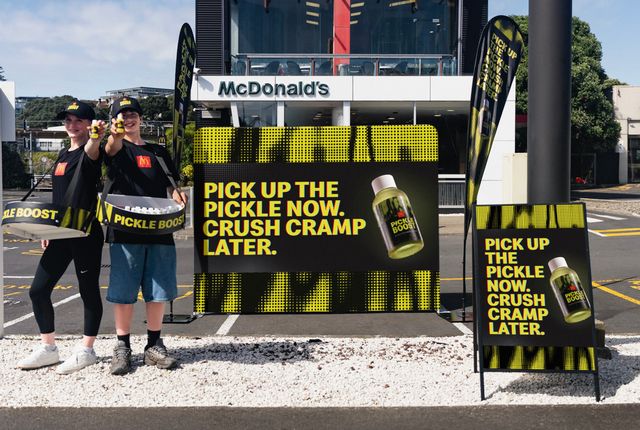
Those outdoor placements gave the stunt a second life. A passerby who never took a bottle could still encounter its pickle-centered running humor on the course. A participant who did pick one up could connect the product to the surrounding signs. The handout and the creative reinforced the same idea from two directions.
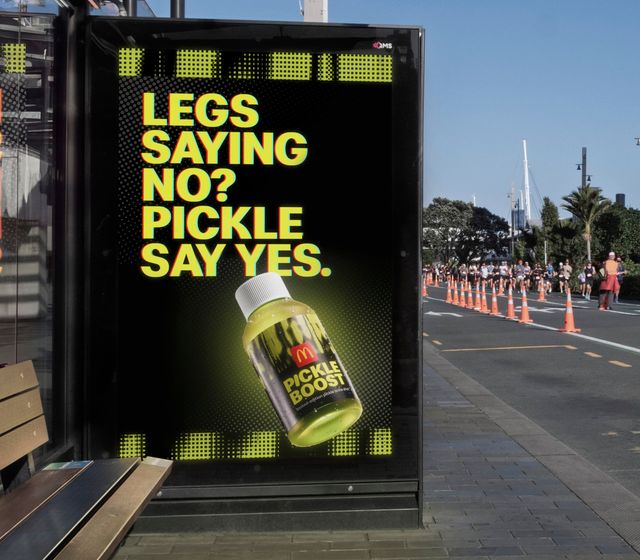
An Instagram post directly linked from the campaign coverage offers another window into the event. It is the visible local experience, rather than a broad claim about social popularity, that gives this particular execution its news value.
Why a small stunt can travel across markets
The same idea has already moved through several sporting settings. McDonald's used Pickle Boost around the Chicago Marathon in October, after the earlier Auckland FC connection. McCann New Zealand's chief creative officer Gary Steele also cited running events in New York when discussing the campaign's international reach. The Auckland runner giveaway is a further event-specific use of that concept, not the debut of a new global product category.
That sequence is interesting because the central prop stays simple. Bottled pickle brine needs little explanation once a viewer knows where it came from. The surrounding story changes according to the occasion: football players at the touchline, marathon participants near race day, or a local running event with course-side outdoor advertising.
McCann New Zealand, FleishmanHillard New Zealand and OMD worked with partner agencies on the campaign. Steele said the New Zealand-originated idea had traveled to events in Chicago and New York. The cross-market spread is reported, but no independently verified sales results or campaign-effectiveness measurements have been disclosed. Distribution across events should not be mistaken for proof of purchase lift.
There is also a distinction between being useful and being memorable. Runners may have their own reasons for trying or avoiding pickle juice. The marketing idea, however, works as an incongruous encounter between a familiar fast-food ingredient and an environment built around endurance. That contrast is understandable even to someone who has no intention of drinking brine.
What marketers should know about brand-owned sports moments
A small race-day giveaway can express a brand's personality without buying the most prominent rights package at an event. That is a timely contrast for McDonald's, which has also been discussing a move toward experiences tied more directly to its own products and customer relationships. It does not mean this particular stunt outperformed a major sponsorship, or that smaller activations necessarily deliver greater returns.
- Start with a truth people already recognize. McDonald's pickles are familiar enough to carry the joke. Inventing an entirely new prop would make the audience work harder to understand it.
- Make the physical action part of the creative. A bottle that fits into a runner's pocket gives the campaign a real-world role. The outdoor placements help other people notice that role.
- Adapt the setting, not necessarily the core idea. The creative has been used around football and running events. A consistent object gives the campaign continuity while local teams provide the right occasion.
- Measure beyond the photo opportunity. The number of placements and the fact of a giveaway are execution details. They do not establish how many customers changed their minds, visited a restaurant or bought something afterward.
The broader marketing question is how brands join sport without appearing merely to rent attention. A familiar product can be a point of entry if the surrounding event gives it a reason to be there. That is more concrete than putting a logo beside an athlete and hoping an audience remembers the association.
For McDonald's, a bottle of pickle brine is a particularly unlikely ambassador. It turns an overlooked part of a burger into something people might encounter while preparing to run. The idea is easy to explain and simple to reproduce, but its real business impact remains unreported. That gap between a memorable moment and a measured result is worth keeping visible.
