Meta turns vibe coding into social content with Pocket
Meta's Pocket turns text prompts into shareable mini-games, testing whether vibe coding can become a lightweight social content format.


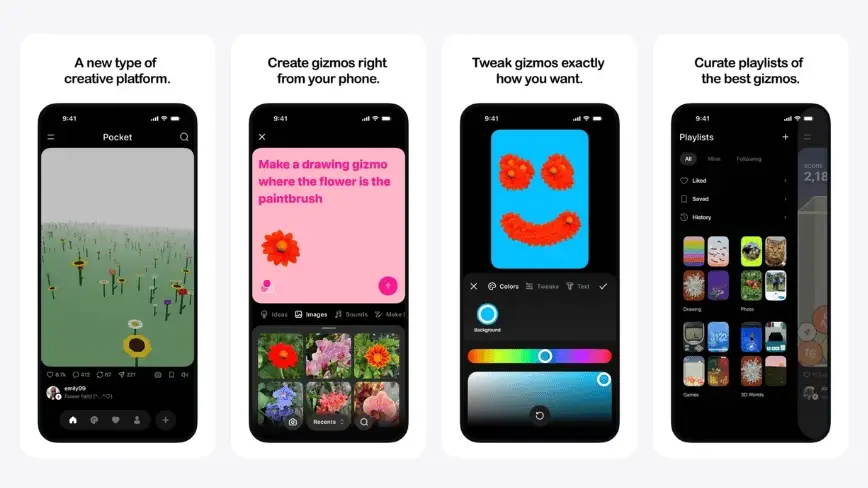
Meta is bringing Pocket, an experimental app that turns text prompts into small playable games, to users across the United States. Instead of asking people to learn a game engine or write code, Pocket lets them describe an idea, generate an interactive experience, tweak it and publish the result into a social feed.
That makes Pocket more interesting than another vibe-coding tool. Meta is testing whether software itself can behave like social content: something users can create quickly, scroll past, play, remix and redistribute without leaving the app.
Key Takeaways
- Pocket lets users create small interactive games from text prompts and publish them into a social feed.
- The app treats playable software more like a post that can be shared, remixed and discovered than a traditional standalone game.
- For marketers, the important signal is the emergence of lightweight interactive content, but Pocket has no disclosed ad product or meaningful traction yet.
Table of contents
Jump to each section:
- How Pocket turns prompts into playable posts
- Why Meta is treating code like social content
- What the Gizmo lineage tells us about Pocket
- What marketers should watch before calling Pocket a channel
How Pocket turns prompts into playable posts
TechCrunch reports that Pocket is now rolling out to US users after an earlier limited launch. The app lets people describe a game or interactive idea in natural language, generate it with AI, make adjustments and then publish the finished experience to a feed.
Meta calls the creations "gizmos." They are closer to tiny interactive toys than full-scale games, which is part of the point. The barrier to making one is intentionally low, so creation can happen at roughly the same speed as posting a piece of media.
Other users can play those creations and, when creators allow it, remix them into new versions. That gives Pocket a loop familiar from social platforms: creation, discovery, imitation and redistribution.
 Lena Marlowe
Why Meta is treating code like social content
Most vibe-coding products are designed around productivity. A user prompts a tool to build a website, prototype or application, then keeps working on the output as a project.
Pocket takes a different approach. The output is not only something to build. It is something to post.
That distinction could matter because social platforms have historically grown by lowering the cost of producing a new content format. Smartphones made photos and short videos easier to create. Templates lowered the barrier for graphics. Generative AI is now lowering the barrier for software-like experiences.
Pocket asks whether a playable interaction can become another feed primitive alongside images, video and text. For Meta, that is a more strategically interesting question than whether users simply want another coding assistant.
What the Gizmo lineage tells us about Pocket
Pocket also inherits ideas and people from Gizmo, an earlier app built by Atma Sciences. Josh Siegel said the Atma Sciences team joined Meta Superintelligence Labs and had been working on Pocket, while Gizmo itself was being shut down.
"It's bittersweet to shut down Gizmo," Siegel wrote in his announcement.
The distinction around the deal matters. The Next Web reports that Meta hired the team and obtained a non-exclusive license to the technology rather than acquiring Atma Sciences outright.
The product lineage helps explain why Pocket already looks more like a social network for tiny interactive experiences than a blank coding canvas. Gizmo was built around the same prompt, play, remix and share behavior, and Pocket appears to carry that model into Meta's broader AI portfolio.
What marketers should watch before calling Pocket a channel
For marketers, Pocket is worth watching because interactive content has historically been expensive to produce. Even a lightweight branded game usually needs creative, development, testing and distribution work that costs far more than a social post.
If tools like Pocket make simple interactive experiences cheap enough to generate on demand, brands could eventually experiment with playable campaign assets, product explainers, fan challenges or remixable experiences without commissioning a full game build.
But that opportunity is still hypothetical. Meta has not disclosed meaningful Pocket user numbers, creation volume, advertising products or monetization plans. There is no evidence yet that brands should treat Pocket as an established distribution channel.
The more immediate signal is about format. Generative AI is making the boundary between media and software less rigid. If consumers become comfortable creating and sharing tiny apps as casually as videos, marketing teams may eventually need to think about interaction design as part of everyday content production rather than a specialist campaign tactic.