
The best product campaign begins with the objection
Objection-led marketing makes customer doubts the starting point for creative. Samsung, Google and SodaStream show how evidence can answer them.


An agency presents a product campaign built around three benefits, an attractive hero film and a set of cutdowns for paid social. The client likes it. Then somebody from customer service asks a question nobody in the room can answer: what will the campaign do about the reason people keep deciding not to buy?
For a folding phone, that reason might be doubt about a visible crease or whether the shape makes daily work easier. For an unfamiliar AI tool, it might be the awkward first step between curiosity and useful work. For a home beverage machine, it might be uncertainty about whether the variety promised in the ad will matter at the kitchen counter. A polished benefit statement can miss all three.
Objection-led marketing is the practice of building campaign content around a real customer hesitation and supplying evidence that helps someone assess it. It is not a sales script disguised as an ad, nor a promise that skeptical audiences will suddenly convert. Its advantage is more basic: it gives creative work a decision to improve rather than just an impression to generate.
Key Takeaways
- An objection-led marketing brief starts with the specific reason a customer hesitates, rather than the feature a brand most wants to promote.
- Evidence should match the doubt: historical comparisons, hands-on trials and product demonstrations answer different questions.
- Campaign measurement should test whether the objection was resolved, not treat reach, views or attendance as proof of persuasion.
Table of contents
Jump to section:
- The objection is more useful than the claim
- Proof has to match the kind of doubt
- Creators can revisit the argument a brand cannot make alone
- Give the campaign a question it can actually answer
The objection is more useful than the claim
Most briefs are organized around what the brand wants an audience to know. An objection-led brief starts from what the audience still cannot believe, imagine or justify. The difference sounds small until the creative team must choose between another polished product shot and a demonstration of the precise problem blocking a purchase.
Samsung Canada's October 22 Re-Reviews campaign is a useful case because it takes the awkward material that brands usually want to move past and puts it at the center. The company invited Karl Conrad, Unbox Therapy and Linus Media Group to revisit their early reactions to folding phones, compare them with the Galaxy Z Fold8 and consider whether their opinions had changed. The Samsung Canada announcement describes the format as a direct comparison between archival skepticism and the present product experience.
The structure supplies a visible question before it supplies a brand answer. Could the early durability and practicality concerns still be valid? A viewer is allowed to remember the criticism rather than pretend it never happened. Showing original footage also prevents the brand from rewriting the history of an unfamiliar category into a smooth, inevitable success story.
Eight years separate the early foldable reactions revisited in Samsung Canada's Re-Reviews concept from its latest campaign; the span describes the creative premise, not a performance result.
There is a limitation. Samsung commissioned the activity and selected the participants. The announcement confirms the brief and the invited reviewers, but it does not provide evidence of changed consumer opinion or sales. A historical comparison may be more credible than a generic endorsement, yet it is still a marketing vehicle whose claims deserve scrutiny.
Samsung Malaysia took a different route with its Team Galaxy content. Local creators were assigned familiar questions about the screen crease, weight, app use and multitasking instead of being asked to recite one long feature list. The Samsung Malaysia newsroom's October follow-up presents use cases across work, photography and entertainment. That is not independent evidence of better sales, but it shows how a large product proposition can be broken into questions someone already has.

A campaign does not need to become negative to acknowledge hesitation. It needs to be specific enough that the audience knows the marketer understands the choice in front of them.
Proof has to match the kind of doubt
An objection is only useful if the answer fits it. A customer questioning a product's reliability does not need a more persuasive slogan about innovation. Someone who cannot picture a product in their routine does not need a longer specification sheet. A buyer concerned about value needs to see what changes after paying, not hear that the category is exciting.
Google's Gemini Campus Tour in Indonesia offers a different method from Samsung's creator comparisons. The product's range can be hard to understand through a single campaign line, so the program put students in interactive situations where they could use the tool for academic tasks and creative work. The participating Universitas Pendidikan Indonesia described a tour organized around practical challenge stations, including idea generation and question answering, during its August 26-27 program.
Five activity stations were used at the UPI stop of the Gemini campus program, according to the university's firsthand account. The count describes the event format, not adoption or retention.
An institution that hosted the tour, Universitas Negeri Yogyakarta, separately reported hands-on Gemini exercises for students and educators in September. The operational question is whether someone leaves able to repeat a useful action without a guide. A booth can produce a memorable first encounter; only later behavior can show whether the encounter changed a habit.

SodaStream's October Fountain launch shows an objection that requires something simpler. Why would a countertop appliance be worth considering when consumers can buy ready-made drinks? Rather than leave customization as an abstract feature, the brand hired Simone Biles to connect her recognizable idea of personal expression with choosing flavor, carbonation and serving size. Its October 22 announcement documents the product controls and the planned TV, digital, social and retail campaign.
Approximately 1,000 drink combinations is SodaStream's product estimate based on available flavors and settings. It is not evidence of campaign effectiveness or actual consumer usage.
The athlete's story makes the proposition easier to recognize, but the appliance still has to carry the proof. A demonstration of adjustable intensity may address the difference between the Fountain and an ordinary sparkling-water maker. It cannot, by itself, establish that households will use enough varieties to justify the cost. That requires a different study.
A useful brief assigns each hesitation a suitable form of evidence rather than asking every execution to show the same hero message.
| Customer doubt | Evidence that fits | What it still cannot prove |
|---|---|---|
| Does the product work differently now? | Transparent historical comparison or observed product test | How often a broader audience will change its mind |
| Can I use this in my routine? | Hands-on task or guided trial with a repeatable next step | Long-term retention without follow-up data |
| Is the difference worth the price? | Specific demonstration paired with transparent costs and alternatives | Customer value from a brand's stated feature count alone |
A well-matched proof format reduces the need for inflated copy. The creative can show enough of the answer for someone to judge it, including its limits.
Creators can revisit the argument a brand cannot make alone
Creator campaigns are often bought for reach, style or audience affinity. Those benefits matter, but a creator's documented relationship with a product category can supply something the brand's new campaign cannot manufacture overnight: continuity. The audience may have seen the same person criticize a device years earlier, or explain a familiar inconvenience long before the sponsorship.
That is the distinctive feature of Samsung Canada's format. The original material is available for comparison. Even viewers who suspect that a partnership shapes the new coverage can evaluate how a creator presents the change. The campaign's strength is not that creator opinion becomes objective when paid for; it is that a past, recognizable question stays visible while a current answer is offered.
Samsung Malaysia's approach is closer to structured explanation. Several creators address narrower questions using different everyday contexts. That reduces the burden on one personality to carry every proof point, but it also increases the need for coordinated claims, usage permissions and an approval process that respects the creators' own ways of speaking. If every answer sounds like a centrally written script, the format loses much of its reason to exist.
There is a tension between useful guidance and staged skepticism. A brand should not ask a creator to perform fake doubt just so the product can win a scripted argument. Nor should it bury a real limitation inside an edited demonstration. Viewers can accept that an advertisement is sponsored; what becomes harder to defend is a format that borrows the credibility of independent inquiry without allowing any meaningful question.
A remark from a different ContentGrip discussion makes the communication problem clearer. In a May 2026 article about generational copy, Enricko Lukman described how audiences need a recognizable reason to engage before they accept a fuller argument. That observation was about Gen Z messaging, not Samsung's campaigns. Its application here is an editorial inference rather than a new interview.
Enricko Lukman, CEO at ContentGrow, an AI-powered content marketing agency:
"They need a signal that the brand understands the moment, then a clear reason to care once they lean in."
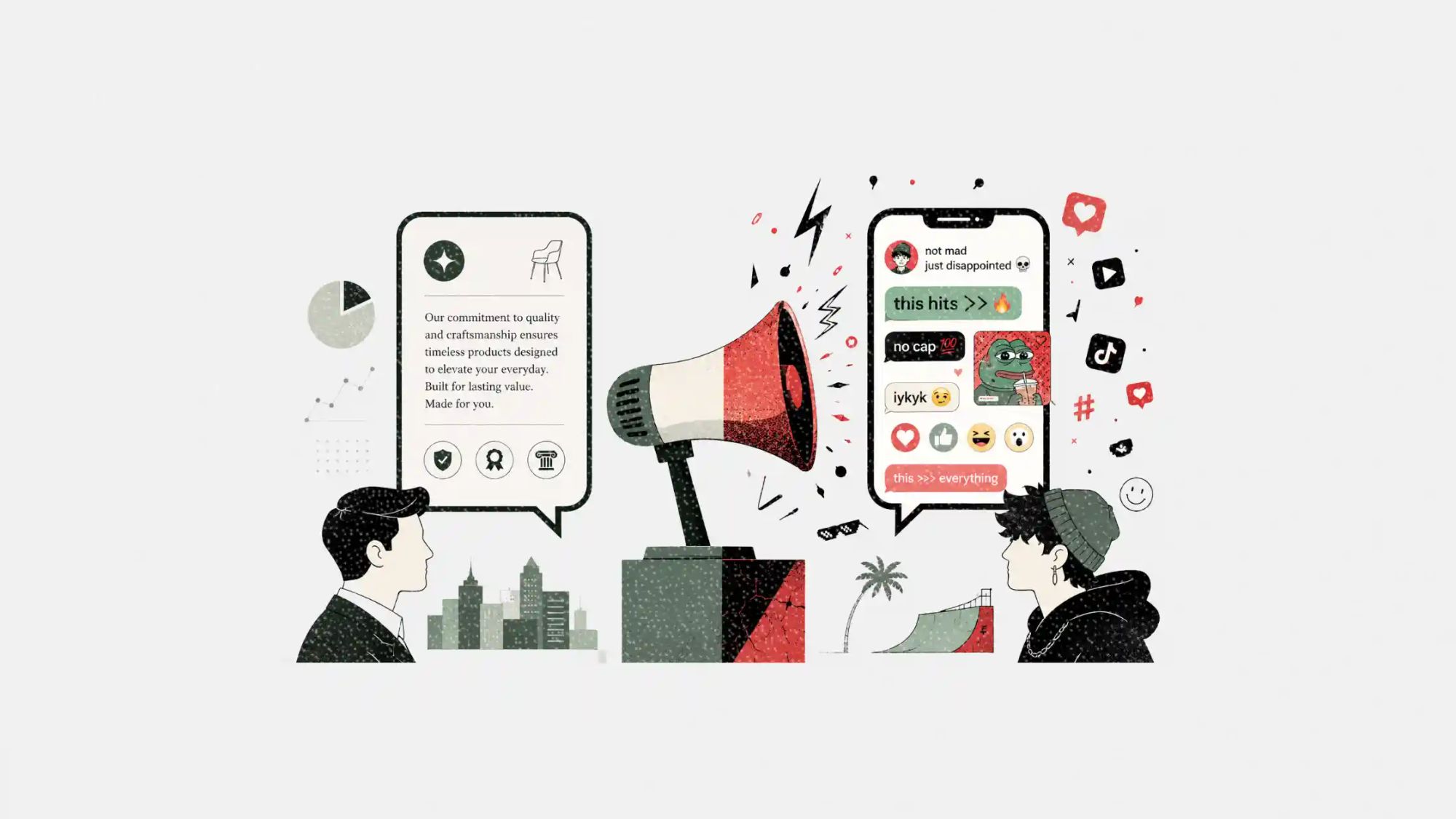
In objection-led marketing, the familiar signal is often the customer's own question. The creator's job is to make the evidence legible and credible, not pretend the brand has no commercial interest. A good answer should still make sense after the viewer learns who paid for it.
Give the campaign a question it can actually answer
Objection-led creative becomes a weak tactic when it is judged only by how many people watched the answer. A video about a foldable's crease can earn views from people who would never consider switching phones. A campus demo can attract a crowd without producing a repeat user. A customization film can make a feature memorable without making the appliance a better purchase for a specific household.
Agencies should tie the research, asset and outcome to the same decision. Start with objections appearing in support tickets, sales conversations, search queries, product reviews and return reasons. Distinguish a misunderstanding that content can clarify from a real product constraint that marketing should not conceal. A complaint about the actual price is not automatically a messaging problem.
For a campaign team, the workflow can be short enough to fit into an ordinary brief:
- Name the hesitation in the buyer's language. Write down the real question and its source, without converting it into a favorable brand statement.
- Choose evidence and its owner. Decide whether the answer requires a comparison, a live use case, a customer record or an independently assessed test. Confirm who can stand behind it.
- Design one piece around one question. Use the format and spokesperson that can show the answer clearly, while keeping important limitations visible.
- Measure the decision, not just the exposure. Compare comprehension, qualified action, trial continuation or conversion among relevant audiences against an appropriate baseline.
- Feed unresolved questions back into the product. If customers remain skeptical for a legitimate reason, document that finding instead of adding another variation of the same claim.
The measurement choice depends on the objection. For a misunderstood feature, a comprehension test may be more revealing than click-through rate. For a product people cannot imagine using, repeat trial or task completion could be more informative than event attendance. For a costly purchase, a better-qualified product-page visit or a lower rate of avoidable returns may matter more than raw reach. None of these metrics, used alone, proves causal lift without a suitable comparison.
This changes how an agency should defend the creative budget. Instead of promising that another film will increase attention, it can identify the decision that film is supposed to help a customer make. A production concept with no clear hesitation to resolve may still be entertaining, but it should not be sold as objection handling.
There is also a point where the method must stop. If the strongest objection exposes a product defect, inaccessible price or misleading claim, marketing cannot responsibly argue it away. That finding belongs with the people who can change the product or offer. The campaign has done useful work even if the best decision is to delay a creative claim.
The most expensive brief is not necessarily the one that spends too much on production. It is the one that never asks what the buyer still needs to believe before the ad can matter.
