
OpenAI’s enterprise AI push signals the rise of the workplace superapp
OpenAI wants AI agents and ChatGPT to become the operating system for modern work

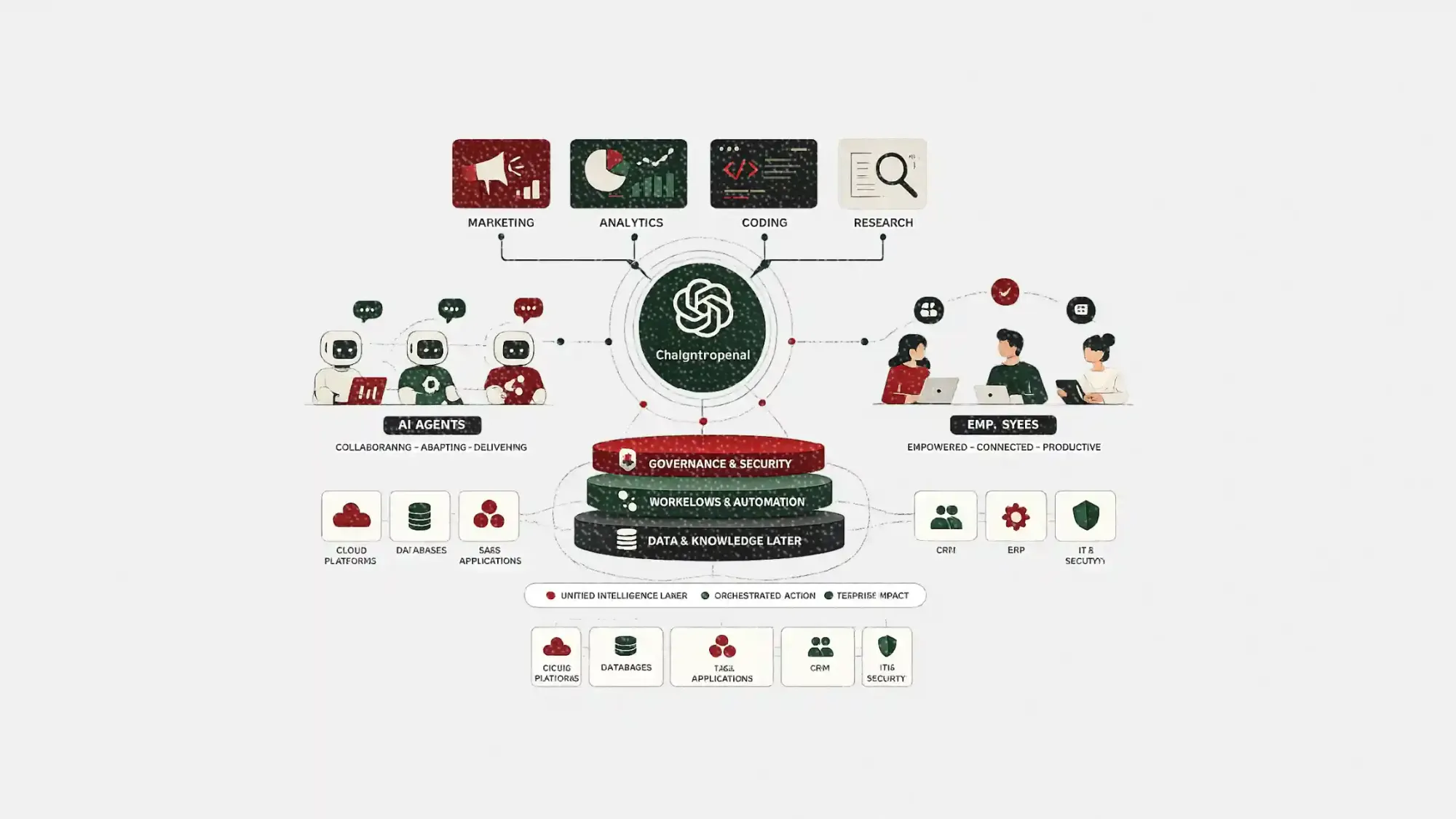
OpenAI says the next phase of enterprise AI is already underway, with agents becoming company-wide infrastructure and ChatGPT evolving into a unified workplace superapp.
The company’s latest enterprise update, combined with reports of a major ChatGPT redesign, offers a clearer picture of where OpenAI believes workplace AI is heading. Rather than deploying isolated copilots across departments, enterprises are increasingly looking for a single intelligence layer that connects systems, data, workflows, and employees.
For marketers, the shift is significant. It suggests the future of AI adoption may not be about adding more tools to the stack, but about consolidating work into AI-powered operating environments that can execute tasks, coordinate agents, and surface insights from across the business.
Table of contents
Jump to each section:
- Why OpenAI believes enterprise AI has moved beyond experimentation
- How OpenAI Frontier aims to become the enterprise intelligence layer
- Why ChatGPT’s reported superapp overhaul matters
- What marketers should know about the rise of AI superapps
- What happens next for enterprise AI adoption
Why OpenAI believes enterprise AI has moved beyond experimentation
According to OpenAI chief revenue officer Fidji Simo, enterprises are no longer asking whether they should adopt AI. Instead, they are focused on how to integrate the most capable AI systems across their organizations and make them part of everyday work.
OpenAI said enterprise now accounts for more than 40% of its revenue and is on track to reach parity with consumer revenue by the end of 2026. The company also highlighted growing adoption among organizations including Goldman Sachs, State Farm, Oracle, Uber, DoorDash, Thermo Fisher, and LY Corporation.
The message is clear: the conversation has shifted from pilots and proofs of concept to deployment at scale.
OpenAI argues that many companies are still underutilizing current AI capabilities despite rapid advances in model performance. The company's focus now is closing what it describes as a "capability overhang" by making advanced AI easier to deploy, govern, and integrate into daily operations.
How OpenAI Frontier aims to become the enterprise intelligence layer
A major part of OpenAI's strategy revolves around Frontier, a platform designed to help organizations build, deploy, and manage AI agents across the entire business.
Rather than embedding agents within a single application, Frontier is positioned as a layer that connects agents to enterprise systems, internal knowledge, external data sources, and governance controls.
OpenAI says customers increasingly want a unified AI operating environment rather than a collection of disconnected AI point solutions. The company believes future enterprise environments will consist of AI coworkers capable of moving between systems, retaining context, and improving performance over time.
To support this vision, OpenAI is expanding partnerships with consulting firms including McKinsey & Company, BCG, Accenture, and Capgemini, alongside technology partners such as AWS, Databricks, and Snowflake.
One notable initiative is OpenAI's Stateful Runtime Environment, being developed with AWS. The goal is to allow agents to maintain memory, preserve context across tasks, and operate more effectively in complex business environments.
 Patrecia Meliana
Why ChatGPT's reported superapp overhaul matters
Alongside OpenAI's enterprise strategy, reports suggest the company is preparing a major ChatGPT redesign that would transform the platform into a broader AI superapp.
According to reports, the overhaul could bring coding tools, AI agents, image generation, and third-party services into a unified experience. Integrations may include partners such as Canva and Booking.com, while coding product Codex is expected to become more prominent within ChatGPT.
The approach mirrors the evolution of platforms such as WeChat and Grab, which expanded from single-purpose applications into ecosystems supporting multiple services.
OpenAI has indicated that the direction aligns with plans previously discussed publicly, including its ambition to bring advanced AI capabilities to nearly one billion ChatGPT users globally.
The strategy also builds on OpenAI's efforts to position ChatGPT as a persistent digital assistant capable of retaining context, conducting research, and completing tasks on behalf of users.
What marketers should know about the rise of AI superapps
For marketing leaders, OpenAI's roadmap points to several important developments:
- AI platforms may replace fragmented workflows
Instead of switching between separate research, content, analytics, and productivity tools, teams may increasingly work through a single AI interface that orchestrates tasks across systems.
- Agent management could become a core skill
OpenAI notes that leading organizations are already moving from using AI assistants to managing teams of AI agents. Marketing teams may need new processes for supervising, evaluating, and optimizing agent performance.
- Enterprise adoption barriers are shrinking
With hundreds of millions of people already familiar with ChatGPT, organizations may face less resistance when introducing AI-powered workflows compared with entirely new enterprise platforms.
- Data governance becomes even more important
As AI agents gain access to internal systems and customer data, governance, permissions, privacy controls, and compliance frameworks will become critical differentiators.
- The competitive advantage shifts from access to execution
Most organizations will eventually have access to similar frontier models. The winners may be the teams that can integrate AI most effectively into real-world workflows.
What happens next for enterprise AI adoption
OpenAI's latest enterprise messaging reveals a company that increasingly sees itself as more than a model provider. Its vision combines frontier AI models, enterprise infrastructure, agents, workplace interfaces, and ecosystem partnerships into a single operating environment.
Whether enterprises fully embrace the superapp model remains to be seen. However, the direction reflects a growing industry belief that AI's future lies not in isolated assistants but in connected systems capable of coordinating work across the organization.
For marketers, the takeaway is straightforward: AI adoption is entering a new phase where success will depend less on experimentation and more on operational integration. Organizations that can embed AI into everyday workflows may gain significant advantages in productivity, speed, and decision-making.