OpenAI shuts down Sora app after six months
OpenAI’s pivot away from its AI video feed highlights what still works and what doesn’t for marketers

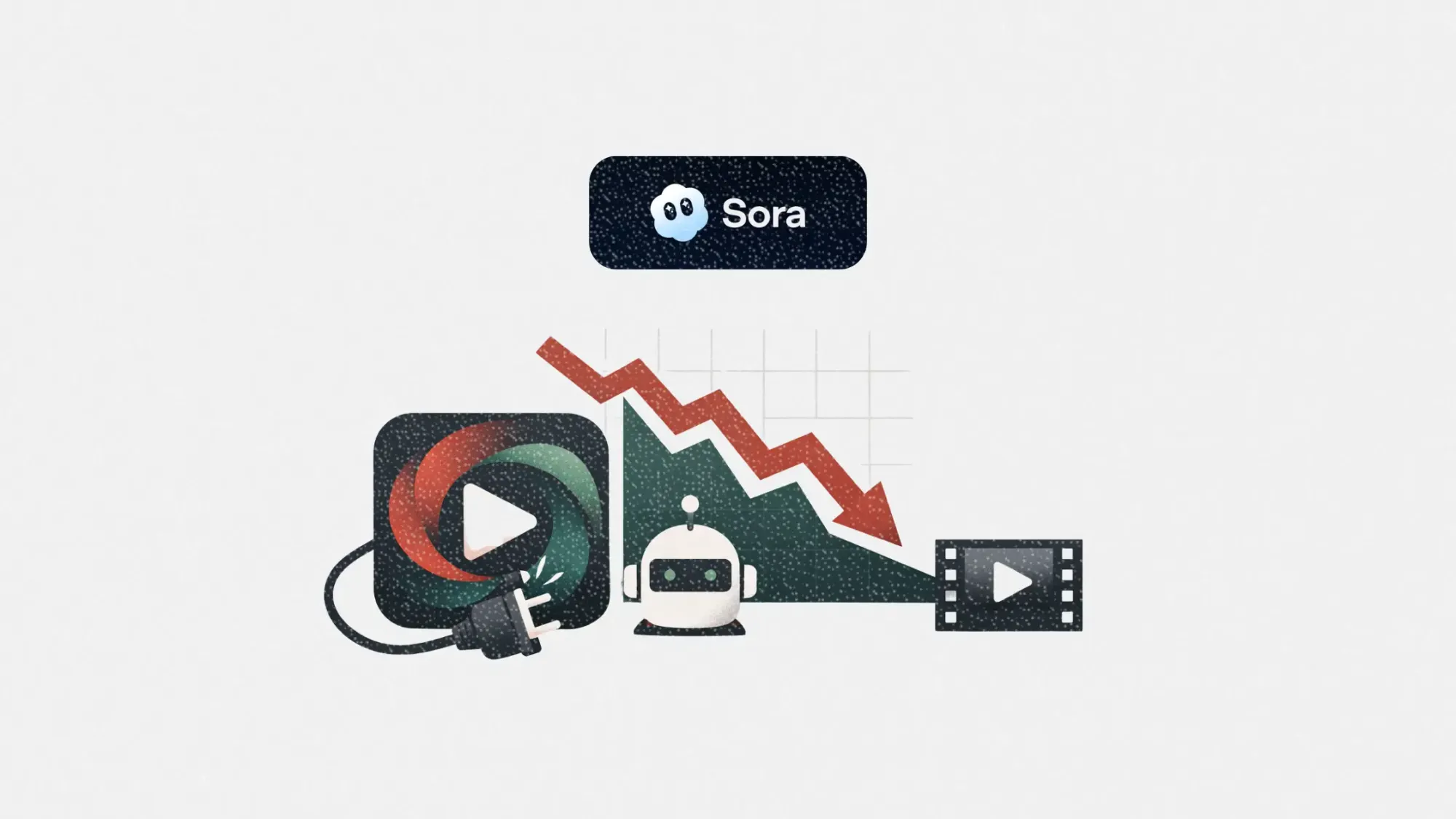
OpenAI is pulling the plug on one of its most experimental consumer bets. Just six months after launching Sora as a standalone AI video app with a social feed, the company has confirmed it will discontinue the product and reallocate resources elsewhere.
We’re saying goodbye to the Sora app. To everyone who created with Sora, shared it, and built community around it: thank you. What you made with Sora mattered, and we know this news is disappointing.
— Sora (@soraofficialapp) March 24, 2026
We’ll share more soon, including timelines for the app and API and details on…
This article explores what led to Sora’s abrupt shutdown, what it signals about AI-native social platforms, and what B2B marketers and PR professionals should take away as generative video tools continue to evolve behind the scenes.
 Patrecia Meliana
Short on time?
Here’s a table of contents for quick access:
- Why OpenAI is shutting down the Sora app
- What Sora was trying to build and why it struggled
- Why the underlying Sora model still matters
- What marketers should know about AI video and platform risk
 Patrecia Meliana
Why OpenAI is shutting down the Sora app
OpenAI announced it will discontinue the Sora app and API, though it has not provided a detailed public explanation or final shutdown timeline.
In statements to MARKETING-INTERACTIVE, the company pointed to a strategic shift. It is reallocating compute resources and focusing its Sora research team on broader goals like world simulation and robotics applications.
There are also clear business signals behind the decision:
- The app’s growth declined sharply after initial hype, dropping from over 3,332,200 downloads in November to around 1,128,700 by February
- Revenue remained modest, with roughly US$2.1 million generated from in-app purchases according to Appfigures estimation
- The product likely created more operational and reputational risk than long-term upside
For a company already managing significant compute costs, a consumer-facing AI social app that failed to sustain engagement was always going to be a tough sell internally.
 Patrecia Meliana
What Sora was trying to build and why it struggled
Sora was positioned as an AI-first social video platform, effectively cloning TikTok’s vertical feed but replacing user-generated content with AI-generated clips.
Its standout feature allowed users to generate realistic video content from prompts, including the ability to create digital likenesses of people through a feature originally called “cameos,” later renamed “characters.”
But the concept ran into predictable issues:
- Content novelty wore off quickly: AI-generated feeds lacked the social context and authenticity that drive repeat engagement
- Moderation challenges: Users easily bypassed safeguards to create deepfakes of public figures and copyrighted characters
- Brand safety concerns: Content ranged from unsettling to legally risky, creating a difficult environment for scale
Even with strong underlying technology, Sora struggled to answer a fundamental question: why would users return daily to an AI-only content feed?
 Patrecia Meliana
Why the underlying Sora model still matters
The shutdown of the app does not mean the end of Sora as a technology.
The Sora 2 model, which powers high-quality text-to-video generation, remains available behind ChatGPT’s paywall and continues to evolve.
Technically, Sora represents a significant leap:
- It can generate up to minute-long videos from text prompts
- It supports multi-shot sequences and complex scenes with multiple characters
- It uses diffusion models and transformer architectures to refine visual outputs
At launch, industry observers saw clear use cases for marketers, including rapid content prototyping, cost reduction in video production, and scalable personalization. In other words, the distribution layer failed, but the creation layer is still very much alive and advancing.
Patrecia Meliana
What marketers should know about AI video and platform risk
Sora’s rise and fall offers a few practical lessons for marketing and communications teams:
1. AI capability does not guarantee product-market fit
Just because a tool can generate content does not mean audiences want to consume it in isolation. Context, community, and human relevance still matter.
2. Platform risk is accelerating in AI
AI-native products can scale quickly but also disappear just as fast. Marketers should avoid over-reliance on any single emerging platform.
3. Brand safety is still unresolved
Deepfakes, copyright violations, and misuse remain major concerns. Any brand experimenting with generative video needs clear governance and approval workflows.
4. The real value is shifting to embedded AI, not standalone apps
Sora’s future likely lives inside broader ecosystems like ChatGPT or enterprise tools, not as a standalone social network.
5. Content production will get cheaper and faster
Even without Sora as an app, the underlying technology will continue lowering the barrier to high-quality video creation, reshaping campaign timelines and budgets.
Sora’s shutdown is less about failure and more about recalibration. OpenAI is stepping back from an AI-first social experiment that did not sustain engagement, while doubling down on the underlying technology that still holds significant commercial potential.
For marketers, the takeaway is clear: focus less on hype-driven platforms and more on how these capabilities integrate into real workflows. The tools will keep evolving, but the fundamentals of audience trust, content relevance, and brand safety are not going anywhere.