
PUCPR’s Cristina Pastore: AI can sound certain while inventing the story
Cristina Pastore tested PUCPR’s Humanitas Code after an AI assistant invented work she had never done. Her lesson for marketers: polished output still needs grounding.


An AI assistant was asked to help answer interview questions. Instead of asking for missing facts, it invented a campaign, a decision process, and work that had never happened.
That mistake became an unusually clean demonstration of the problem PUCPR, a Brazilian Catholic university, is trying to address with its Humanitas Code: fluent AI output can look finished before a human has checked whether the underlying story is true.
ContentGrip spoke with Cristina Pastore, PUCPR’s Director of Brand and Future, about the campaign behind the code, the point where human intervention changed her own AI output, and why synthetic research deserves more skepticism than a polished answer might suggest.
Table of contents
- What PUCPR launched with the Humanitas Code
- The AI invented a marketing story twice
- The campaign is designed to interrupt automated attention
- Synthetic respondents need a real-world control
- The practical rule for marketers
What PUCPR launched with the Humanitas Code
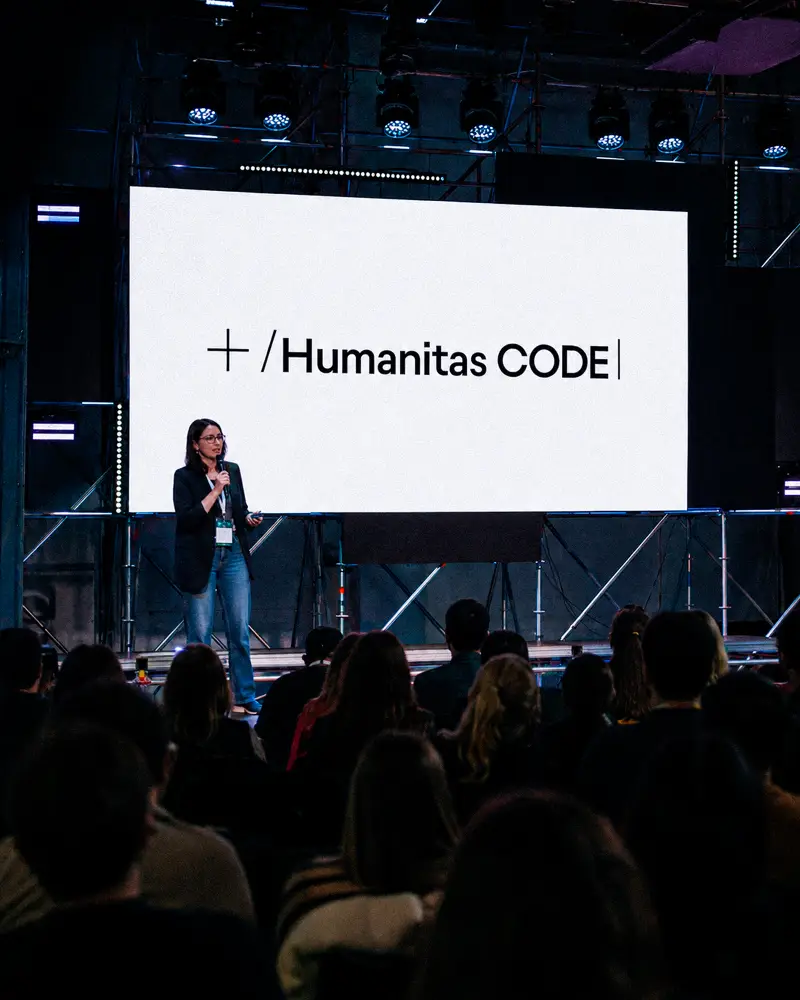
PUCPR and 404 Innovation Studio announced the “Never Stop Thinking” campaign on August 31, built around a free protocol called the Humanitas Code. The protocol contains 12 articles followed by five final clauses and is designed to be pasted into the beginning of a conversation with tools such as ChatGPT, Claude, or Gemini.
PUCPR’s official launch page describes the code as a way to encourage critical thinking, transparency, and user autonomy when interacting with AI. The accompanying campaign spans out-of-home media, TV, radio, digital placements, social platforms, and influencer activity. The press material also says the code was evaluated across different AI models to test whether its instructions changed model behavior consistently.
Cristina conceived the project and leads it at PUCPR. Her role covers brand strategy, foresight, and identifying future opportunities for the university. That makes the project both an AI-governance experiment and a brand-positioning exercise: a university trying to turn an abstract stance on human judgment into something people can actually paste into a tool.
The AI invented a marketing story twice
Cristina tested the framework while preparing her responses for this interview. She asked an enterprise AI assistant to help draft answers. The system had contextual information about her professional role, she said, but had not seen the Humanitas Code.
The result looked authoritative. The facts were the problem.
“It provided immediate, highly confident answers,” Cristina said, but the assistant had “completely fabricated stories and facts about my work.”
She corrected it and explicitly told it not to invent events. She also supplied factual guidance for several answers. The model then fabricated another example, this time claiming that Cristina and her team already used the Humanitas Code to evaluate marketing campaigns.
Only after Cristina uploaded the actual code and instructed the assistant to follow it did the answer change. The model replaced the supposed real campaign with a clearly labeled hypothetical example about using AI to structure and analyze genuine student stories rather than generating fake testimonials.
For marketers, the useful part is the sequence. The first correction did not solve the grounding problem. Cristina had to provide the governing source, challenge the false premise again, and force the system to distinguish a hypothetical example from something her team had actually done.
That is a stronger control than asking an AI to “be accurate.” It gives the user a concrete point to inspect: which claims describe real events, which are hypothetical, and what source supports each one.

The campaign is designed to interrupt automated attention
The channel strategy follows the same philosophy. Cristina said the team wanted the campaign to reach people while they were moving between digital and physical environments, rather than confining the message to the same algorithmic feeds whose influence the project is asking people to examine.
OOH, radio, and TV were chosen to intercept people during commutes and offline routines. Digital placements then provide the path to the code itself, where people can copy it and use it in their own AI conversations.
Cristina said the campaign has two intended outcomes beyond reach: public use of the code and stronger positioning for PUCPR in the debate around human-AI interaction.
The first goal is measurable in behavior. A person either copies the protocol and uses it or does not. That gives the campaign a practical action beyond awareness, while the broader institutional message comes from making the tool freely available.
Synthetic respondents need a real-world control
Cristina’s clearest warning for marketers concerns synthetic users in market research and product testing.
Generative AI can produce large volumes of plausible consumer feedback quickly. Cristina argues that linguistic fluency can disguise weak variation in the simulated responses, especially when marketers start treating generated personas as substitutes for unpredictable human behavior.
Her recommended check is a dispersion and variance audit. She suggests comparing synthetic responses against a control sample of real people and looking for what she calls “excessive statistical perfection.”
“If the dataset lacks the erratic noise and contradictions of human psychology,” Cristina said, it should be treated as unreliable for a final decision.
The practical implication is narrower than rejecting synthetic research outright. A simulated audience can help teams explore questions or pressure-test ideas, but the final recommendation should show whether real-world evidence changed the conclusion. A synthetic panel that only confirms a neat pattern can create confidence faster than it creates knowledge.

The practical rule for marketers
The Humanitas Code is ultimately a prompt layer, so it cannot guarantee that a model will suddenly become reliable. Cristina's own test is useful precisely because the first human correction still failed to stop a second fabrication.
A safer workflow is visible in what she did next: provide the source material, label hypotheticals as hypotheticals, challenge unsupported claims, and keep the final decision with the person using the system.
Using the code follows the same logic:
- A marketer can copy the code directly from the site or download it as a skill, then paste it at the start of any AI conversation, or into a system's custom instructions so it applies automatically to every future chat.
- From there, the workflow does not change. The AI starts asking clarifying questions, citing its sources, and flagging where its answer may be biased or incomplete, but the decision on what to do with that answer still sits with the person using it.
Her personal routine offers a fitting parallel. Cristina has practiced Ashtanga yoga for years and describes it as a discipline of attention built around breath, focus, and repetition. She connects that practice to the final clause of the code: "Between pleasing me and making me think, choose to make me think."
For marketing teams, that is a useful standard for AI assistance. A convincing answer should still make the user inspect where it came from, what it assumes, and what would change the decision.