Roblox now mandates facial age checks to chat
Roblox is rolling out mandatory age verification to access chat. Here's what this means for brand safety and platform marketing.

Roblox just took a major step toward age-gated safety by globally enforcing mandatory age verification for anyone who wants to use chat features. What started as a test in select markets has now expanded across the board, making Roblox the first major online gaming platform to require facial age checks for communication access.
This article explores what’s changed, why it matters for user safety and platform trust, and what marketers should consider as Roblox tightens the reins on who can talk and to whom on its platform.
Short on time?
Here’s a table of contents for quick access:
- What changed with Roblox chat?
- Why Roblox is implementing facial age checks
- What marketers should know about Roblox’s new safety rules
 Patrecia Meliana
What changed with Roblox chat?
As of this week, Roblox users worldwide must verify their age before gaining access to chat features. The age check comes in two forms:
- Facial verification via the user’s phone camera, processed by third-party vendor Persona.
- ID-based verification, available as an alternative for users aged 13 and older.
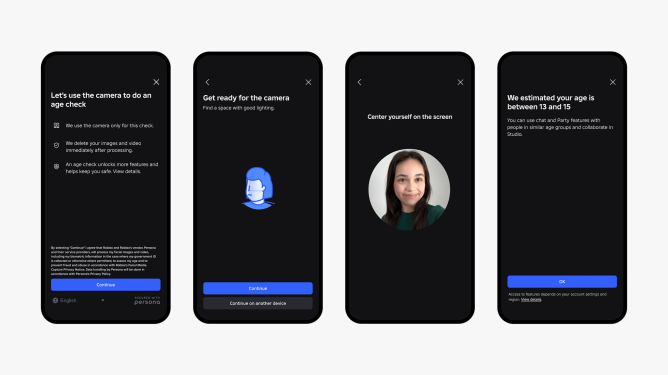
Users who skip verification can still play games but won’t be able to access any form of communication on the platform.
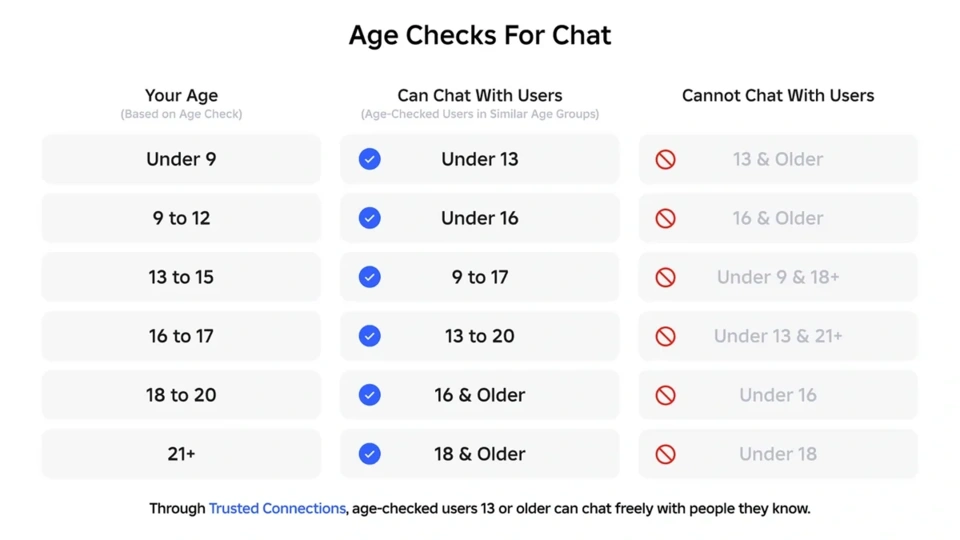
Once verified, users are sorted into six distinct age bands (under 9, 9–12, 13–15, 16–17, 18–20, and 21+). Each group can only chat with those directly above or below them in age. For example, a 12-year-old can message users aged 9 to 15, but not 18-year-olds.
For children under 9, chat remains disabled by default unless a parent opts in after verification. Roblox is also building tools to let kids message parents or siblings in different age brackets more easily.
 Patrecia Meliana
Why Roblox is implementing facial age checks
The global rollout follows months of public pressure, including lawsuits from attorneys general in Texas and Louisiana alleging that Roblox exposed minors to grooming and explicit content. In response, Roblox has overhauled its communication system with age-check gates designed to block inappropriate interactions across age groups.
Unlike traditional age-gate methods, like entering a birth year, Roblox’s system uses facial age estimation, which the company says has a mean absolute error of 1.4 years for users under 18. Processed by Persona, the data is deleted after verification to address privacy concerns.
The company also flagged that it’s using behavioral signals to monitor for suspicious age discrepancies. Users flagged by the system may be prompted to repeat the age-check process.
Roblox isn’t stopping here. Age verification will soon be required for developers using Roblox Studio’s real-time collaboration tools, indicating a broader strategy to limit interactions across age boundaries, even behind the scenes.
What marketers should know
Whether you’re a brand exploring in-game activations or an agency running influencer campaigns on Roblox, this policy shift marks a significant change in how the platform governs its ecosystem. Here’s what it means for your strategy:
1. Tighter communication = fewer direct touchpoints
Marketers can no longer assume easy access to young audiences through chat-based features or group messaging. Age-based segmentation limits interaction, and parental consent is now a prerequisite for younger users. This may affect campaign mechanics that rely on community chat or direct engagement.
2. Brand safety is stronger but needs monitoring
The new system enhances Roblox’s brand safety credentials, which could be a win for marketers in regulated industries or those targeting family-friendly segments. But it also puts pressure on brands to ensure in-game activations or influencer tie-ins align with new platform norms and don’t inadvertently bypass age gates.
3. Platform trust may improve but friction is rising
Mandatory age checks could increase trust among parents and regulators, but may also introduce friction for casual users or global markets with lower verification tolerance. Marketers should track user sentiment and opt-in rates closely to evaluate long-term audience accessibility.
4. Expect more segmentation in campaign design
With users confined to adjacent age brackets, campaigns must now consider the narrow social bubbles Roblox enforces. Content, messaging, and experiences will need to be tailored more carefully to ensure relevance within each allowed chat group.
Roblox’s shift toward mandatory facial age verification is a bold move that sets a new bar for communication safety on youth-centered platforms. While it introduces friction, it may also shield brands from the reputational risks tied to child safety failures.
For marketers, this means doubling down on trust, transparency, and tailored engagement. As platforms raise the bar on user protections, marketing strategies need to get smarter, not just louder.