How Samsung turned Apple launches into a 15-year content strategy
A chronological look at how Samsung has reused Apple launches, product choices and controversies to keep Galaxy in the same media cycle.

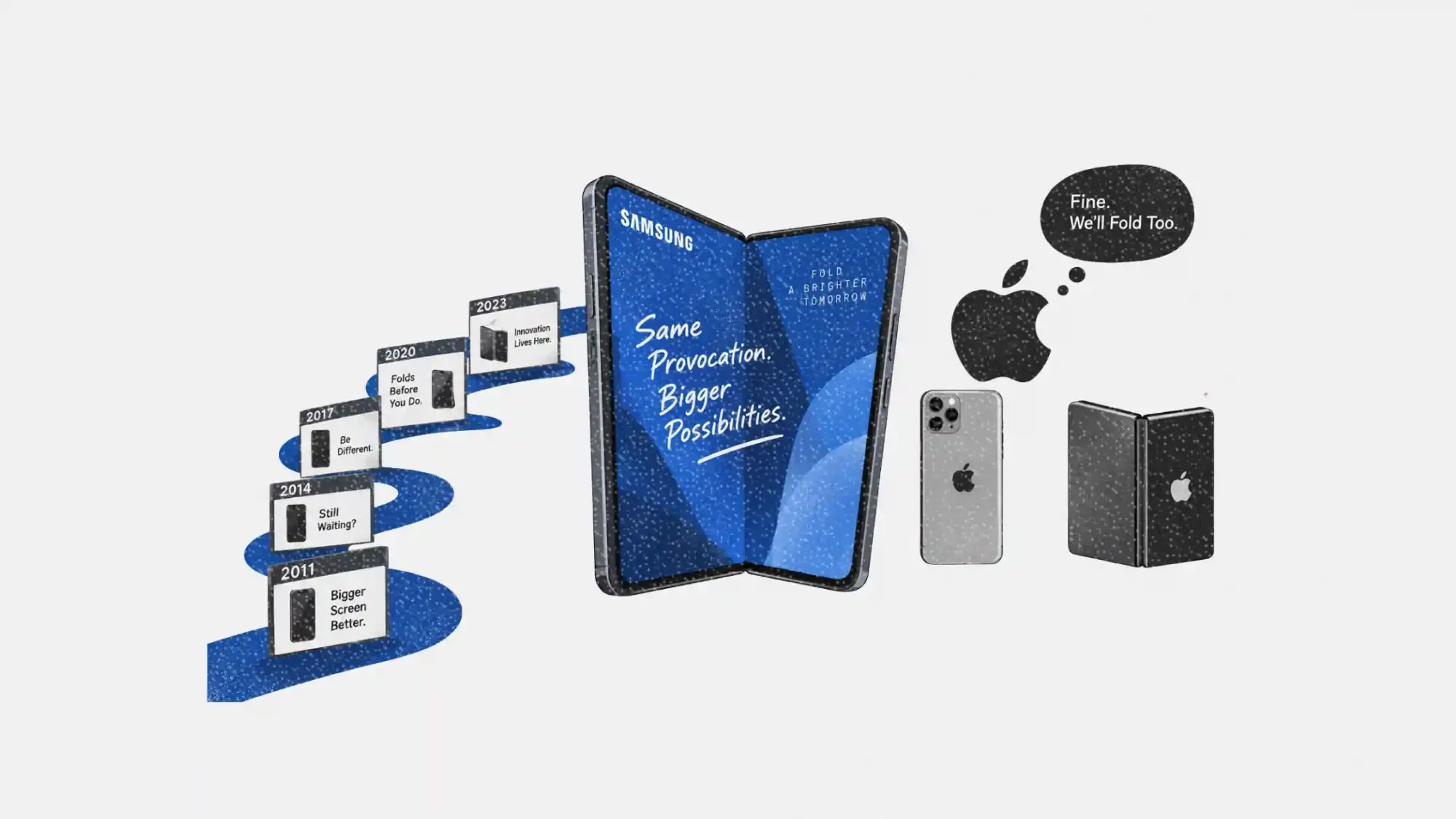
For four years, Samsung had a very simple joke waiting for Apple: “Let us know when it folds.” It was the kind of line that worked because everyone already understood the setup. Samsung had foldable phones. Apple did not. The joke barely needed a second sentence.
Then Apple unveiled the iPhone Duo, its first foldable iPhone, and Samsung suddenly had something better than a new joke: a payoff to an old one. The moment makes Samsung’s latest “Welcome to Foldables” video and post-launch jabs feel timely, but it also exposes a much longer pattern. Samsung has spent roughly 15 years turning Apple product launches, design choices, controversies and even Apple’s retail language into raw material for Galaxy marketing.
The interesting part is not simply that two technology giants like to troll each other. Apple rarely plays the rivalry the same way. Its competitive ads have often targeted Android or “your phone” broadly. Samsung repeatedly makes Apple itself a character, then uses that character to reinforce whatever Galaxy wants to claim at the time: bigger screens, more open storage, earlier foldables, more customization or simply a willingness to joke in public.
Table of contents
Jump to each section:
- 2011 to 2016: Samsung makes iPhone culture the setup
- 2017 to 2018: The rivalry becomes a recurring comedy format
- 2019 to 2021: Competitive jokes leave receipts
- 2022 to 2024: Apple launch day becomes Samsung media inventory
- 2026: The foldables joke comes full circle
- What marketers should know about the Samsung Apple playbook
2011 to 2016: Samsung makes iPhone culture the setup
1. 2011: “The Next Big Thing” turns the iPhone line into a character
Samsung’s modern Apple-baiting playbook is easy to recognize in its 2011 Galaxy S II work. People stand in lines outside stores, speculate about the phone they are waiting for and then notice Galaxy owners already using a larger-screen, 4G device. Apple and the iPhone are not named in every frame, but the reference is unmistakable.
The creative move matters because Samsung did not just compare specifications. It made iPhone launch culture itself the joke. The queue, the anticipation and the social identity around owning the latest iPhone became recurring characters that Samsung could revisit whenever Apple had another release.
2. 2012: The iPhone 5 becomes a comparison prop
A year later, Samsung returned to the same line-waiting setup around the iPhone 5. A Galaxy S III commercial covered by Wired contrasted Apple fans’ excitement with features Samsung could already point to, including a larger display and NFC-based sharing.
Samsung also ran a print comparison headlined “It Doesn't Take a Genius”. That title did two jobs at once. It mocked the iPhone 5 comparison while borrowing language closely associated with Apple’s retail experience. The rival was becoming more than a product benchmark. Apple’s own brand vocabulary was becoming creative material.
3. 2015: “6 > 6” makes the product name part of the punchline
By 2015, Samsung could compress the rivalry into three characters. The “6 > 6” campaign put Galaxy S6 Edge features against the iPhone 6, emphasizing the curved display, wireless charging and camera functions.
The format is worth noticing. Samsung did not need to introduce Apple or explain why the comparison mattered. The audience already knew which two premium phones were being compared, so the creative could spend its time turning individual product differences into short, easy claims.
4. 2016: Samsung borrows Apple’s own camera language
Samsung’s “Captured on Galaxy S7” work went one step further by echoing Apple’s “Shot on iPhone” framing. Instead of merely attacking an iPhone weakness, Samsung borrowed a familiar Apple advertising format and redirected attention toward the Galaxy S7 camera.
Across these first years, a pattern had formed. Apple launches gave Samsung a predictable cultural setting, but the joke still needed a product claim underneath it. Bigger screens, 4G, sharing, charging and camera performance were the substance. The rivalry was the packaging that made those claims easier to notice.
2017 to 2018: The rivalry becomes a recurring comedy format
5. 2017: Apple says “switch,” but keeps Samsung mostly unnamed
Apple did run competitive creative. Its 2017 “Switch to iPhone” campaign included short spots about photos, speed, privacy and moving from another phone to iPhone. But the framing was usually broader: switch from Android, or switch from “your phone.”
That difference helps explain the strange asymmetry in the rivalry. Apple can sell against a category. Samsung often sells against Apple as a recognizable cultural object. That does not mean Apple has never targeted Samsung specifically, but Samsung has been far more consistent about making the rival itself part of the entertainment.
6. 2017: “Growing Up” turns a decade of iPhone ownership into the joke
Samsung’s “Growing Up” ad followed one man through years of iPhone ownership before he eventually moved to Galaxy. Storage limits, water resistance, stylus use and dongles all became chapters in the same story. The final image returned to the familiar iPhone launch line.
This was more ambitious than a launch-day quip. Samsung turned the accumulated memory of past iPhone frustrations into a narrative arc. The audience did not need to remember every product specification. It only needed to recognize the feeling of watching two smartphone ecosystems trade advantages over time.
7. 2018: “Ingenius” makes the Genius Bar itself the set
The next year, Samsung made the Apple Store parody even more explicit. Its “Ingenius” shorts staged conversations at a fake Genius Bar, with customers asking about limitations Samsung wanted to highlight. The series included the notch, storage and multitasking.
By this point, Samsung had a reusable comedy world. Apple stores, launch lines, Genius language and iPhone-owner stereotypes could be remixed around whatever Galaxy advantage needed attention next. That made competitive advertising cheaper conceptually. The brand did not have to invent a new relationship every time. The audience already knew the roles.
2019 to 2021: Competitive jokes leave receipts
8. 2019: The headphone-jack joke becomes a liability
A repeatable rivalry has one obvious risk: the internet remembers. In 2019, Samsung removed ads that had mocked Apple’s missing headphone jack as Samsung prepared phones without the same port.
This is the less glamorous side of reactive marketing. A punchline built on “we would never do that” can age badly when product strategy changes. Competitive content creates receipts, and the sharper the original joke, the easier it is for audiences and media to resurface it later.
9. 2020: The charger joke creates another receipt
The same thing happened again after Apple stopped including a charger in the iPhone box. Samsung mocked the decision, then deleted the post as reports pointed toward a similar move.
Those reversals did not end the strategy, but they reveal an important constraint. Samsung’s best Apple jokes tend to work when they are attached to an advantage it can credibly hold for a while. The more permanent the brand sounds, the more painful a later product reversal can become.
10. 2021: iTest stops joking and lets iPhone users try Galaxy
Samsung’s iTest campaign changed the competitive mechanic. Instead of telling iPhone owners that Galaxy was better, it let them simulate a Samsung experience on the iPhone itself. A web experience recreated elements of Samsung’s interface without requiring someone to change phones first.

The idea still depended on the same Apple-versus-Samsung tension, but it used curiosity rather than ridicule. D&AD later recognized iTest with a Black Pencil. More importantly for the longer pattern, Samsung had found another way to make Apple’s installed base part of its own media environment. This time, the iPhone was not only the rival product. It was the demo screen.
2022 to 2024: Apple launch day becomes Samsung media inventory
11. 2022: “Let us know when it folds” turns keynote night into Samsung content
When Apple introduced the iPhone 14 lineup, Samsung Mobile US did not need a full campaign film to join the conversation. It could simply post through the event. The line that lasted was “Let us know when it folds,” a compact way to remind people that Samsung already had years of foldable products behind it. Another post looked at the Apple Watch Ultra and joked, “A little boxy”.
Let us know it when it folds. 💁♀️
— Samsung Mobile US (@SamsungMobileUS) September 7, 2022
This is where the strategy starts to look less like conventional comparative advertising and more like an editorial calendar. Apple already guarantees an audience on launch day. Samsung’s job is to identify the part of the announcement that can be reframed through a Galaxy advantage, then publish fast enough to become part of the same media cycle.
12. 2023: “Join the Flip Side” turns switching into a running story
Samsung kept building around foldables with “Join the Flip Side”, a campaign platform that treated the attraction of a folding phone almost like something contagious. The joke was no longer only that Apple lacked a foldable. Samsung was trying to make folding feel like a behavior people could be tempted into.
That matters because a rival can only carry a campaign so far. “Apple does not have this” is useful during the comparison. “You might want to live like this” gives the category its own identity. The strongest competitive campaigns eventually have to make the promoted behavior interesting even when the rival is not on screen.
13. 2024: “UnCrush” lets Samsung answer an Apple controversy without a launch
When Apple’s “Crush!” iPad Pro ad drew criticism for showing creative tools and objects compressed in an industrial press, Samsung responded with “UnCrush”. Its message was that creativity should not be crushed.
This was a useful evolution of the playbook. Samsung did not need Apple to announce a competing phone. Any high-attention Apple brand moment could become an opening if Samsung had a relevant counter-position. The trigger was controversy, not a specification sheet.
14. 2024: WWDC becomes live commentary
A month later, Samsung used Apple’s software announcements as another source of posts. On Apple Intelligence it wrote, “Adding Apple doesn’t make it new or groundbreaking. Welcome to AI.” On iOS 18 home-screen customization, it reminded followers that it had been moving icons freely since 2010.
The specific feature changes. The content mechanism does not. Wait for the Apple moment, find the feature Samsung can claim it reached earlier, compress the advantage into a social-native line and let Apple’s launch attention do part of the distribution work.
2026: The foldables joke comes full circle
15. 2026: “Welcome to Foldables” arrives before Apple can own the category moment
Apple’s first foldable created the most obvious Samsung opening in years. The brand had spent multiple launch cycles treating folding as evidence that Galaxy was ahead. As the iPhone Duo arrived, Samsung released a “Welcome to Foldables” film that showcased its own foldable range while Apple was about to enter the category.
The clever part is the timing. Apple was introducing a new product, but Samsung could frame the moment as an arrival into Samsung’s existing world. That lets the challenger steal a little of the category narrative without needing to launch a new Galaxy device on the same day.

16. 2026: The old fold joke finally pays off
Samsung Mobile US also revived the tone of its older launch-night posts. Current coverage captured lines including “Welcome to the fold” and “Let us know when you're done reheating our leftovers,” while another Samsung response to the iPhone Duo leaned on the idea that the new form factor felt familiar. Marketing-Interactive tracked the wider wave of reactive brand posts around the launch.
The 2022 “Let us know when it folds” line now reads differently. Back then, it was a feature gap. In 2026, Apple closed that gap. Samsung could no longer rely on “you do not make this” forever, so the argument naturally shifts toward experience: we have been doing this longer, you are arriving where we already are.
17. 2026: Samsung finds a Tim Cook who will switch
Samsung New Zealand then found another way to keep the story going. Its latest social work features a New Zealander named Tim Cook trying a Galaxy foldable, an obvious name-based wink at Apple’s former chief executive. The campaign turns the switch itself into the joke, without pretending the Apple executive is involved.
That is the playbook in miniature. An Apple moment creates the attention. Samsung looks for a product advantage, an old joke, a cultural reference or even a name it can repurpose. The resulting content does not need Apple to respond. It only needs people to understand the rivalry quickly enough for the punchline to land.
What marketers should know about the Samsung Apple playbook
Samsung’s advantage is not simply that it is willing to make jokes. It has turned competitive marketing into a repeatable content system, with Apple launches acting as predictable moments when that system can switch back on.
1. Give the rival a stable role in the story.
Samsung has spent years casting Apple as the premium incumbent that Galaxy can tease for arriving later, restricting a feature or asking users to accept a trade-off. Because that role is familiar, each new campaign can start halfway through the conversation. The audience already understands the setup.
2. Treat competitor launch calendars like editorial calendars.
Apple events are guaranteed attention moments. Samsung repeatedly prepares for them as if they were media opportunities of its own. That does not require matching Apple’s production budget or launching hardware on the same day. A fast post can work if the brand already knows which competitive truth it wants to reinforce.
3. Make the joke carry a product point.
The lines that last tend to sit on top of a simple claim: Samsung had the larger screen, the more flexible storage, the more customizable interface or the foldable phone first. Humor earns the look. Product difference gives the joke a reason to exist beyond a few minutes of social chatter.
4. Leave yourself room to change.
The headphone-jack and charger episodes show the danger of turning a temporary product choice into a permanent moral position. Competitive jokes are searchable history. Brands should be careful with any line that could become embarrassing if the category moves and their own product roadmap follows.
5. A rivalry does not need equal participation.
Apple’s competitive advertising has often talked about Android or switching in broad terms. Samsung benefits from being more specific. By repeatedly naming, depicting or unmistakably referencing Apple, Samsung can frame the relationship as an ongoing public rivalry even when Apple does not answer each jab.
That asymmetry is part of what makes the strategy useful. Samsung gets a recurring antagonist, a predictable set of cultural moments and a shorthand for explaining Galaxy differences. Apple does not have to cooperate for the format to work.
The iPhone Duo closes one of Samsung’s oldest openings. Apple now folds too. But the last 15 years suggest Samsung will simply move the joke to the next point of difference. The durable asset was never one punchline. It was the habit of treating a competitor’s biggest moments as content opportunities of its own.