Searchable says AI visibility scores miss most buyer prompts
Searchable's Prompt Universe maps buyer questions before choosing what to track, challenging narrow AI visibility scorecards.


Searchable has launched Prompt Universe, a feature designed to map the range of questions buyers could ask AI about a brand before deciding which prompts are worth tracking.
The company describes Prompt Universe as a market map built around products, audiences, competitors and buying situations. The bigger argument behind the launch is more consequential than the feature itself: an AI visibility score can look precise while still resting on a narrow, unrepresentative sample of buyer questions.
Table of contents
Jump to each section:
- What Prompt Universe changes
- Why prompt selection is becoming the measurement problem
- The category is splitting between breadth and relevance
- What marketers should know about AI visibility tracking
What Prompt Universe changes
Prompt tracking usually begins with a list. A marketing or SEO team chooses questions it thinks customers might ask ChatGPT, Gemini or another answer engine, then monitors whether the brand appears, gets cited or is recommended.
Searchable is trying to move the list-building step earlier and make it more systematic. Prompt Universe first models a broader question space around a business, then narrows that space into a representative tracking set. The company says the map can incorporate products, audiences, competitors, locations and buying situations, rather than treating a prompt as a standalone keyword-like string.
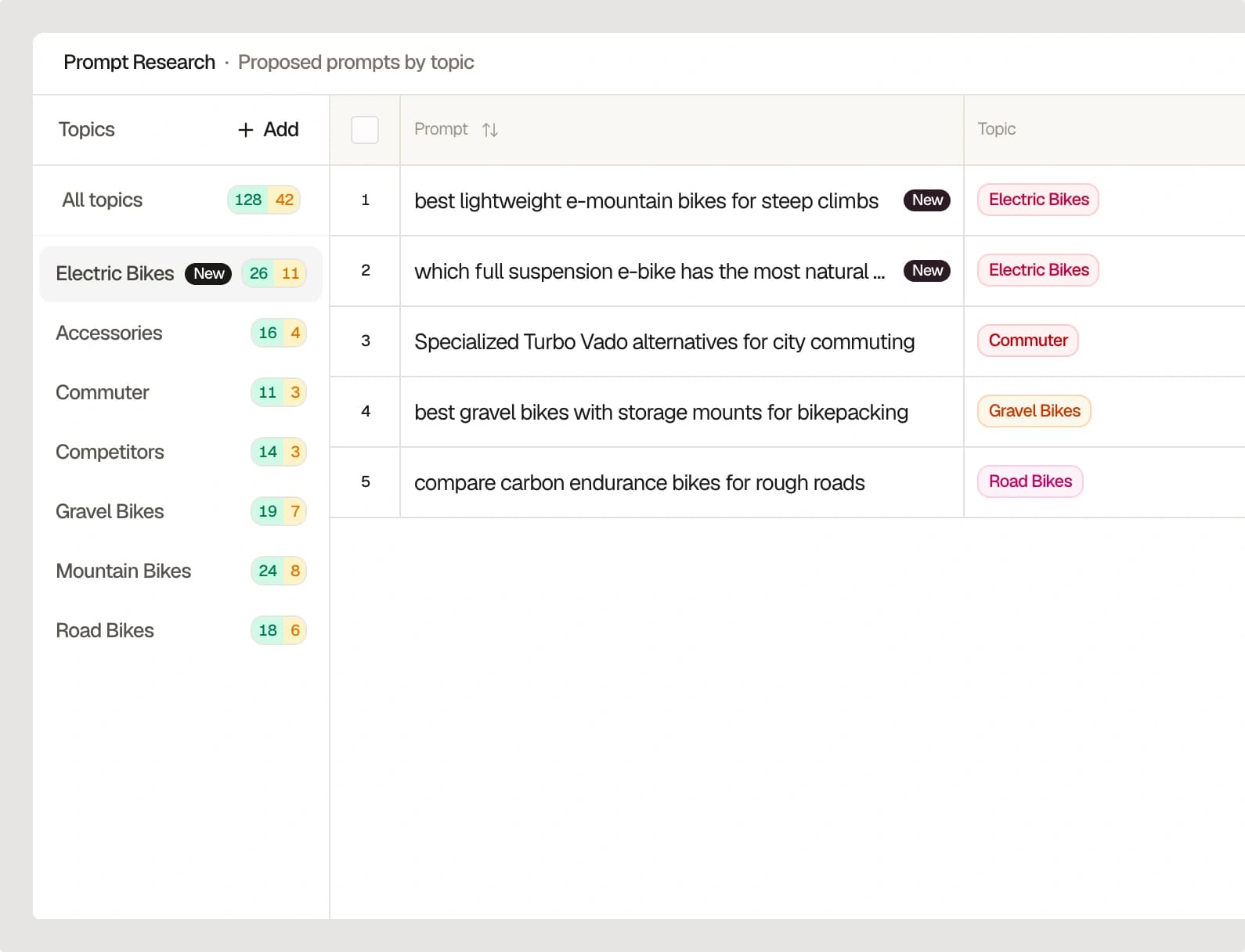
115,000+ possible prompt permutations, narrowed to 33,000+ prompts for consideration were mapped in Searchable's Delta Air Lines example, according to Searchable's supplied launch materials.
Those figures are not search volume. Searchable explicitly says the universe is a model of possible buyer questions, not a record of private ChatGPT conversations or a count of questions people have actually submitted.
That distinction matters because a large prompt universe is useful as a coverage map, not as a mandate to monitor everything inside it.
Chris Donnelly, Searchable's CEO and co-founder, put the measurement problem this way: "Most brands track a few hundred prompts they guessed. Prompt Universe maps the questions buyers could ask AI about your business, often in the hundreds of thousands. Then we narrow that down to the set worth tracking."
The strategic change is subtle: prompt research is moving from an onboarding chore into part of the measurement model.

Why prompt selection is becoming the measurement problem
AI visibility dashboards often compress many prompt-level results into a single score. That creates a familiar analytics problem. The score can be mathematically correct and still be strategically misleading if the underlying sample is poorly chosen.
Searchable says businesses moving from other providers sometimes arrive with prompt sets that represent only a small share of what it considers relevant coverage.
As little as 2% of relevant prompt coverage, and below 0.3% for many larger businesses is the gap Searchable says it has observed in some incoming customer setups, according to the company's launch materials.
Those percentages are company-reported and depend on Searchable's own definition of the relevant prompt universe. They should not be read as an independent benchmark for the whole AEO market.
Even with that caveat, the methodological question is real. A visibility score for a carefully selected set of buying questions means something different from a score built from a short list of generic comparison prompts.
The common assumption is that better AI visibility measurement requires tracking as many prompts as possible. The more useful reality is almost the opposite. Exhaustive tracking is difficult, expensive and noisy. What matters is whether the sample covers the business questions that could actually change a buyer's decision.
A prompt should not earn a place because it is easy to imagine. It should earn a place because it represents an important part of the market.
Ivan Slobodin, Searchable's founding AEO product lead, summarized that principle in the launch: "Every prompt has to earn its place in AI visibility tracking."
The category is splitting between breadth and relevance
Searchable is not the only company trying to solve prompt selection. The wider AI search tooling market is moving beyond simple monitoring and toward prompt research, segmentation and prioritization.
Profound lets teams build prompts manually or with a prompt builder, organize them by audience and region, and validate prompt ideas against its own dataset of AI conversations. SE Ranking argues for intentional prompt sets tied to buyer intent and warns that larger tracking lists can add cost without improving the quality of the measurement.
| Approach | How prompt selection is handled |
|---|---|
| Searchable Prompt Universe | Maps a broad modeled question space, then recommends a representative tracking set. |
| Profound | Combines prompt creation, segmentation and data-based prompt validation before daily tracking. |
| SE Ranking | Emphasizes focused prompt sets built around buyer intent, category relevance and manageable monitoring scope. |
The tools differ in method, but they point toward the same market shift: prompt discovery is becoming part of the measurement product, not a setup task that sits outside it.
That changes what marketers should ask vendors. The key question is no longer only which AI engines are tracked or how often the dashboard refreshes. Teams also need to understand how the prompt set was constructed, what parts of the buying journey it represents, and which dimensions are missing.
An AI visibility score without a clear sampling method risks becoming a polished answer to an undefined question.
What marketers should know about AI visibility tracking
AI visibility measurement is still young enough that teams can easily confuse precision with representativeness. The dashboard may show a score to one decimal place, but the business meaning of that score still depends on the prompts underneath it.
Audit the denominator. Before comparing visibility scores across brands, periods or vendors, check which prompts are included and whether they cover the same products, audiences and buying situations.
Separate universe size from demand. A modeled prompt universe shows what buyers could ask. It does not automatically show how often each question is asked, so marketers should avoid treating modeled breadth as observed market volume.
Treat visibility as sampled measurement. A prompt set is closer to a research panel than a keyword database. Its value comes from how well it represents the decisions marketers care about.
Tie prompts to commercial questions. A narrower prompt set connected to revenue drivers, product priorities and buyer stages can be more useful than a much larger list that produces cleaner-looking dashboards but weaker decisions.
The deeper shift is that AEO is becoming a measurement-design discipline as much as an optimization discipline.
Traditional SEO gave marketers a relatively stable unit of analysis in the keyword. AI search weakens that stability because the same underlying intent can be expressed in countless conversational forms, with different context layered into each request.
That means the next generation of AI visibility tools may compete less on who can track the most answers and more on who can define the right sample of questions before the tracking begins.