
Taco Bell and Duolingo turn Taco Day into a global language stunt
Taco Bell and Duolingo turn Global Taco Day into a multilingual campaign spanning sauce, rewards, collectibles and live events.


Taco Bell and Duolingo have found a partnership idea that barely needs translation: the word “taco” already travels.
For Global Taco Day on October 6, the two brands are turning that linguistic shortcut into a campaign that moves between food, language learning, collectibles and live experiences. Taco Bell brings the ritual and restaurant footprint. Duolingo brings Duo, streak culture and the kind of internet personality that can make a sauce packet feel like part of a joke rather than ordinary packaging.
Table of contents
- How one word becomes the campaign idea
- Why Duo is more than a mascot cameo
- How the promotion connects app and store behavior
- What marketers can learn from the partnership
How one word becomes the campaign idea
Taco Bell says the word “taco” is recognizable across more than 30 languages. That gives the brand a simple reason to take a food holiday that has largely been framed around the U.S. and make it global.
30+ languages recognize the word “taco,” according to Taco Bell.
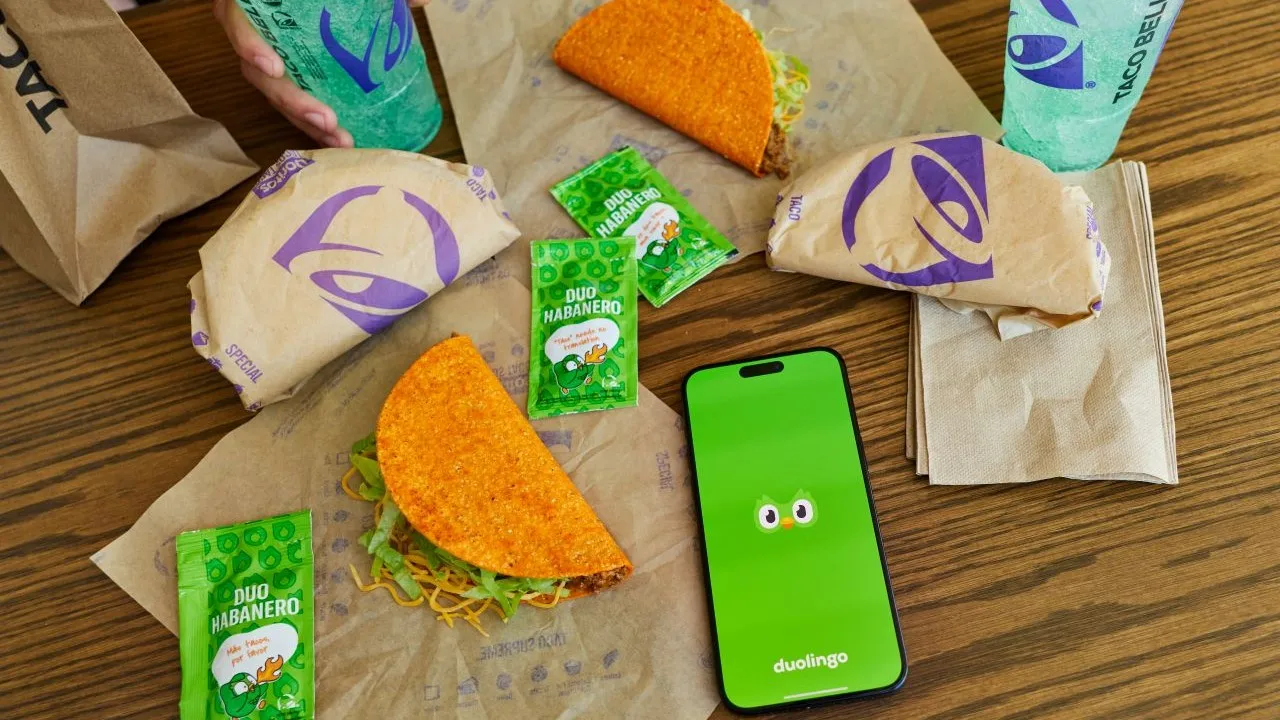
The campaign’s most visible product is Duo Habanero Sauce. The packets carry taco-themed lines in nine languages, including English, Spanish, French, Hindi, Portuguese, German, Korean, Mandarin and Japanese. International assortments are designed around local languages and the languages people are learning in each market.
The campaign is running across the U.S., Canada, Australia, China, India, Spain and the UK, while Taco Bell and Duolingo are also staging in-person moments in New York City, Mumbai, Toronto and Shanghai.
Luis Restrepo, Taco Bell North America’s chief marketing officer, described the idea as a celebration of the connections tacos create between people. The useful part of that framing is that localization is not treated as an afterthought. Language is the creative device.

Why Duo is more than a mascot cameo
Duolingo contributes more than a recognizable character. Taco Bell Rewards members can unlock a free month of Super Duolingo under campaign terms, so the collaboration moves people into Duolingo’s actual product rather than stopping at co-branded imagery.
The brands are also releasing 1,000 Taco Bell x Duo plushies globally. In the U.S., Rewards members can enter through Taco Bell’s Tuesday Drops page. The plush dresses Duo in a Taco Bell uniform with a miniature headset, turning the mascot into a collectible tied to the restaurant brand.
That matters because Duo already behaves like a character people encounter outside language lessons. Duolingo’s marketing repeatedly uses the owl’s personality as campaign material. Taco Bell is borrowing that established behavior rather than asking audiences to understand a new mascot story from scratch.
How the promotion connects app and store behavior
The campaign links several actions that would normally sit in different channels. In the U.S., customers can receive a Duo Habanero Sauce packet with a Doritos Locos Taco. Taco Bell Rewards members can unlock Super Duolingo. The plush drop adds scarcity. The restaurant takeovers add a physical event layer.
Each piece gives the partnership a different reason to exist. The sauce makes the idea visible at the point of purchase. The subscription reward moves customers into Duolingo. The plush gives collectors something tangible. The city activations turn the campaign into a place people can visit.
None of those mechanics alone is especially complicated. Their value comes from sharing the same core idea, so the campaign feels like one collaboration rather than a list of unrelated promotional tactics.
What marketers can learn from the partnership
- Start with the overlap people can understand immediately. “Taco” as a shared word gives the partnership a clean reason to exist.
- Give each brand a job. Taco Bell owns the food ritual and physical footprint. Duolingo owns language learning and mascot culture.
- Let the campaign enter the products. Sauce packets, app rewards and restaurant experiences make the collaboration something people can use, not just watch.
- Use collectibles when the character already has recognition. Duo can carry merchandise because the mascot already has a distinct identity.
- Localize the expression, not the central idea. The same campaign can move across markets while the language mix and events change around it.
Taco Bell and Duolingo do not need to force a complicated connection between their businesses. The campaign works because it starts from a tiny cultural fact that is easy to repeat: people may speak different languages, but they already know what a taco is.