
Telstra turns Steve Buscemi's space villain into a repeatable brand character
Telstra brings back Steve Buscemi's space villain, showing how serialized characters can make a functional network benefit more memorable.


Telstra is bringing back Steve Buscemi's intergalactic villain for another round.
That makes the new campaign more interesting than a standard celebrity sequel. The Australian telco is not only reusing a famous face. It is building a recurring brand character around a functional product benefit: network safety.
The latest chapter brings back Buscemi as an alien emperor whose plans keep getting stopped by Telstra's network. Created by Bear Meets Eagle On Fire with +61, the campaign rolls out across TV, digital, social, cinema and Telstra stores.
For marketers, the useful idea is the repetition. Telstra has taken a service feature that can be difficult to dramatize and placed it inside a recognizable entertainment world that can keep generating new stories.
Table of contents
Jump to each section:
- Why the sequel matters more than the celebrity return
- How Telstra turns network safety into character comedy
- Why product proof keeps the joke grounded
- What marketers can learn from recurring campaign worlds
Why the sequel matters more than the celebrity return
Bringing a celebrity back can easily feel like repetition for its own sake. Telstra gives the return a clearer job.
In the first campaign, launched in 2025, Buscemi played an intergalactic emperor trying to outsmart Telstra's network. The company described that work as an entertaining product demo designed to differentiate the network on safety as well as scale.
The 2026 campaign keeps the same central conflict but expands the number of stories around it. Telstra Head of Brand and Marketing Communications Alita McMenamin described the new work as a second chapter that raises the stakes.
That structure matters because it moves the celebrity from spokesperson to character.
Buscemi does not need to explain the product in every execution. His role is to create the problem. Telstra's network resolves it. The pattern is simple enough to repeat, while the situations, supporting characters and jokes can change.
How Telstra turns network safety into character comedy
Network safety is important, but it is not naturally visual.
Telstra solves that problem by personifying the threat as a recurring villain. The space-opera setting gives the campaign a reason to be exaggerated, while the product role stays straightforward: the villain tries something, and the network stops it.
The creative also avoids the visual language that often makes safety advertising feel interchangeable. Instead of serious warnings, dark dashboards or generic phone screens, Telstra uses a cinematic sci-fi world with recurring characters and production design.
That gives the brand a distinctive way to talk about the same benefit more than once.
The campaign is also modular. Campaign Brief Asia says the new work consists of several individual narratives in different formats, with distribution spanning TV, digital, social, cinema and Telstra stores. One fictional world can therefore produce multiple assets without forcing the brand to invent a new premise for every placement.
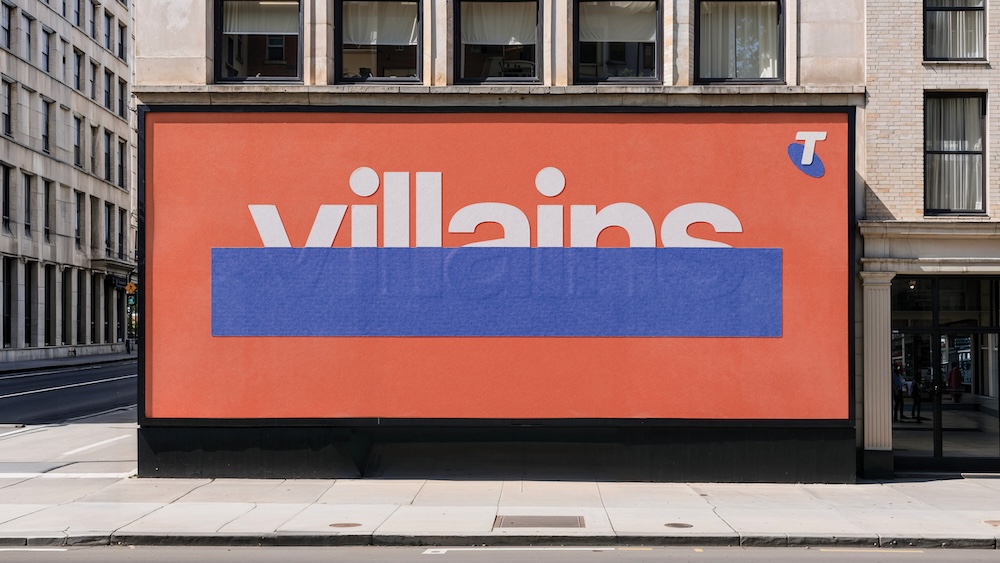
Why product proof keeps the joke grounded
The entertainment works because Telstra can connect it to a real service behavior.
On its own network-safety page, Telstra says that since 2024 it has blocked an average of 21 million scam calls and 11 million scam SMS every month. Those figures give the campaign a concrete product truth underneath the fictional villainy.
The category context is serious too. Scamwatch's 2025 Targeting Scams report records A$2.18 billion in combined reported losses across its contributing data sources.
That gap between serious problem and comic execution is what gives the campaign its tension.
The humor can make the message easier to watch, but the joke does not replace the product claim. It gives the claim a more memorable narrative shape.
This is the important boundary for marketers. A recurring character can carry attention, but it still needs something durable underneath it. Without a consistent product role, the character risks becoming entertainment that could belong to almost any brand.
What marketers can learn from recurring campaign worlds
Telstra's sequel offers a practical way to think about celebrity campaigns beyond the launch moment.
- Cast a celebrity as a character, not only a spokesperson. A defined role gives the partnership somewhere to go after the first ad.
- Keep one conflict stable. Telstra can change the individual story because the central problem remains the same.
- Build a world that can produce multiple assets. A recognizable setting and cast make it easier to create cutdowns, sequels and channel-specific executions without rebuilding the campaign from zero.
- Anchor the entertainment in a product behavior. The network has a clear role in every story, which keeps the creative connected to what Telstra actually sells.
- Use repetition to create memory, not sameness. The recurring structure should be familiar while the execution still gives audiences something new to notice.
There is no verified public evidence yet showing whether the new chapter has improved brand lift or commercial performance.
What is already clear is the creative architecture. Telstra is treating Steve Buscemi's villain as more than a one-off celebrity appearance. The character is becoming a reusable device for turning an invisible network benefit into a story people can immediately understand.
