Salesforce rolls out Agentforce for Communications for telco AI agents
Salesforce launches Agentforce for Communications, offering telcos AI agents to automate sales, service, and boost customer engagement.

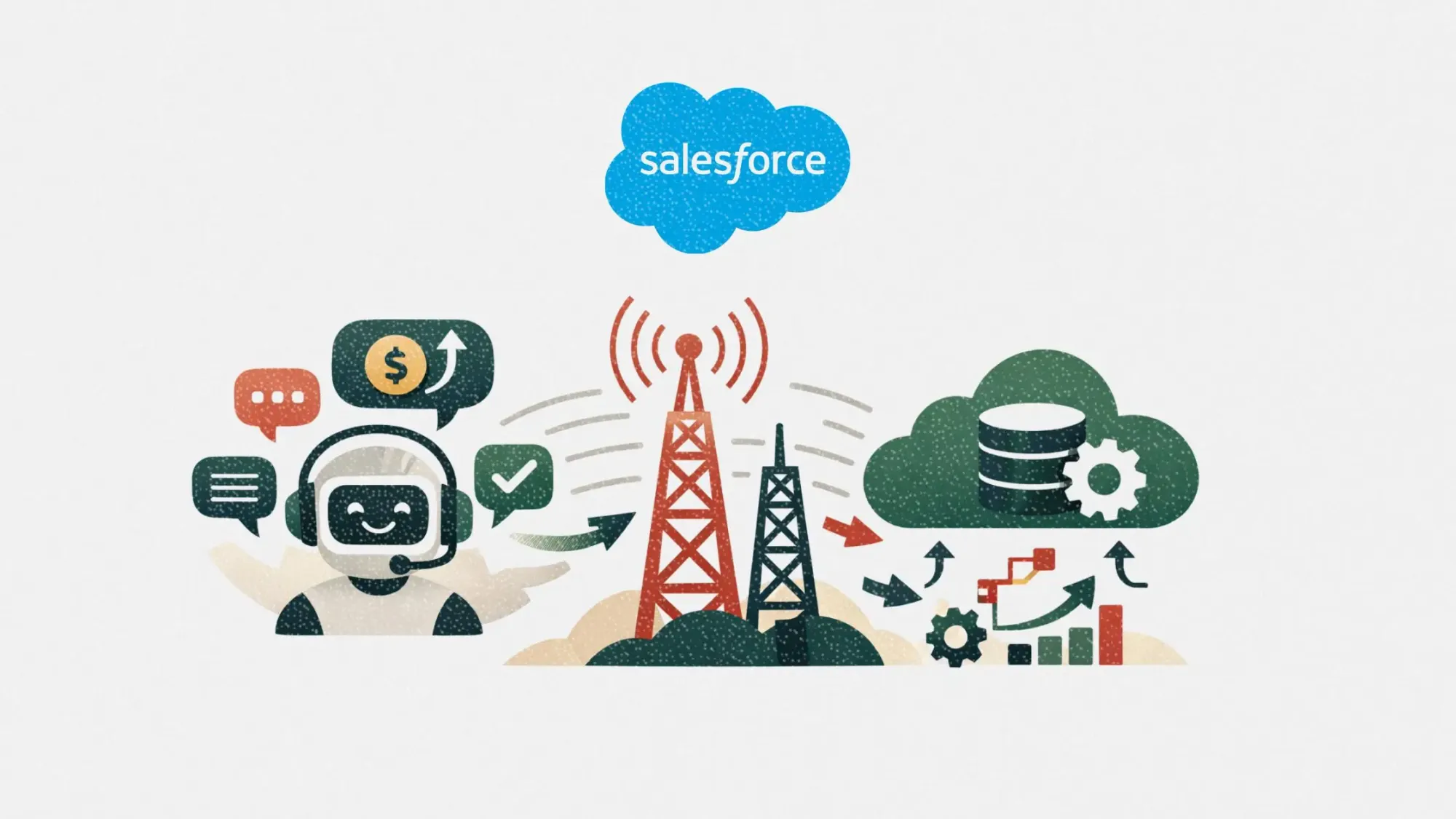
Salesforce has released Agentforce for Communications, a telco-focused set of AI agents designed to automate and improve workflows across sales, customer service, and field operations.
The launch targets a telecom sector facing slowing growth and high churn, with Salesforce positioning “agentic” automation as a way to reduce manual work while turning service interactions into upsell and retention moments.
Short on time?
Here’s a quick look at what’s inside:
- What Agentforce for Communications includes
- Why telcos are pushing harder on retention and efficiency
- How it compares with telco software vendors and in-house builds
- What marketers at telecom brands should do next
What Agentforce for Communications includes
Agentforce for Communications is positioned as domain-specific AI agents that operate with context from customer experience, billing and service history, and product offerings. The key promise is autonomy within constraints, rather than a generic chatbot experience.
Salesforce says the release includes multiple agents out of the box, such as:
- Billing resolution agent
- Service level objective insights agent
- Quoting agent
- Site grouping agent
- Guided sales agent
Availability is staggered: Billing Resolution, Quoting and Site Grouping are available now, while Service Level Objective Insights and Guided Selling are expected later.
From a go-to-market perspective, this packaging matters because it frames “agents” as role- and workflow-specific building blocks. That reduces the burden on telecom teams to start from scratch when deploying AI into revenue operations and customer care.
 Valery Moniaga
Why telcos are pushing harder on retention and efficiency
Telecom operators are under pressure from multiple directions: heavy infrastructure spend, slowing growth, and churn that can reach very high levels depending on market and segment. PricewaterhouseCoopers projects that revenue growth could slow to 2.9% by 2029, with ARPU winding down and churn reaching as high as 40%.
That context helps explain why Salesforce is emphasizing two outcomes:
- Productivity recovery: reducing manual labor and operational drag
- Revenue capture: converting service and field interactions into upgrade and cross-sell moments
For marketers, this is part of a broader shift: growth targets are increasingly tied to lifecycle performance (retention, expansion, reduced cost-to-serve) rather than pure acquisition. AI agents are being positioned as execution infrastructure for that shift, especially when human teams are stretched across channels and touchpoints.
How it compares with telco software vendors and in-house builds
This market is still emerging, and it sits at the intersection of CRM, customer care platforms, and telecom-specific BSS/OSS ecosystems. Established vendors such as Amdocs and Comverse compete here with packaged telecom workflows, and many telcos also build internal automation layers on top of their own data platforms.
Salesforce’s differentiation claim is the CRM and customer interaction layer: embedding agents into the system where sales, service, and case data already live, then extending that into field operations. The tradeoff is that success depends on integration quality and data readiness, because agents are only as effective as the context they can reliably access.
In practice, telcos evaluating this category should expect competitive overlap. Salesforce can win where teams want prebuilt agents tightly connected to CRM workflows, while telecom suite vendors and in-house builds may be favored where deeper network, provisioning, and billing stack coupling is required.
What marketers at telecom brands should do next
Salesforce cites early user signals from telecom organizations including One New Zealand Group Ltd. and Lumen Technologies. Examples include:
- One NZ reporting a 4x increase in engagement versus traditional channels
- Lumen reporting 300+ hours of productivity reclaimed weekly and $5.6 million saved in the first year
- Personal (Telecom Argentina S.A.) targeting a 20% to 30% reduction in support calls
Treat these as directional, not universal benchmarks. The actionable step for marketers is to translate “agent” capability into measurable lifecycle improvements with clear ownership across marketing, sales, and care.
The bigger implication is that telecom marketing is moving closer to service operations. When AI agents sit inside customer care and field workflows, the boundary between “support” and “growth” becomes a shared operating model, which changes how lifecycle programs are designed and governed.