AI adoption is high, but marketing execution still falls short according to 2026 Salesforce State of Marketing report
Adoption is no longer the problem. Execution is where most marketing teams are falling behind.

Marketing teams are not short on AI anymore. According to Salesforce’s Tenth Edition State of Marketing 2026 report, 75% of marketers have already adopted AI, signaling that the technology has moved well beyond experimentation. On paper, the industry looks transformed.
But execution tells a different story. Despite widespread adoption, most marketers still struggle to deliver meaningful personalization, relevant messaging, or consistent customer experiences.
This article explores the growing gap between AI adoption and real marketing outcomes, and why simply having AI in the stack is not translating into better performance.
Short on time?
- AI adoption is widespread, but execution is inconsistent
- Generic campaigns still dominate despite AI usage
- High-performing marketers are using AI differently
- Skills and strategy gaps are slowing AI impact
- Why this matters for B2B marketers
 Patrecia Meliana
AI adoption is widespread, but execution is inconsistent
AI has quickly become a standard part of the marketing stack. Most marketing teams now use it across campaign execution, content generation, and analytics.
However, the report makes it clear that results are uneven. Many teams are still operating with disconnected tools, limited integration, and unclear strategies for applying AI beyond basic use cases.
Most teams have adopted AI, but very few have actually changed how marketing works. Instead of transforming workflows, AI is often used to accelerate existing processes, leading to incremental gains rather than meaningful improvements.
Generic campaigns still dominate despite AI usage
One of the most telling findings in the report is that 84% of marketers still admit to sending generic campaigns, even with AI tools in place. This highlights a core issue. AI is being used to scale output, not improve relevance. That means faster execution, but not better marketing.
Instead of enabling true one-to-one personalization, many teams are using AI to produce more content, faster. The underlying targeting, segmentation, and messaging strategies remain largely unchanged.
The result is predictable:
- Customers continue to receive irrelevant or repetitive content
- Personalization remains surface-level
- Campaign performance improvements are limited
AI has increased speed, but not necessarily precision.
High-performing marketers are using AI differently
The report also shows a clear divide between high-performing teams and the rest of the market.
High-performing marketers are:
- 2.8 times more likely to use customer data to create relevant experiences
- 2.4 times more likely to have unified their data sources
- 1.5 times more likely to frequently reply to customers via email and text
- Nearly twice as likely to use AI agents
- Able to increase ROI by 20% and reduce costs by 19% using AI
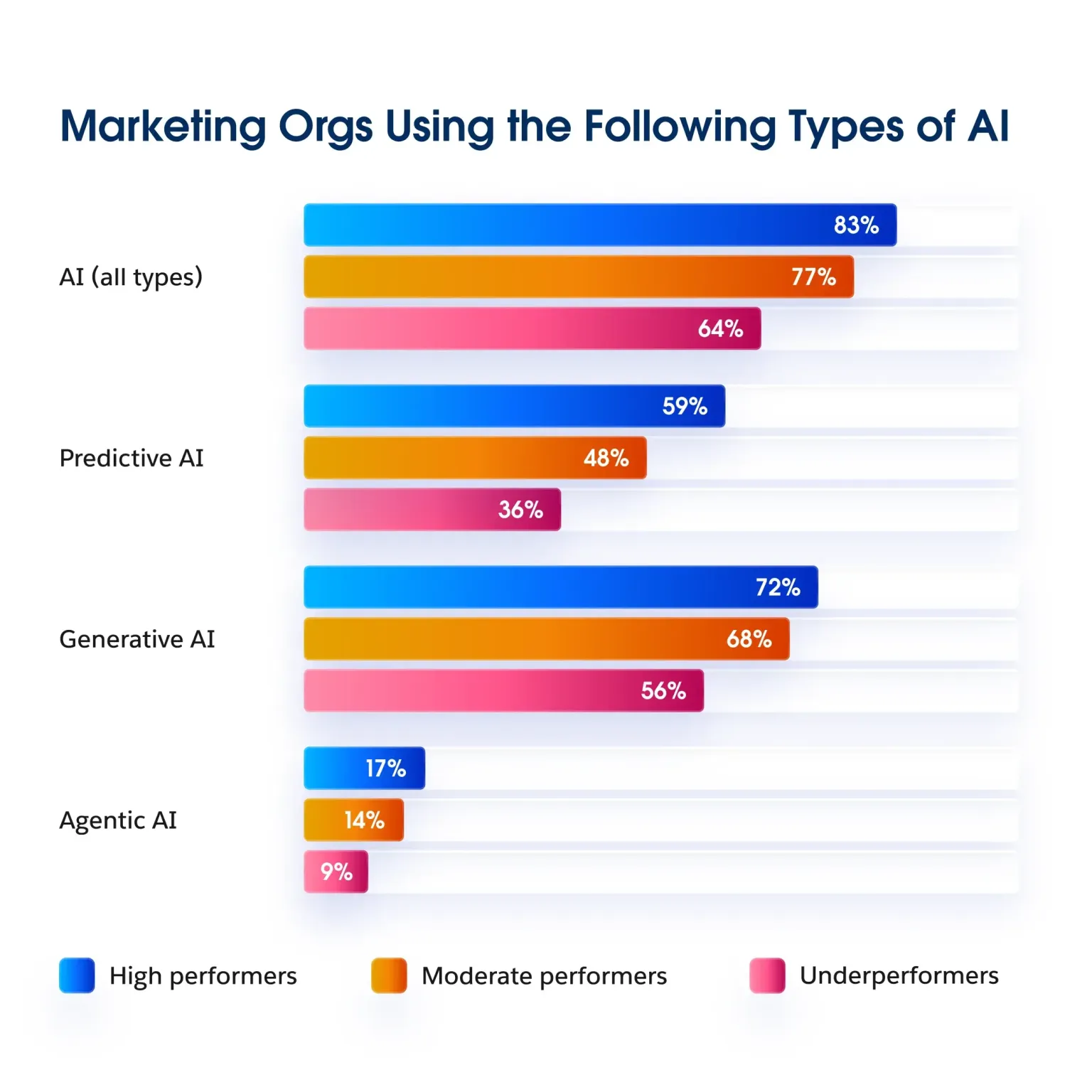
This is not just a tooling difference. It is an operational one.
High-performing marketers treat AI as a decision layer, not just a content engine. They connect AI to real customer context, which allows them to deliver more relevant, timely, and effective experiences.
The result is a widening gap. Teams that operationalize AI properly are pulling ahead, while others are still using it to scale outdated workflows.
 Atikah Amalia
Skills and strategy gaps are slowing AI impact
Another key constraint highlighted in the report is the lack of internal readiness. Many marketing teams are still developing the skills needed to fully leverage AI.
The report makes it clear that adoption is outpacing readiness. This includes:
- 48% of marketers say they haven’t figured out how to adapt their strategies to AI
- 61% say AI is not yet fully integrated into their marketing systems
- 78% of marketers need more personalized content than they can produce
- 98% of marketers report at least one barrier to personalization
- 46% struggle with lacking customer preference data or relevance
These are not minor gaps. They point to a structural issue.
AI is being adopted faster than teams can build the skills, workflows, and data foundations needed to support it. Without those capabilities, AI remains underutilized.
This explains why adoption is high, but outcomes are inconsistent. The limiting factor is no longer access to AI. It is the ability to operationalize it effectively.
Patrecia Meliana
Why this matters for B2B marketers
For B2B marketers and PR professionals, this shift is significant. AI adoption is no longer a differentiator. Execution is.
Teams that continue to treat AI as a productivity layer will struggle to stand out. Those that rethink workflows, data usage, and customer engagement strategies will gain a clear advantage.
The takeaway is straightforward. The next phase of AI in marketing is not about adding more tools. It is about closing the gap between what AI can do and how marketing teams actually use it.