AI-first organizations are emerging according to McKinsey's latest research
McKinsey’s latest research suggests the next phase of AI adoption will reshape how organizations operate

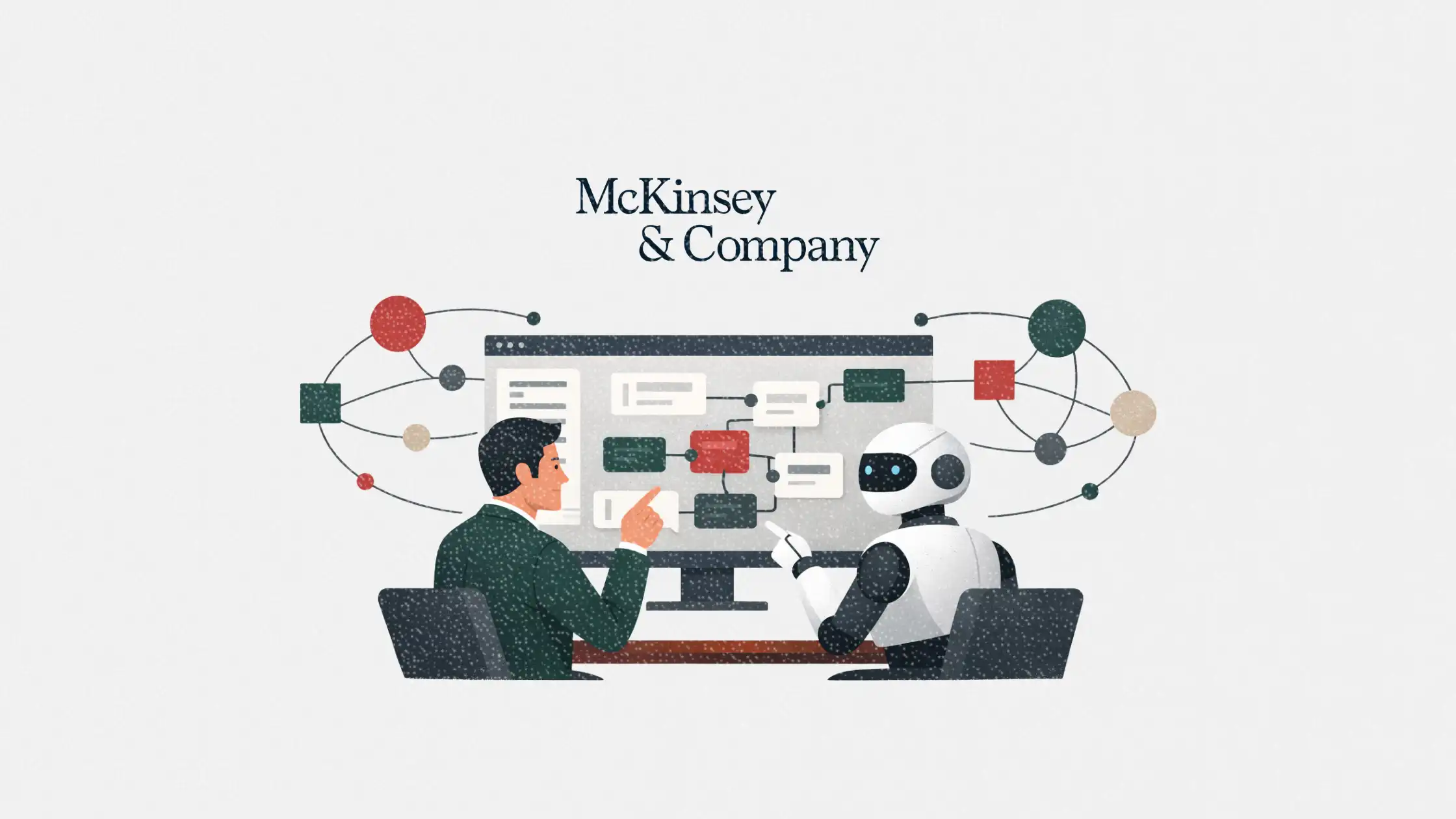
Artificial intelligence is now embedded across much of the modern workplace. Companies are experimenting with generative AI, automation tools, and predictive analytics to improve productivity and decision-making.
Yet despite widespread experimentation, many organizations still struggle to translate AI investments into measurable business impact.
According to McKinsey’s The State of Organizations 2026 report, the challenge is not access to technology but organizational readiness. Many companies are testing AI in isolated projects rather than redesigning workflows around it. That gap between experimentation and operational change could define the next phase of AI adoption.
This article explores how organizations are beginning to shift toward AI-first operating models, why human-AI collaboration is reshaping enterprise workflows, and what these changes could mean for marketing teams navigating a more automated business environment.
Short on time?
Here’s a table of contents for quick access:
- Why AI-first organizations are becoming a strategic priority
- How human-AI collaboration is reshaping enterprise workflows
- Why AI-native shared services are emerging
- What marketers should know about AI-first organizations
 Patrecia Meliana
Why AI-first organizations are becoming a strategic priority
Across industries, companies are racing to experiment with artificial intelligence. Tools that generate content, automate workflows, and analyze large data sets are rapidly becoming part of everyday business operations.
But experimentation alone does not guarantee results. McKinsey’s research shows that 88% of organizations are experimenting with AI, yet many leaders say they have not yet seen meaningful financial impact from those initiatives.
The reason often comes down to how AI is deployed. Many companies treat AI as a productivity tool layered onto existing workflows rather than redesigning those workflows entirely.
As AI capabilities expand, organizations are beginning to realize that incremental adoption may not be enough. Capturing the full value of AI may require companies to rethink how work is structured across teams, departments, and systems.
How human-AI collaboration is reshaping enterprise workflows
One of the most significant shifts highlighted in the report is the emergence of hybrid human-AI collaboration.
Instead of operating purely as automation tools, new AI systems are increasingly capable of supporting decision-making, coordinating information across systems, and assisting with complex tasks.
This shift is expected to reshape many roles across the enterprise. McKinsey estimates that around 75% of roles will require new combinations of technical and human skills as organizations integrate AI more deeply into their operations.
For employees, that means learning how to work alongside intelligent systems rather than simply using software tools. For organizations, it means building workflows where humans and AI collaborate to complete tasks more efficiently.
Why AI-native shared services are emerging
Another development highlighted in the report involves the transformation of shared-services centers.
Traditionally, shared services focused on centralizing administrative processes such as finance, procurement, or HR. With the introduction of AI, these centers are evolving into technology-driven hubs capable of orchestrating workflows across entire organizations.
AI-powered shared-services platforms can automate routine processes, analyze operational data, and coordinate tasks between human teams and digital systems. According to McKinsey, 84% of organizations plan to expand the scope of their shared-services centers within the next one to two years.
For many companies, these hubs may become the operational backbone of AI-first organizations.
What marketers should know about AI-first organizations
As companies move toward AI-first operating models, marketing teams are likely to experience significant changes in how work gets done.
Several implications stand out for marketing leaders.
- Marketing workflows will become more automated
AI systems are increasingly capable of analyzing customer data, generating campaign ideas, and optimizing performance in real time.
Patrecia Meliana
- Human-AI collaboration will reshape creative processes
Instead of replacing marketers, AI will increasingly function as a collaborator that assists with ideation, analysis, and testing.
- Campaign cycles will accelerate
AI-powered analytics and automation allow marketing teams to test multiple campaign variations and adjust strategies much faster.
- AI literacy will become a core marketing skill
Marketers who understand how to work effectively with AI systems will be better positioned to manage data-driven campaigns.
Artificial intelligence is no longer just another productivity tool. It is gradually becoming part of the operating model that defines how organizations function. As companies transition from isolated AI experiments to AI-first workflows, the ability to coordinate human creativity with machine intelligence will become a key competitive advantage.
For marketing teams, understanding how these hybrid systems work may soon be as important as understanding customers themselves.