Anthropic’s AI labor data shows a hiring shift marketers can’t ignore
Anthropic’s latest findings reveal where AI is actually being used at work, and where the risks are still theoretical


The debate over AI's impact on jobs just got a new data point. Anthropic has introduced “observed exposure,” a fresh way to measure which occupations are most at risk of being disrupted by AI—especially large language models (LLMs) like Claude.
For marketers and business leaders tracking the ripple effects of automation, the key insight is this: AI hasn’t yet hit hard across the labor market, but adoption patterns suggest subtle shifts are underway—particularly in hiring pipelines for high-exposure roles.
This article explores how the metric works, what it reveals about exposed job categories, and why early career professionals may be the first to feel the squeeze. While much of the conversation around AI and employment has been speculative, this framework attempts to quantify real-world usage against theoretical capabilities, offering a more grounded view of where displacement might actually occur.
Short on time?
Here’s a table of contents for quick access:
- What happened: Anthropic introduces a new AI job exposure metric
- How observed exposure changes the labor risk conversation
- What marketers should know
 Patrecia Meliana
What happened: Anthropic introduces a new AI job exposure metric
Anthropic has released a framework for gauging AI’s potential impact on employment, centered around a new measure called “observed exposure.” Unlike traditional task-based models that only assess theoretical risk (such as whether an LLM could technically perform a task), observed exposure also incorporates real-world usage data—specifically, how Anthropic’s Claude is being used in automated, professional contexts.
By blending O*NET occupational task data, usage from the Anthropic Economic Index, and theoretical exposure scores from Eloundou et al. (2023), the company aims to identify where AI is being actively deployed in ways that could displace labor.
So far, the data suggests a gap between capability and deployment. While 90% of tasks in categories like Office & Admin are theoretically automatable, only a fraction are currently covered by LLM usage.
Anthropic’s analysis shows that:
- High-exposure occupations like Computer Programmers and Customer Service Representatives are already seeing usage in automated workflows.
- 30% of jobs—including Cooks, Lifeguards, and Motorcycle Mechanics—show zero exposure.
- Roles with higher observed exposure are projected by the US Bureau of Labor Statistics (BLS) to grow more slowly through 2034.
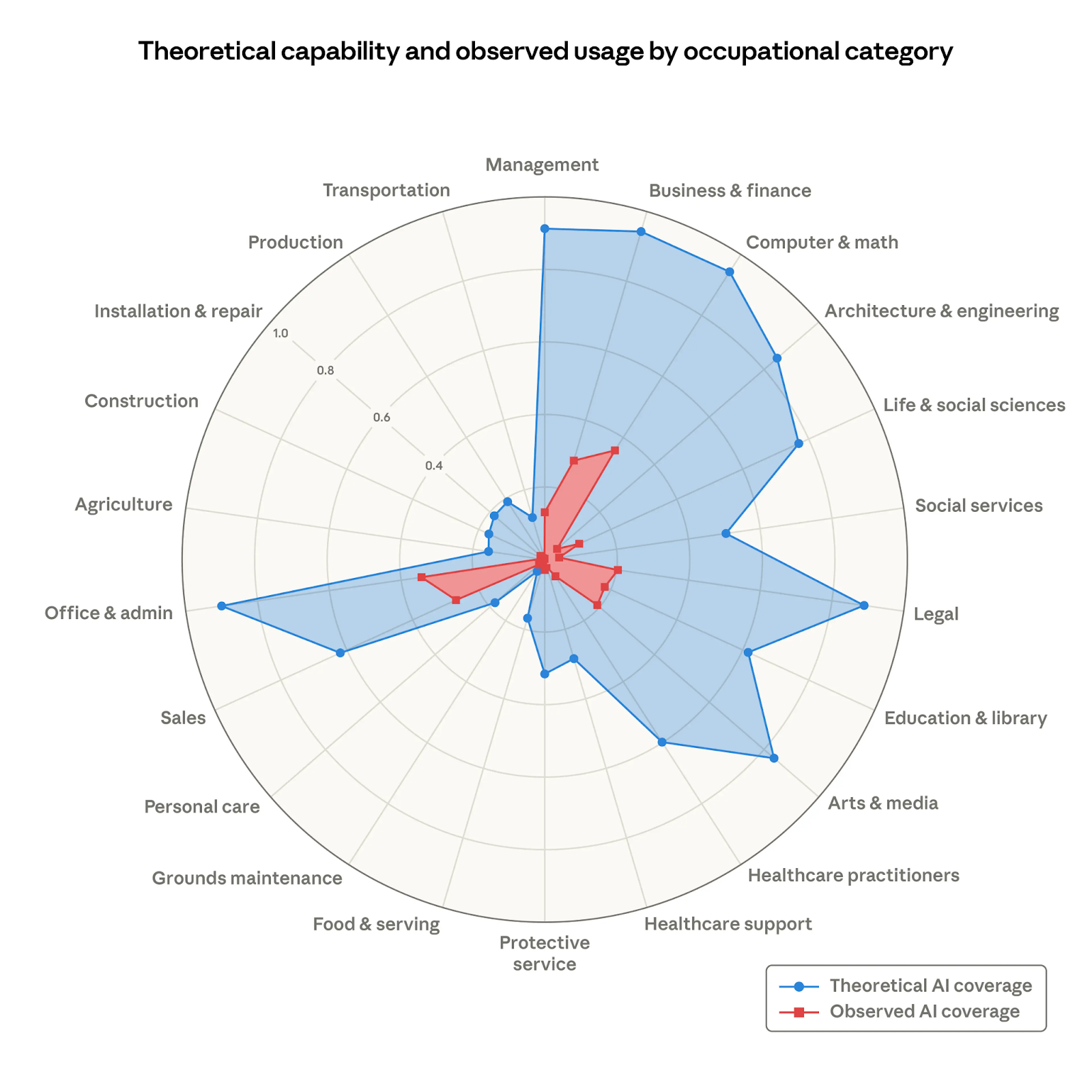
Notably, workers in the most exposed occupations are more likely to be female, older, more educated, and higher paid than those in unexposed roles.
How observed exposure changes the labor risk conversation
This new metric addresses a common flaw in earlier labor impact forecasts: they over-relied on theoretical automation potential and lacked real-world validation. Anthropic’s framework instead zeroes in on actual usage patterns—emphasizing automated implementations in work contexts.
That nuance matters. According to the analysis, only tasks with substantial workplace usage via Claude were counted, and full automation carried more weight than simple augmentation. In other words, this isn’t just about AI that can help—it’s about AI that’s already doing the work.
While some feared an AI-driven unemployment wave, Anthropic’s findings suggest otherwise—at least for now. Unemployment rates haven’t increased meaningfully for highly exposed workers since ChatGPT’s release. However, there's a notable signal: hiring for young workers (ages 22–25) into high-exposure occupations has declined by 14% compared to 2022, suggesting potential shifts in early career trajectories.
For now, AI’s footprint on the labor market appears to be evolving quietly. But as usage patterns expand, the framework offers a way to detect disruption early—before it hits macroeconomic indicators like aggregate unemployment.
What marketers should know
Anthropic’s findings aren’t just for economists. Here’s how marketers, especially those managing teams or hiring pipelines, can respond:
- Audit team exposure to automation
Use tools like O*NET or Anthropic’s observed exposure methodology to assess which roles in your team could be affected by LLM automation. Roles involving data entry, basic copywriting, or customer response may warrant reskilling or role evolution.
- Plan for hiring shifts
Younger workers may face a steeper climb into high-exposure fields. Marketers hiring early-career talent in areas like customer success or digital operations should consider longer onboarding and training ramps—or reposition roles toward strategy and oversight.
- Use observed exposure as a forecasting lens
Instead of reacting to AI headlines, use real deployment data (like Anthropic’s Economic Index) to track where automation is gaining traction. That can inform everything from talent planning to agency selection.
- Balance automation with oversight
In high-exposure workflows like content creation or campaign ops, full automation might offer speed but not nuance. Keep human checkpoints in place to manage tone, ethics, and brand integrity.
 Patrecia Meliana
Anthropic’s observed exposure measure doesn’t offer AI doomsday predictions—but it does introduce a more practical, evidence-based way to track which jobs are actually being touched by automation today. That makes it a useful early-warning system for hiring teams, workforce planners, and marketers navigating the AI transition.
The fact that young workers in exposed fields are being hired less frequently should raise a flag—not for panic, but for preparation. As AI deployment deepens, strategies that anticipate disruption (rather than scramble to react) will become a key differentiator.