43% of brands are optimizing for AI-driven product search according to Adobe Express study
Adobe Express survey reveals how marketers are preparing for AI-powered product discovery and rising AI budgets.


AI-driven product discovery is shifting from hype to infrastructure. As ChatGPT, Google’s Search Generative Experience, and Meta AI increasingly influence shopping decisions, visibility inside AI systems is becoming a technical discipline, not just a marketing tactic.
A new Adobe Express survey of 1,000 US marketers and business owners reveals how teams are preparing for AI-first discovery.
This article explores how brands are operationalizing AI search optimization, why data hygiene is becoming a competitive differentiator, and what readiness really means.
Short on time?
Here’s a table of contents for quick access:
- How many brands are optimizing for AI-driven product search
- Why data hygiene is now a visibility risk
- How teams are operationalizing AI readiness
- What marketers should prioritize next
 Patrecia Meliana
How many brands are optimizing for AI-driven product search
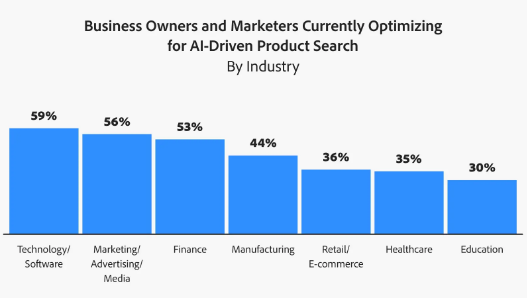
43% of marketers and business owners say they are already optimizing for AI-driven product search. Another 26% plan to do so within the next year.
That means nearly 7 in 10 organizations are moving toward AI readiness.
Optimization levels by industry:
 Patrecia Meliana
Why data hygiene is now a visibility risk
50% of respondents are concerned their products will not surface in AI-driven results due to poor data hygiene.
That concern is rational because AI systems depend on:
- Structured metadata
- Consistent product attributes
- Accurate descriptions
- Updated availability
- Clean cross-platform formatting
In AI-curated shopping environments, messy data is not just inefficient. It can remove products from consideration entirely. Unlike traditional search where paid media can offset ranking weaknesses, AI recommendations may rely heavily on structured clarity and semantic relevance.
How teams are operationalizing AI readiness
According to the survey, teams are preparing for AI-curated shopping by:
- Optimizing product data (39%)
- Improving content freshness and accuracy (37%)
- Investing in AI-driven personalization tools (24%)
- Conducting SEO and AI visibility audits (23%)
- Training internal teams on AI best practices (22%)
Budget allocation also reinforces this shift.
On average, 21% of marketing budgets are currently allocated to AI readiness. That number is expected to grow to 29% by 2026, representing a 38% increase. This signals long-term capability building, not just short-term experimentation.
 Patrecia Meliana
What marketers should prioritize next
The Adobe data makes one thing clear: AI visibility is becoming an operational discipline, not a creative one.
1. AI visibility is becoming a systems discipline, not a campaign tactic
The survey data signals a structural shift. When 43% of organizations are already optimizing for AI-driven product search and 50% worry about poor data hygiene limiting visibility, the issue is no longer messaging. It is infrastructure.
AI systems rely on structured product attributes, consistent metadata, accurate descriptions, and synchronized availability signals. If those elements are fragmented or inconsistent, visibility declines regardless of creative quality or paid media investment.
In AI-curated environments, discoverability begins at the data layer.
2. Data hygiene is now directly tied to revenue exposure
Half of respondents fear their products may not surface due to poor data hygiene. That concern reframes data governance from an operational matter to a growth risk.
In traditional search, paid promotion could compensate for structural weaknesses. In AI-driven recommendations, eligibility itself may depend on structured clarity and semantic alignment. If a product cannot be interpreted correctly by the system, it may not be recommended at all.
3. AI readiness requires cross-functional alignment
Optimization for AI search cannot sit solely within the Marketing function. It demands coordination across Marketing, Ecommerce, Product, and IT.
Structured schemas, API readiness, content freshness, and taxonomy alignment are rarely controlled by one department. Organizations treating AI optimization as a shared governance initiative are likely building long-term advantage.
The projected increase in AI budgets from 21% to 29% by 2026 suggests that companies understand this is not short-term experimentation. It is capability development.
4. Early architectural preparation could create compounding advantage
Half of respondents have not yet considered Model Context Protocol, while a smaller segment is auditing data and restructuring schemas.
That gap may widen over time. As conversational interfaces mature, structured integration standards could determine how deeply products are surfaced, contextualized, and recommended. Early movers who prepare their data architecture today may benefit from disproportionate discoverability tomorrow.
AI optimization is evolving into marketing architecture. The brands that treat it as such may gain structural resilience as assistant-led commerce expands.
AI shopping will not eliminate traditional search overnight. But visibility inside AI systems is already becoming operational reality. The brands that win will not simply create better ads. They will maintain cleaner data, structured product architecture, and cross-functional readiness.
AI visibility is becoming an infrastructure discipline.