
Apple makes MacBook Neo a second chance at art in The Dreamer
A film by Melina Matsoukas uses a young artist's return to drawing to make MacBook Neo part of a family story.


For anyone who used to spend hours drawing and then quietly stopped, Apple's new holiday film starts with a familiar ache. There is a version of you who filled notebooks with characters, imagined impossible worlds and never wondered whether making art was a sensible use of time. Growing up can make that person feel very far away.
That is the emotional territory of The Dreamer, the holiday film shared on Apple's official channel. A boy's love of drawing fades as he grows older, until his parents give him a MacBook Neo and a reason to try again. Instead of selling a laptop through a rapid tour of features, the film turns it into something more personal: evidence that someone still believes in the creative part of him.
Table of contents
Jump to each section:
- Why a childhood sketch carries the whole story
- How the MacBook Neo becomes a gift of permission
- The artists who made The Dreamer feel personal
- How Apple changed the hero of its holiday film
- What marketers can learn from The Dreamer
Why a childhood sketch carries the whole story
The first images are not about computers. The boy's early life is full of sketches and colorful shapes, and his parents notice the worlds he invents. The drawings become an unusually effective shortcut for a universal experience: childhood is when some people feel most comfortable making things without worrying whether those things are any good.
As he gets older, that easy confidence erodes. The film shows social pressures and discouragement that can make an imaginative child retreat from his own interests. The audience does not need a dramatic speech to understand the loss. A familiar hobby gradually disappears from the center of his life.
That sets up a different kind of Christmas present. When his parents eventually give him a laptop, they are not simply filling a wish list. They are responding to something they remember about him, something he may have stopped recognizing in himself. The gift matters because of the relationship behind it.
For marketers, the distinction is important. Many festive ads promise that a product will create happiness. Here, the happiness comes from being understood. The product enters that relationship after the emotional need is already clear.

How the MacBook Neo becomes a gift of permission
The MacBook Neo arrives late enough in the story to feel earned. After receiving it, the young man returns to the characters he used to draw and starts shaping one into an animation. The film makes creation the payoff, rather than the unboxing.
The visual world of Apple's new holiday campaign is visible in this scene from the film.
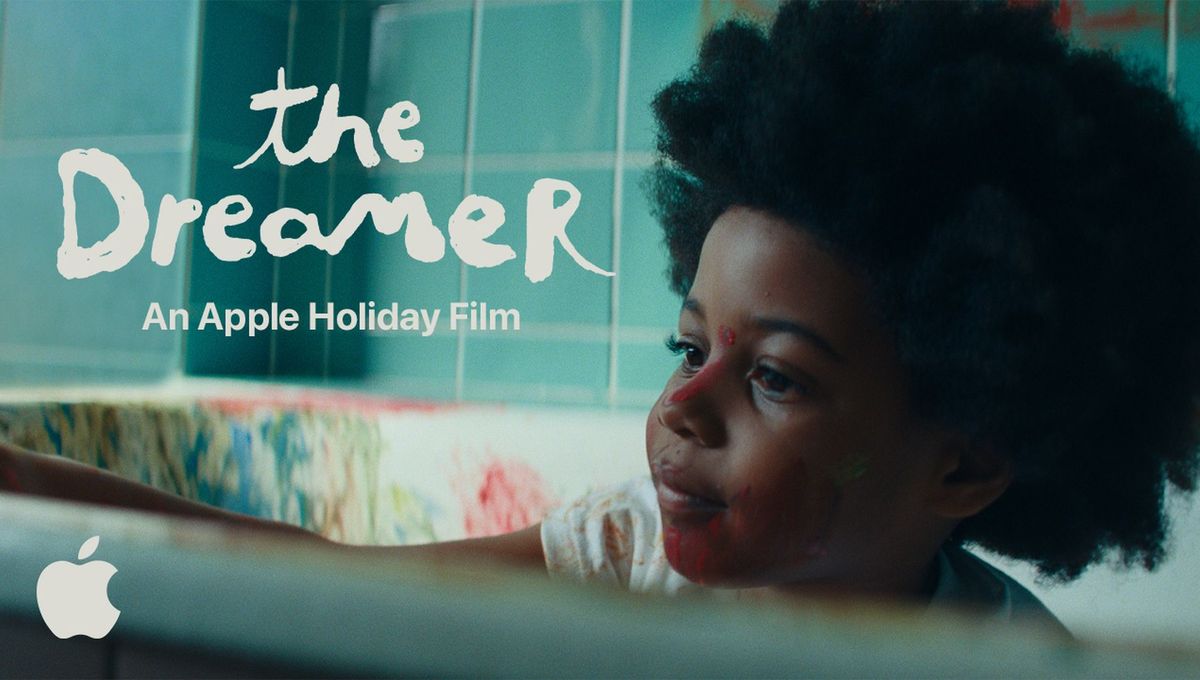
This is a deliberate role for the machine. Apple introduced MacBook Neo in March as an entry point to the Mac lineup, highlighting everyday work and creative hobbies alongside its lower starting price. Its holiday story gives that positioning a human face. A new computer becomes less about getting more done and more about finally returning to something meaningful.
The official film also keeps the presentation relatively quiet. There is little need for dialogue or product explanation, with Strawberry Guy's Give Me A Dream carrying much of the mood. A viewer can understand the emotional change even without knowing the laptop's technical specifications.
That approach does not prove the campaign will sell more MacBooks. No sales lift or measured brand response has been disclosed in the retrieved campaign material. What can be observed is the creative decision to make the product a supporting character in someone else's story.
The artists who made The Dreamer feel personal
The emotional credibility comes partly from the people making the film. Director Melina Matsoukas, whose work includes Beyoncé's Formation and the film Queen & Slim, worked with cinematographer Bradford Young and artist Hebru Brantley. The production came through TBWA\Media Arts Lab, PRETTYBIRD and De La Revolución.
Brantley is particularly central. The Chicago-born multidisciplinary artist created the boy's drawings, from early sketches to the animated character he eventually brings to life. He developed the final character using the MacBook Neo, so the craft shown in the film is connected to a real artist's process rather than merely a fictional illustration.
The artist described how the theme echoes his upbringing. "My mother saw the artist in me before I could see it in myself," Brantley said in remarks published with the campaign. That memory gives the parents' role in the film a personal dimension.
The production also includes a companion behind-the-scenes piece, Creating the Art, which follows Brantley's work. It gives curious viewers a way to move from the finished film into the artistic choices that made it possible. This is a useful extension for a campaign about creativity: the people behind the images become part of what viewers can discover.
Matsoukas's own background in music videos and filmmaking helps explain why the work feels closer to a short narrative than a traditional product demonstration. The viewer is invited to care about a character's interior life before being asked to notice the computer.
How Apple changed the hero of its holiday film
There is a clear contrast with Apple's 2025 holiday film A Critter Carol. That story followed handmade woodland puppets that discovered a lost iPhone 17 Pro and used it to make a musical video. Human-made craft was the attraction, while the phone's camera played a more visible role in capturing the fun.
The Dreamer keeps the craft but changes who gets the spotlight. The film looks toward the person who has stopped creating, not an ensemble already busy making something. Its question is not simply what the technology can record, but what someone might feel able to attempt with it.
Those are different stories, yet they show continuity in Apple's festive advertising. Both use creative work that viewers can recognize as labor, imagination and artistic choice. Neither relies on a sequence of feature claims to carry the film.
The wider holiday ad category is crowded with cinematic sentiment. Disney's 2026 short The Invisible Horse, for example, also draws on childhood imagination and a family's emotional connection. Apple's distinction is that its object of affection is a tool, while its central emotional reward comes from a person finding an abandoned part of themselves.
That comparison is not a claim that one approach is outperforming another. The campaigns offer different ways to turn a familiar holiday feeling into a recognizable brand story.
What marketers can learn from The Dreamer
A gift feels different when it says, "I remember who you are." Apple's film turns that small human idea into a longer story about confidence, family and the possibility of beginning again. The marketing lesson is not to make every ad longer or more sentimental. It is to find the emotional truth that makes the product's presence feel natural.
- Start with a recognizable human moment.The lost sketchbook, the encouragement from a parent and the awkwardness of growing up are understandable before any technology appears. When a campaign has a clear human observation, viewers have a reason to keep watching beyond the promise of a new feature.
- Let the product change what the character can do.MacBook Neo matters because it becomes part of the young man's return to art. A product can have a prominent role without taking over the narrative, provided the story makes its contribution obvious.
- Give the makers a place in the story.Brantley's hand-drawn work and personal memory make the creative process more than a production credit. Behind-the-scenes material can add depth when it reveals something meaningful about the campaign rather than serving only as promotional extras.
- Compare creative continuity, not just campaign novelty.From woodland puppets to a young illustrator, Apple keeps finding routes back to human creativity. Repetition of a recognizable value can build a consistent identity even when characters, formats and featured products change.
The risk with emotional advertising is that feeling can become a substitute for relevance. A moving film that could sell any product may attract praise while leaving the brand behind. The Dreamer avoids some of that risk by making a computer part of the character's act of creation, not an unrelated object in the final scene.
It also raises a useful question for brands talking about new technology. If a product is increasingly capable of doing things for people, is the stronger promise sometimes what it helps people rediscover in themselves?
Apple is not offering evidence that this narrative has changed demand. It is offering a clear creative proposition: technology can be a gift of confidence when it reaches someone at exactly the right moment. That is a more personal holiday message than another list of things a device can do.
