
Why B2B startups lose deals after the demo (and it's not your competitor's fault)
Most B2B startups blame competition when deals stall after a demo. The real problem is message decay inside the buyer's own organisation. Here's what to fix.

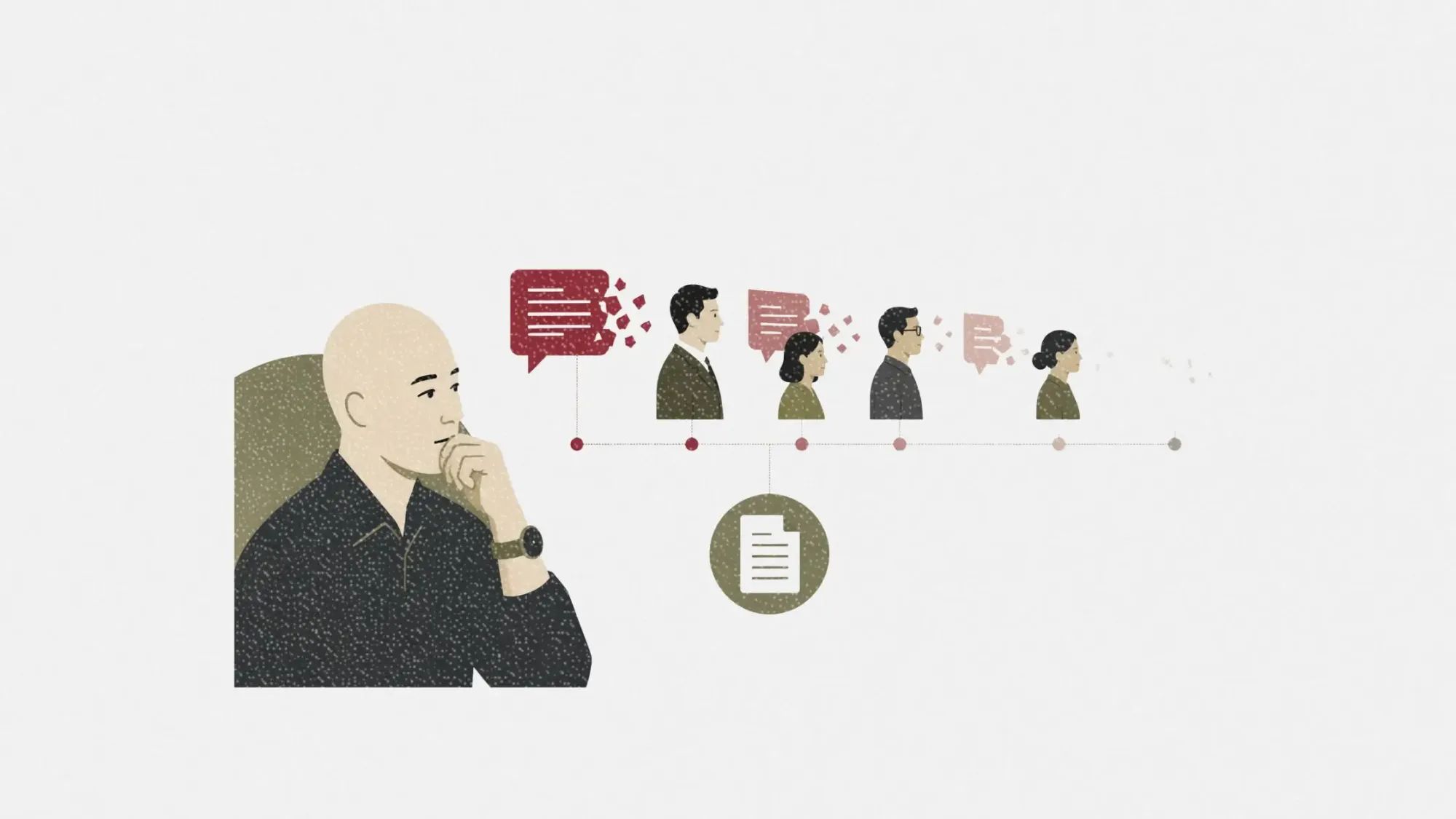
Most B2B startups diagnose the wrong disease.
When a deal goes quiet after a promising demo, the instinct is to blame the competition, or the pricing, or the timing. Sometimes those things matter. But recent research from Forrester and Gartner points consistently to a different culprit: the deal doesn't die, it decays. And it decays inside the buyer's own organisation, in conversations the startup was never in the room for.
Understanding that distinction is the difference between patching symptoms and fixing the actual system.
Table of contents
- The moment the deal leaves your hands
- Your product isn't hard to understand. It's hard to re-explain.
- Message stability: what it looks like (and how to tell when you don't have it)
- The first three things to fix if deals are decaying
- What buyers actually need to defend a purchase internally
- The actual constraint: system design, not messaging volume
The moment the deal leaves your hands
Picture a familiar scene. A B2B sales call goes well. The buyer is engaged, asks smart questions, and then says: "Can you send something we can share internally?"
That line sounds like progress. Often, it's where momentum starts to quietly bleed out.
"That is the moment the message starts to fragment," says Farrell Tan, Founding Partner of Orchan Consulting Asia, a Kuala Lumpur-based strategic communications agency that has advised brands including PUMA, Dyson, Garmin, and UNICEF. "The person you are speaking to may understand your product. But they now have to translate it across stakeholders with different priorities, technical and non-technical audiences, and internal politics. That translation layer is where deals weaken."
The numbers back this up. According to Forrester's 2024 State of Business Buying report, the average B2B purchase now involves 13 stakeholders, and nearly 89% of buying decisions cross multiple departments. Most of that process happens behind closed doors, inside a buying group the startup has no visibility into.
And when those groups try to reach agreement, the results are telling. A Gartner survey of 632 B2B buyers conducted in late 2024 found that 74% of buying teams experience unhealthy conflict during the decision process. Forrester found that 86% of B2B purchases stall at some point. These aren't edge cases. They're the norm.
 Enricko Lukman
Your product isn't hard to understand. It's hard to re-explain.
The most common assumption startups make is that deal stalling means the buyer didn't understand the product well enough. The solution then becomes more collateral: more case studies, more slides, more follow-up emails.
Farrell pushes back on this framing directly. "The real issue is not just product understanding. It is transferability. The problem is that the understanding did not survive contact with the organisation."
There's a meaningful distinction there. A startup's champion may fully grasp the value proposition. But they're now expected to re-explain it to a CFO, a procurement lead, a technical team, and possibly a senior director who joins every third meeting. Each retelling introduces a layer of interpretation risk. The message doesn't collapse all at once. It dilutes, step by step.
More content often makes this worse rather than better. When different assets describe the same product in slightly different ways, the buyer isn't dealing with a lack of information. They're dealing with inconsistency across information. That's harder to resolve, and it gives internal skeptics exactly the ammunition they need to stall.
"Stop adding content until the core story is stable," Farrell advises. "More information without a stable narrative will only make things worse. Lock one clear, repeatable statement before producing anything new."
Message stability: what it looks like (and how to tell when you don't have it)
Farrell introduces a concept he calls "message stability," and it's worth unpacking. A stable message is one that different people in different contexts repeat in essentially the same way without distortion.
"Message stability means your value proposition is repeated identically by different people in different contexts without any change," he explains. "In practice, it looks like: a salesperson, a customer success lead, and a product manager all describe the product's core value using nearly the same words."
The inverse, message instability, is easier to spot than most startups expect. Farrell offers a quick diagnostic: record a five-minute call where a salesperson explains a recent win. Then ask an engineer to explain the same win. If the two stories sound different, the message is not stable.
Other warning signs include: prospects asking the same clarifying question after every demo, three team members giving three different explanations of what the product does, and internal decks using different headlines or numbers for the same claimed benefit.
This is particularly acute in Southeast Asia, where B2B buying decisions tend to be collective and hierarchical. A startup selling into a Malaysian conglomerate may need to pass through procurement, finance, a technical team, and a senior director who wasn't present for the original pitch. What works in a direct sales conversation may not survive a WhatsApp group discussion among stakeholders who heard about it second-hand.
Gartner's research reinforces the stakes. When buying groups achieve consensus, they are 2.5 times more likely to report a high-quality decision outcome. Separately, Gartner data shows purchase likelihood drops from 81% with one to two stakeholders involved to just 31% when five or more are engaged. Message stability isn't a communications nice-to-have. It is a conversion lever.
Enricko Lukman
The first three things to fix if deals are decaying
If a startup suspects its deals are stalling due to internal message fragmentation rather than external competition, Farrell recommends three immediate moves.
1. Find the handover failure. Ask the sales team at what exact point buyers start asking for "more information" or "something to share internally." That moment marks where the message starts to fragment. The short-term fix is creating a one-page summary that any stakeholder can understand in 90 seconds, without the startup representative present to explain it.
2. Test the narrative on non-customer-facing staff. Get someone from finance, operations, or HR to explain the product's value proposition unprompted. If they cannot repeat it clearly, the message will not survive internal review. This is a cheap, fast diagnostic that most startups skip entirely.
3. Pause new content production until the core story is locked. This is the hardest advice to follow because it feels like doing less. But adding content on top of an unstable narrative accelerates the problem. Before producing anything new, the team should be able to state the core value proposition in a single, unambiguous sentence that every internal stakeholder would say the same way.
What buyers actually need to defend a purchase internally
Once the core message is stable, the question becomes what materials help buyers advocate internally. Farrell's answer cuts against the conventional content marketing instinct.
"Instead of more content, I would provide the following," he says, and then lists three specific assets.
The first is a one-page business case. No more than 500 words. It states the problem, the solution, the measurable outcome, and the investment. It is designed to be forwarded to a CFO or procurement lead without needing explanation.
The second is a comparison grid, not a feature list. This grid shows how the product performs against alternatives on the three criteria that matter most to the buyer's organisation, prioritising the buyer's frame of reference over the startup's preferred strengths. This helps the decision maker justify the choice to colleagues who were not at the demo.
The third is a short FAQ for internal skeptics. It anticipates the three toughest questions a technical team or risk officer would raise and answers them plainly, without jargon. This equips the champion to handle pushback in meetings the startup will never attend.
The difference between these assets and typical B2B content is the audience. Most content is written for the champion who is already sold. These materials are written for every stakeholder who has not been sold yet.
Farrell points to one client case that illustrates the shift. A B2B SaaS company had deals consistently stalling after their first internal review. Their main sales asset was a 40-slide deck. After introducing a one-page business case and a three-question internal FAQ, their conversion rate from demo to signed contract improved by 30% within six weeks. One example doesn't make a rule, but it does show what becomes possible when the focus moves from volume to transferability.
Enricko Lukman
The actual constraint: system design, not messaging volume
The pattern that emerges from both Farrell's experience and the research is that most B2B startups think they have a demand problem when they actually have a conversion system problem.
Generating attention is not the hard part anymore. Content marketing, paid search, and social can fill a pipeline with curious buyers. The gap is in what happens after attention. Does the message hold up when the champion explains it to their manager? Does it survive an internal Slack thread? Does it make it through procurement without getting stripped of its nuance?
Those are system design questions, not messaging volume questions.
The practical implication is that the priority should shift toward consistency across touchpoints, internal navigability of the value proposition, and narrative resilience outside the sales conversation. Not just what is said during the demo, but what survives after it.
"Very few B2B deals end cleanly," Farrell observes. "Instead, follow-ups stretch, urgency fades, stakeholders disengage, timelines move out. Eventually, it becomes: let us revisit this next quarter. The difference between winning and losing often hinges on how easily value survives internal review."
As buying committees grow in size and complexity, that gap between initial interest and final decision will only widen. Startups that build for the room they are not in are the ones that close.