
Warner Bros. turns The Cat in the Hat into an Amazon mini-game
Warner Bros. and Amazon Ads pair a tilt-controlled game with Bill Hader's Alexa voice experiences ahead of The Cat in the Hat.


Some movie characters are more fun when audiences get to join their world instead of simply watching them. The Cat in the Hat, Dr. Seuss's mischievous character known for turning ordinary moments upside down, is a natural fit for that approach.
Ahead of the animated film's November 6 theatrical release in North America, Warner Bros. Pictures Animation is giving audiences another way to encounter the character. This time, the Cat appears through mobile gameplay, voice interactions and advertising across Amazon's services.
The studio has teamed up with Amazon Ads on Open to Fun, a campaign developed by the company's Brand Innovation Lab. As detailed in Amazon's official announcement, the promotion combines an interactive mini-game, two Alexa experiences and placements across Prime Video, IMDb, Twitch and other Amazon properties.
The notable part is not simply how many places the movie appears. It is how the campaign lets people interact with its fictional world before entering a theater.
Table of contents
Jump to each section:
- How the Cat turns a trailer into a game
- Bill Hader brings the character into homes
- Warner Bros. extends the movie across gaming and streaming
- What marketers can learn from the campaign
How the Cat turns a trailer into a game
At the center of Open to Fun is a dedicated Amazon Brand Store page that serves as a destination for trailers, exclusive film content and movie tickets. The page is scheduled to remain available through November 8.
But visitors are not limited to watching promotional material. A mini-game invites them to tilt their mobile phones to catch the Things, the playful characters associated with the Cat's unpredictable adventures. Players encounter a countdown, visual feedback as they catch or miss the characters, and a results screen where they can choose to play again or share their scores.
Desktop visitors can access the game through a QR code. Bill Hader, who voices the Cat in the animated film, also recorded lines for the mini-game, connecting the interaction to the character audiences will hear in theaters.
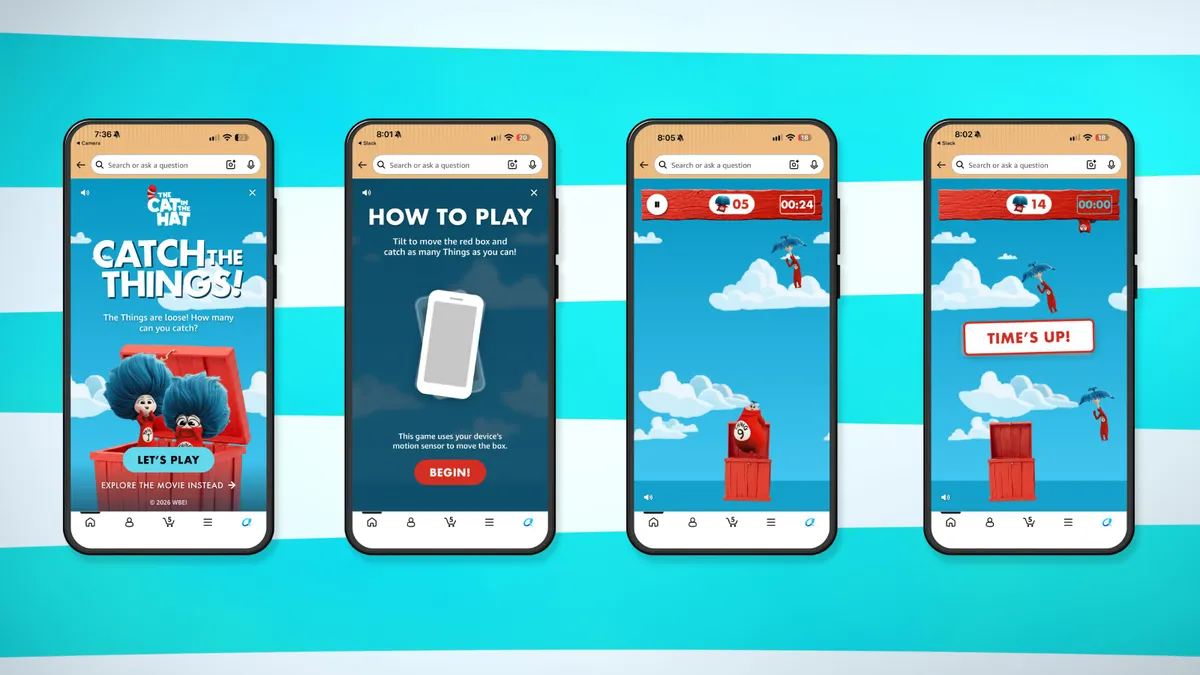
The game is more than a movie-branded diversion because its action reflects the character's personality. Catching mischievous characters under time pressure turns the film's playful premise into something audiences can experience themselves.
The option to share scores creates a potential way for the promotion to travel beyond its Amazon destination. The companies have not disclosed participation or sharing figures.

Bill Hader brings the character into homes
The same idea extends to Alexa. Rather than asking people to visit a website, Amazon has created two branded voice experiences featuring Hader's performance.
The first, called Cat-ffirmations, delivers daily affirmations in the character's playful style. The second, Cat in the Hat Jokes, lets audiences hear jokes from the character. Alexa audio ads and home-screen placements support both interactions.
These are brief encounters rather than full entertainment experiences. Their significance is that they can bring the character into an activity people already know how to perform, such as speaking to a voice assistant.
Lauren Anderson, US Head of Amazon Ads Brand Innovation Lab, described the campaign as "transforming beloved cultural IP into an engaging pan-Amazon experience." That intention is visible across the game and Alexa experiences: let people participate in the character's world, even briefly.
Warner Bros. extends the movie across gaming and streaming
Open to Fun is not the only interactive promotion supporting the new Cat in the Hat film. Warner Bros. has also brought the character into three established Roblox games, creating another route for players to encounter the movie ahead of release.
The two campaigns take different routes toward participation. Roblox places the film inside existing gaming communities. Amazon brings the property into its own ecosystem through shopping, streaming, voice interactions and mobile entertainment.
Together, they illustrate an approach to film promotion in which audiences can encounter a character across multiple environments instead of only seeing the same advertising message.
An impression on Prime Video or IMDb can introduce the film to someone. Playing a mini-game, collecting a virtual item or hearing a character through Alexa asks for a different kind of attention. Neither guarantees a ticket purchase, and Warner Bros. has not released campaign-specific results demonstrating such an effect.
Still, the combination gives the studio several ways to introduce the film's tone before release, while the Amazon Brand Store provides a direct path from the experience to ticket information.
What marketers can learn from the campaign
The Cat in the Hat campaign illustrates how a recognizable entertainment character can connect different advertising formats through a consistent personality.
- Make participation feel connected to the story. The mobile game's playful mechanics are tied to the character's behavior, making the experience feel less like a generic game carrying a movie logo.
- Use a recognizable voice across different experiences. Hader's performance appears in the film, mini-game and Alexa interactions, giving different formats a common identity.
- Bring the experience into existing routines. Alexa interactions and Roblox integrations meet audiences in environments they may already use.
- Offer an optional reason to share. Score sharing and virtual collectibles can create social opportunities, although participation must be measured before drawing conclusions about impact.
The larger opportunity is to make promotional experiences feel like extensions of entertainment itself. For a character built around surprise and playful interruptions, that approach has a natural fit.
For marketing teams, the lesson is not to add mini-games or voice assistants to every campaign. It is to identify what makes an entertainment property appealing and create interactions that communicate that appeal naturally.
Whether Open to Fun translates into more moviegoers remains to be seen. The campaign nevertheless shows how film marketing can give audiences something to do before asking them to buy a ticket.
