
Cloaked survey finds 89% withhold contact details from businesses
Cloaked finds widespread contact-data workarounds. The implications for CRM and AI personalization depend on consent and reachability.


Cloaked's October 2026 survey suggests a basic assumption behind many marketing databases deserves closer inspection: when someone fills out a contact field, the information may be intentionally different from their primary address or number.
The privacy company surveyed 1,006 Americans online in August 2026. Its findings describe reported privacy behavior, not measured CRM accuracy or campaign performance. Still, they raise practical questions for teams building personalization systems around contact identifiers.
Table of contents
Jump to each section:
- Why contact details are becoming conditional
- What the findings mean for CRM and AI personalization
- What marketers should know about permission and data quality
Why contact details are becoming conditional
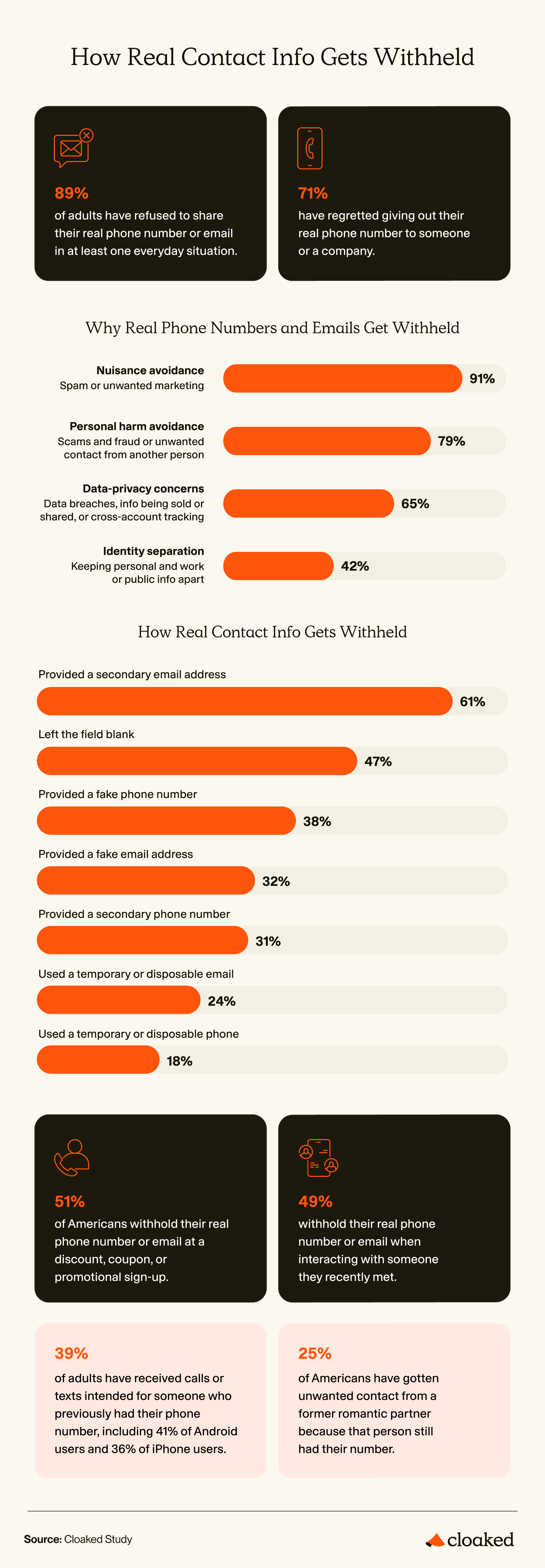
Cloaked reports that 89% of respondents withhold their real phone number or email in at least one everyday situation. A separate 92% say they use a workaround, including secondary emails, blank contact fields or fake phone numbers.
Those actions are not interchangeable. A secondary address may be fully functional, while a blank field offers no contact channel and a fake number may be unusable. Treating every alternative identifier as bad data would miss the consumer's reason for using it.
The company also found that 71% regret sharing their real phone number. Respondents most commonly cited avoiding nuisance contact, followed by scams or fraud and broader privacy concerns. Because Cloaked sells privacy tools, its survey should be read as company-sponsored research, not an independent market census.
What the findings mean for CRM and AI personalization
Marketers often assume more captured identifiers will produce a better customer view. But volume and permission are different properties. A valid alias can still be a chosen way to communicate, while a genuine phone number does not establish consent for every future message.
AI-assisted segmentation and personalization depend on what the underlying data represents. If a team cannot distinguish a preferred channel from an identity-matching field, automation can magnify that ambiguity. The survey does not prove that AI campaigns are failing because of aliases. It gives marketers a reason to test the assumption.
The deeper question is not whether a customer provided their primary identity. It is whether the brand earned a reliable, permitted route to reach them.
What marketers should know about permission and data quality
Separate reachability from identity. Verify that a channel works for the stated purpose without insisting that every signup use a lifelong personal identifier.
Make contact expectations explicit. Explain whether a number is needed for delivery, security, support or promotions, and give customers a meaningful choice.
Review AI inputs. Distinguish opt-in, verification status and channel preference before using identifiers for automated decisions or messaging.
Measure useful relationships. Evaluate consented engagement and successful service interactions, not only the number of records collected.
Cloaked's findings do not justify abandoning first-party data. They suggest its value depends on context and stewardship. The next test for AI-enabled marketing may be whether systems can respect the boundaries customers set while still making the relationship useful.
