
Clorox uses AI to keep campaigns improving after launch
Clorox says AI-assisted signals helped its PURE team revise live creative without a reshoot, while Pine-Sol and Brita test continuous learning.


The Clorox Company is changing how it manages consumer-brand campaigns by using AI-assisted insights and social signals to revise creative while the work is still in market. Instead of treating each launch as a finished piece of advertising, its marketing team is building an operating model in which audience feedback can shape what happens next.
In an account of the approach published by Clorox, chief marketing officer Eric Schwartz describes a system that pairs human judgment, artificial intelligence and agency partners. The examples span Clorox PURE advertising, Pine-Sol product experiments and Brita's social content. They show different parts of the model, though not all of the results can be attributed to AI.
Table of contents
Jump to each section:
- Why Clorox is treating campaigns as ongoing systems
- Clorox PURE shows what AI changes in the creative process
- Pine-Sol and Brita test a social-first learning model
- How the approach compares with Kroger AI creative testing
- What marketers can learn from Clorox
Why Clorox is treating campaigns as ongoing systems
Traditional campaign planning assumes a relatively orderly sequence: develop the idea, approve the assets, launch the work, then evaluate performance. Schwartz argues that approach is increasingly mismatched with the speed of consumer conversations and the volume of content brands are expected to produce.
Clorox calls its alternative a system of continuous relevance. People identify useful consumer signals, AI helps shorten the process of interpreting and testing them, and agency partners help turn decisions into content and distribution. The company says the approach is being used across brands with different audiences and purchase occasions.
There is an important distinction between continually publishing and continually learning. A team can generate more content without becoming any better at knowing what works. Clorox's operating model puts the harder question after production: what evidence is strong enough to change the next creative decision?
That creates a different role for automation. Rather than replacing the person responsible for a campaign, AI can reduce the time between a signal arriving and a marketer deciding how to respond. The company has not identified the underlying AI vendor or disclosed the level of automation in its approvals.

Clorox PURE shows what AI changes in the creative process
The clearest AI-specific example comes from Clorox PURE, the household-allergen product line introduced earlier this year. During its campaign, Clorox used AI-powered in-market signals to identify which settings and usage occasions appeared to be influencing consideration.
The team then updated existing creative to better reflect those signals without organizing a new shoot. Schwartz described the shift this way: "The content is no longer finished at launch. It's built to keep getting better."
What changed was not simply production speed. The brand had a way to reconsider a live message while it could still influence the campaign. That turns creative review from a retrospective exercise into a recurring decision point.
AI is useful in this example not because it can manufacture unlimited variations, but because it can shorten the distance between evidence and revision. The economic and effectiveness case remains unproven publicly: Clorox has not disclosed the system's cost, whether results improved relative to a control group, or how much human review was required.
That uncertainty matters. Faster revisions are valuable only if the signals reflect genuine consumer response rather than noise, and if the team has a clear standard for deciding which changes deserve to go live.
Pine-Sol and Brita test a social-first learning model
Pine-Sol illustrates another side of the same operating model. Its social-first identity, OMG Da Pine, uses platforms such as TikTok and Instagram as places to learn about consumer preferences, not only to publish branded content. That feedback informed limited-edition fragrances tested on TikTok Shop before a seasonal scent moved into broader retail.
The underlying commercial mechanism is more significant than the novelty of the scents. Social participation can influence product decisions and generate observable purchase signals. Yet the company has not established that AI caused those product outcomes, and the role of automation is different from the AI-assisted Clorox PURE creative example.
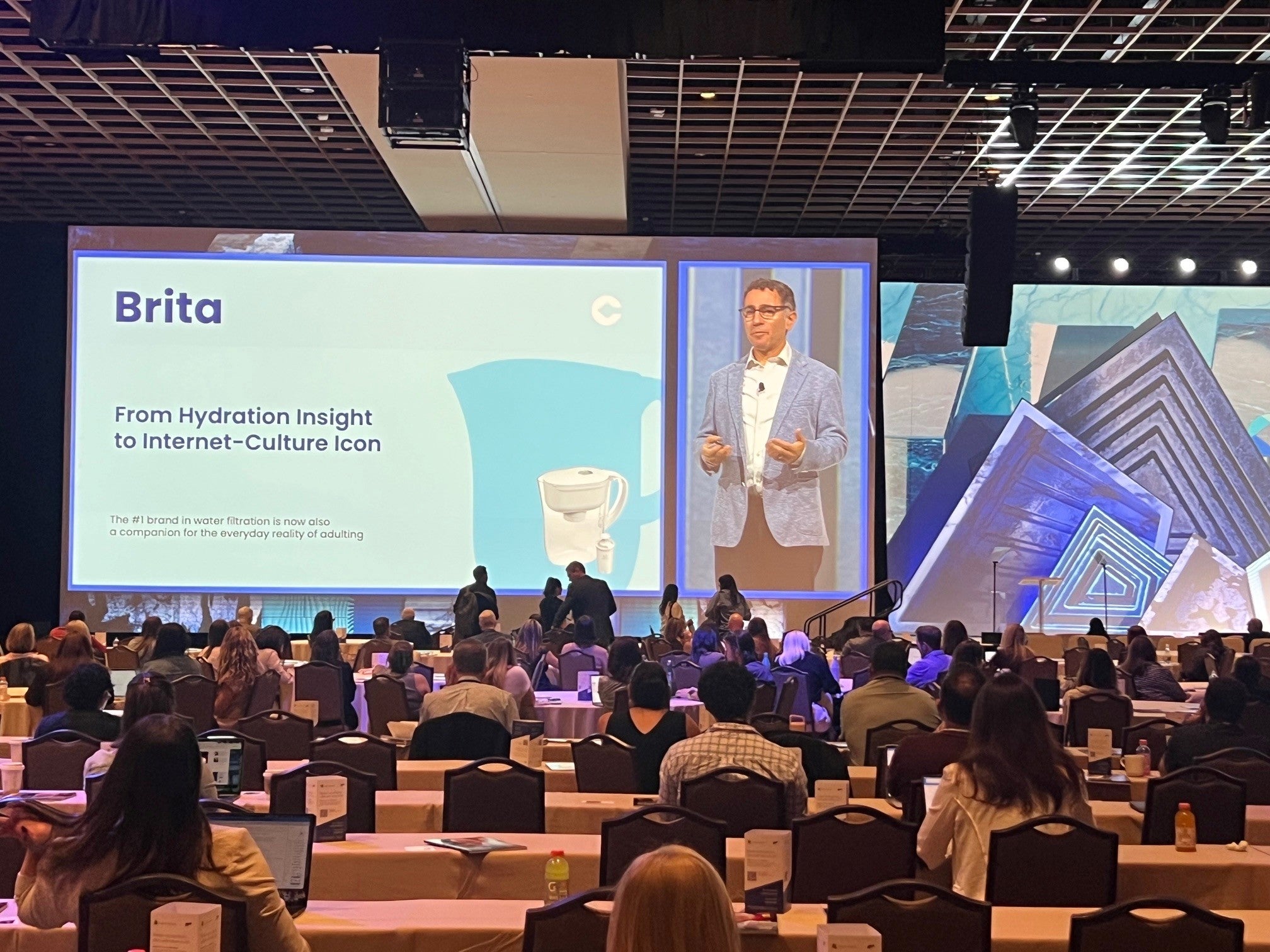
Brita provides a high-volume content example. Clorox says the brand used social listening to identify hydration as a form of manageable self-care for younger consumers, then shaped creative around that insight. Its animated shark and an original song helped inform the "At Least I'm Hydrated" platform.
22 million engagements and an 8.17% engagement rate were reported for Brita's social-first effort by Clorox CMO Eric Schwartz during the ANA presentation, as covered in the October 26 account of his remarks.
These are company-reported campaign outcomes, not independent proof that AI improved engagement. Brita and Pine-Sol help explain the organizational conditions surrounding the technology: frequent listening, a willingness to test and the authority to change course.
A publishing engine is not necessarily a learning engine. If a brand only measures how many assets it has made, automation may accelerate output without improving relevance.
How the approach compares with Kroger AI creative testing
Clorox is not the only marketer experimenting with how AI changes creative decisions. In a separate Kroger test involving Vidmob and MMA Global, AI-enabled analysis connected advertising attributes with ecommerce conversion data to assess which creative decisions were more likely to produce business outcomes.
The two approaches work at different points in the process. Kroger's example centers on evaluating creative and media allocation with historical and test data. Clorox PURE emphasizes using live consumer signals to adjust assets after a campaign begins.
Neither approach removes the need for marketers to define what counts as success. More precise predictions can still lead to narrow or repetitive creative if a team optimizes only for immediate conversion. And faster adaptations can become expensive churn when changes are not tested against meaningful outcomes.
The strategic issue is the feedback loop, not the AI label attached to the technology. Brands need a way to connect audience evidence, creative judgment, distribution and measurement without treating every automated recommendation as an instruction.
What marketers can learn from Clorox
Clorox's examples suggest that the practical value of AI in brand marketing depends less on the number of tools deployed than on the decisions a marketing organization is prepared to change.
Treat launch as the start of evaluation. Clorox PURE provides a concrete example of revising an existing asset while the campaign is still relevant, rather than waiting until the budget has been spent.
Separate AI impact from social-media outcomes. Pine-Sol's product tests and Brita's engagement figures support the broader social-first model, but neither should be presented as proof of AI-driven lift without a comparison that isolates the technology's contribution.
Give people ownership of the feedback loop. Faster analysis creates value only when marketers know which signals to trust, who can approve creative changes and what evidence should trigger another test.
Measure learning quality, not just content volume. A useful operating system should reveal which adjustments improved a business result, which failed and what the team should stop repeating.
For marketing leaders, continuous relevance is therefore an organizational question as much as a technology decision. The promise of AI lies in making a brand more responsive, but responsiveness can also make a campaign less coherent if every new signal changes its direction.
The larger shift may be from managing campaigns as isolated projects to managing a continuing stream of hypotheses. Creative judgment remains essential. AI changes how quickly a team can gather evidence and test its next decision; it does not decide what the brand should stand for.
