
Gartner survey finds 70% of CMOs prioritize AI, but 30% have infrastructure
Gartner’s survey suggests AI intent is outpacing execution. CMOs may need to prioritize data foundations, governance, and training before shifting more budget into AI tools.

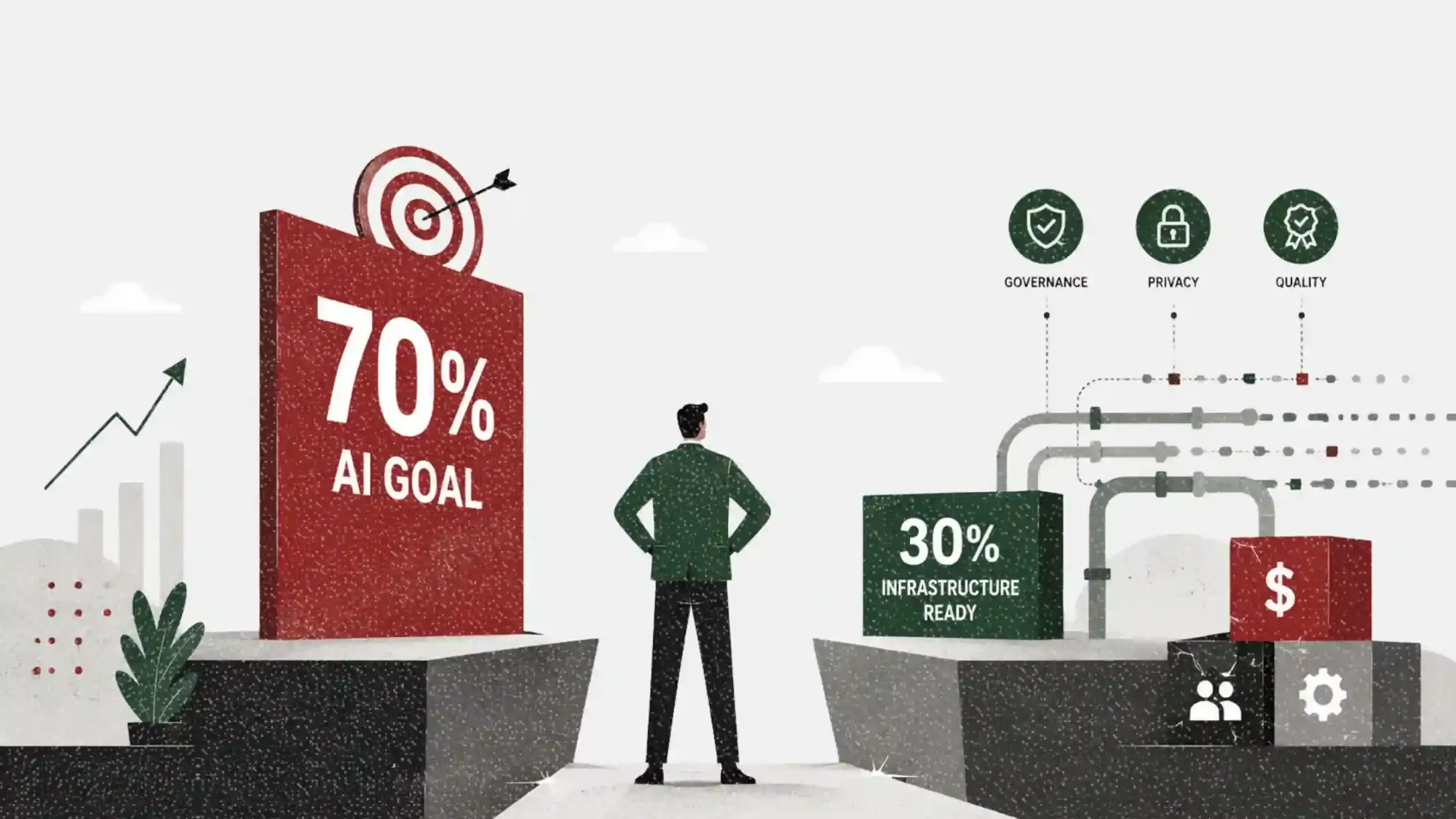
Seventy percent of CMOs say becoming a leader in AI is a key goal for 2026, yet only 30% say their organizations have the infrastructure needed to achieve it, based on Gartner survey data. The gap matters because it suggests many teams are trying to scale AI adoption before their data, governance, and operating model are ready.
Budget signals also look mixed. Gartner’s CMO Spend Survey data indicates marketing budgets are largely flat year over year, and AI is taking a defined share of spend, but the organizations that report being better equipped to scale AI allocate meaningfully more to it.
Table of contents
Jump to each section:
- What the Gartner survey data signals about AI readiness
- Why AI budget share can rise even when total budgets stay flat
- The hidden work behind “AI leadership”: data, governance, and talent
- Planning implications for CMOs heading into 2026
 Patrecia Meliana
What the Gartner survey data signals about AI readiness
Gartner’s data points to a common pattern: executive intent to use AI outpaces the operational capacity to deploy it at scale. In the survey results cited, 70% of CMOs prioritize AI leadership as a 2026 goal, but only 30% believe their organization has the infrastructure to get there.
The readiness gap is not just a technology issue. It often shows up as fragmented data foundations, unclear decision rights, inconsistent processes for model and vendor evaluation, and a lack of practical enablement for teams expected to use AI in day-to-day work.
The survey context also matters for interpretation. Gartner’s CMO Spend Survey was fielded between January and March 2026 and included 401 CMOs and marketing professionals across North America, Europe, and the U.K., with many respondents coming from organizations above $1 billion in annual revenue. That mix can skew toward enterprises with larger stacks and more complex governance needs, which can slow standardization.
Why AI budget share can rise even when total budgets stay flat
Gartner’s findings show marketing budgets as a share of company revenue stayed almost flat: 7.8% in 2026 versus 7.7% in 2025. In that environment, AI investment becomes a reallocation problem, not a pure growth problem.
On average, 15.3% of marketing budgets are directed toward AI, per the same Gartner data. However, organizations described as better equipped to scale AI allocate 21.3% on average. Practically, this implies two different operating realities:
- Some teams are funding pilots and tool experiments within tight constraints, which can create a scattered portfolio of point solutions.
- Others are treating AI as a program with enough critical mass to justify deeper infrastructure, integration work, and sustained enablement.
Gartner’s numbers also suggest a link between AI program maturity and budget positioning within the company. Organizations with “optimized AI programs” average a higher marketing share of revenue (8.9%), versus the overall 7.8% average. That does not prove AI causes higher budgets, but it does indicate that companies confident in execution may earn more internal headroom.
The hidden work behind "AI leadership": data, governance, and talent
One risk Gartner flags is sequencing: marketing organizations may invest in AI tools faster than they build the foundations to scale them, including data foundations, processes, governance, and talent. This is where many AI roadmaps become fragile.
Budget and capacity constraints reinforce the problem. Gartner’s data indicates 56% of CMOs do not think their organizations have the budget needed to execute their 2026 strategy, and 54% say they do not have the necessary resources. When teams are stretched, they tend to optimize for faster deployment rather than durable operating changes, even if leadership messaging calls for “AI transformation.”
Talent signals in the data look especially important for planning. Gartner reported that while nearly two-thirds of marketers believe AI will change their jobs, only 32% believe they need to update their skills. If that perception gap holds inside organizations, it can slow adoption, reduce output quality, and create downstream compliance and brand-risk issues when AI is used without sufficient training and review processes.
Gartner also predicts that half of agencies’ proprietary AI platforms will be obsolete by 2029. For marketing leaders, that projection increases the value of portability: practices, governance, and measurement approaches that can survive vendor churn and platform shifts.
 Patrecia Meliana
Planning implications for CMOs heading into 2026
For CMOs, the practical question is how to turn “AI is a priority” into execution without creating a tool-heavy, low-integration stack. Gartner’s guidance emphasizes scaling AI judiciously and strategically, which translates into a few operational decisions that can be made early:
- Define outcome-linked use cases before scaling
If the organization cannot name the expected outcome and how it will be measured, AI spend can become hard to defend in flat-budget conditions.
- Build a roadmap that covers change management, not just tooling
Adoption often fails due to unclear workflows, training gaps, and misaligned incentives, not model quality alone.
- Audit and consolidate martech where possible
Gartner notes CMOs are scrutinizing stacks for consolidation and integration opportunities, especially around AI agents and automation.
- Keep the customer journey central while adapting to AI-mediated behavior
Gartner highlights customer behavior shifts tied to GenAI tools and AI-driven search experiences, which can force dual strategies for human and AI customer personas.
For most organizations, the near-term win is not “AI leadership” as a slogan. It is building repeatable, governable execution that can absorb more AI budget share over time without adding disproportionate risk.